
Free Training & Career Tips... Subscribe to Get Weekly Career Tips

By Subscribing You are Agreeing to Terms and Conditions
In plain terms, the 5th Industrial Revolution (5IR) means people and machines working together, with technology designed around human needs, well-being and sustainability rather than built to replace people. Below you will find how 5IR follows the first four industrial revolutions, the technologies and design principles behind it, and what it changes for people at work. To put the human-and-machine side of 5IR into practice, BOTI’s AI and Copilot courses show staff how to use AI tools in their everyday work.
This is Part 2 of our series on the 5th Industrial Revolution. Part 1 introduced the idea; this part explains what 5IR means, the technologies behind it and how it changes the relationship between people and technology at work.
Each industrial revolution has been a stepping stone to the next, building on the innovations of the one before it:
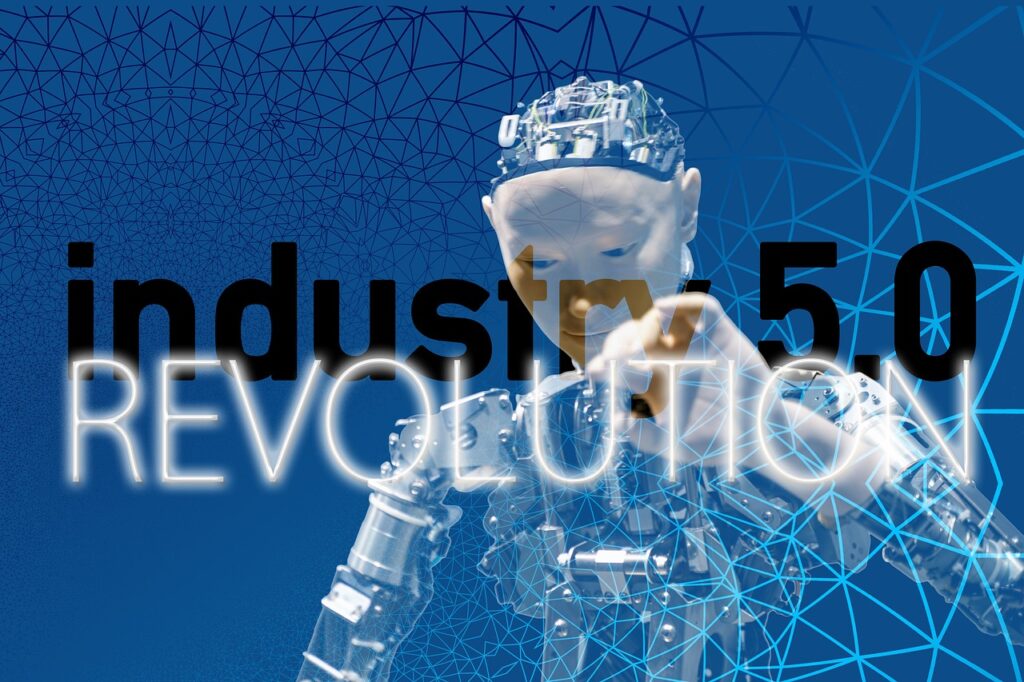
The 5th Industrial Revolution is still taking shape. Unlike the earlier revolutions, it is not defined by a new source of power or a single breakthrough technology. It is defined by a change of purpose: using the technologies of the fourth revolution in ways that put people, society and the environment first. You will also see the idea described as Industry 5.0.
5IR, or the fifth industrial revolution, describes an approach to technology built on three ideas:
Put simply, where the fourth revolution asked what technology can do, the fifth asks what it should do, and for whom.
Much of the public discussion of the 4th Industrial Revolution focused on automation and the fear that machines and algorithms would take over work that people do. That concern has not gone away, and some tasks will continue to be automated. The 5IR view changes the emphasis. The aim is not to remove people from the process but to combine the strengths of people and machines, so that technology makes people more capable rather than less necessary.
For employers, that is a practical design question. When you introduce a new tool, ask which parts of the job it should take over, which decisions should stay with people, and what the people doing the job need to learn to work well with it.
The 5th Industrial Revolution focuses on using advanced technologies to improve the quality of life of everyone they affect: society at large, businesses, employees and customers. Earlier industrial revolutions often required people to adapt to machines; 5IR expects machines to adapt to people. Key aspects of this symbiosis include:
There is no separate set of 5IR technologies. 5IR uses the technologies of the fourth revolution and points them at human needs. Examples include:

The 5th Industrial Revolution is not only about technology. It also asks organisations to change the way they think about technology: to recognise its potential to make work and society better, and to take responsibility for how it is used. In practice, that shift shows up in three ways:
When people and machines share the work, the skills that matter most change:
BOTI’s one-day Introduction to AI for the Workplace covers widely used AI tools, good prompting and responsible use, for any employee. AI Tools for Everyday Productivity covers everyday AI apps for writing, notes, slides and simple automation, and AI for Managers and Leaders helps managers lead AI adoption in their area, including governance and managing the change.
For South African organisations, the practical question is not whether 5IR has arrived but how to introduce new technology in a way that helps people do better work. A sensible way to start:
5IR starts where 4IR left off, so the foundations are the same: understanding the technologies of the fourth revolution and preparing people to use them well, in ways that are more connected, more humane and more sustainable.
The 5th Industrial Revolution is the stage that follows the fourth. It is not simply more automation: it is a shift towards a symbiotic relationship between humans and machines, in which technology adapts to human needs instead of people adapting to machines. Its focus is using advanced technology to improve quality of life for society, businesses, employees and customers, without harming the environment.
5IR does not have a separate set of technologies. It builds on fourth-revolution technologies such as artificial intelligence, robotics and the Internet of Things, and points them at human needs. Examples include AI assistants that support people’s decisions, collaborative robots that work safely alongside people, sensors and wearable devices that support health and safety at work, and technology that saves energy and materials. Human-centred design, which makes technology intuitive and accessible, runs through all of them.
The fourth industrial revolution brought artificial intelligence, robotics, the Internet of Things and blockchain, integrating digital and physical systems, and with them came fears that automation would displace human jobs. The fifth keeps those technologies but changes the aim: humans and machines collaborate, machines adapt to people rather than the other way round, and innovation is directed at well-being and sustainability.
In a 5IR workplace, technology is designed to enhance human capabilities rather than replace them, so people work alongside AI and automated systems instead of competing with them. The emphasis moves to collaboration, empathy and well-being, and to using new tools in ways that serve employees and customers as well as the business.
Each industrial revolution builds on the one before it, so 5IR starts from the technologies of the fourth: AI, robotics, the Internet of Things and blockchain. BOTI’s two-day course, Prepare for the Fourth Industrial Revolution (4IR) in South Africa, runs in-house at your premises, at BOTI’s venue in Sunningdale, Johannesburg, or online.
About Us




Monday to Friday, 08:00–17:00. After hours, we reply on the next working day – or call 011 882 8853.
Copyright text 2026 by Business Optimization Training Institute.