

Mastering the Inner Landscape: A Guide to Q4 Stress Management & Sustainable Resilience
The Anatomy of Year-End Exhaustion
The final quarter of the corporate calendar is a paradox. On one hand, it represents the home stretch – a time of closing accounts, hitting annual targets, and preparing for the psychological milestone of a new year. On the other hand, it is universally recognised as the peak season for occupational burnout, mental fatigue, and acute stress.
See all BOTI leadership and management courses.
By October and November, cumulative micro-stresses have compounded. The accumulated pressure of shifting deadlines, interpersonal workplace friction, organizational restructuring, and the relentless hum of digital notifications creates a perfect storm. Professionals across every tier – from administrative coordinators to senior executives – find themselves running on emotional fumes, relying on caffeine and sheer willpower to cross the finish line.
The danger of this approach is profound. When we treat the year-end holiday break as an emergency recovery ward rather than a well-deserved celebration, we cheat ourselves of genuine rest. We limp across the threshold of December, spend half our vacation sleeping or recovering from minor stress-induced illnesses, and return to work in January just as depleted as when we left.
To break this cycle, we must redefine stress management not as a reactive luxury, but as an active, daily professional discipline.

Phase One: Recognising the Biological and Mental Toll of Q4 Burnout
Stress is not merely a psychological feeling; it is a whole-body physiological event. When prolonged over months of organisational change, high-stakes deliverables, and personal trials, chronic stress keeps the sympathetic nervous system locked in a permanent state of fight-or-flight.
- Cognitive Tunnel Vision: Under high chronic stress, the prefrontal cortex – the seat of executive function, strategic planning, and critical thinking – effectively goes offline. In its place, the amygdala takes over, leading to emotional reactivity, decision fatigue, and preventable administrative errors (such as misplaced documentation or overlooked compliance details).
- The Empathy Deficit: When internal resources are depleted, patience with colleagues, clients, and family members evaporates. Misunderstandings multiply, workplace friction intensifies, and small communication glitches escalate into full-scale relational conflicts.
- The Erosion of Joy: Hobbies, creative outlets, and personal rituals get pushed aside in favour of endless task management. The internal monologue shifts from thriving to merely surviving.
Recognising these symptoms is the first step towards reclamation. Acknowledging that you are running on empty is not a sign of weakness; it is an honest diagnostic assessment of a system crying out for recalibration.
Phase Two: Practical Strategies for Mid-Quarter De-escalation
You cannot control the external velocity of the business world, but you can master your internal posture towards it. Implementing structured stress-management techniques during Q4 changes the entire trajectory of your year-end experience.
1. Establishing Energetic Boundaries
The blurred lines between remote work, mobile connectivity, and office expectations have created an era of perpetual availability. To manage stress effectively, you must re-establish sacred boundaries:
- The Hard Stop: Define a rigid conclusion to your workday. When evening arrives, physically and digitally detach. Let tomorrow’s tasks wait for tomorrow’s energy.
- Attention Quarantine: Stop multitasking. Neuroscientific research confirms that task-switching drains cognitive energy exponentially faster than sustained focus. Handle tasks sequentially with deliberate presence.
2. Cultivating Somatic Regulation
When the mind is trapped in a loop of anxiety, talking yourself down rarely works because the panic lives in the physical body. Somatic interventions bypass cognitive rumination:
- Coherent Breathing: Inhale slowly for a count of four, hold for four, exhale for four, and hold for four. Doing this for just three minutes signals the vagus nerve to down-regulate heart rate and lower cortisol production.
- Physical Grounding: Step away from the desk, feel your feet firmly planted on the earth or floor, stretch your upper back, and release the tension held silently in your jaw and shoulders.
3. Transforming Mistakes into Teachers
When stress leads to human error – like a misfiled record or a missed administrative detail – the natural reaction is a spiral of self-reproach. High stress convinces us that a mistake defines our entire professional worth. Instead, view errors as diagnostic signals. A mistake is your nervous system’s flashing dashboard light, indicating that the workload has outpaced your current operational systems. Shift from self-blame to structural repair: build checklists, institute double-verification steps, and give yourself the grace to be human.
Phase Three: Preparing for a Transformative Year-End Transition
The ultimate goal of Q4 stress management is arriving at your year-end break with enough residual energy to actually enjoy your life, your family, and your personal passions.
- The Clear-Desk Protocol: In your final week before the break, resist the urge to start ten new projects. Instead, systematically clear your operational slate. Document open items, hand over necessary responsibilities with crystal-clear notes, and leave your workspace in an immaculate state. Walking away to an organised desk primes your brain for genuine psychological detachment.
- Reconnection with Higher Purpose: Use the slowing pace of late December to reconnect with what fuels your spirit outside of corporate metrics – whether that is music, nature, creative writing, or quiet reflection. Let your downtime be an active sanctuary rather than passive numbness.
Stepping Into 2027 Fully Aligned
Stress management is not about achieving a stress-free existence; it is about building an unshakeable inner anchor amidst external turbulence. By addressing burnout proactively in the final quarter of the year, you protect your mental clarity, safeguard your professional accuracy, and ensure that when you step back through the office doors in the new year, you do so with renewed vitality, sharp focus, and deep resilience.


Celebrating Heritage Day with a South African Braai: Three Recipes from Our Traditions
A South African braai is a meal cooked over open coals from wood or charcoal, usually meat on a grid with side dishes, shared outdoors with family, friends or colleagues. On Heritage Day, 24 September, many South Africans braai to celebrate the cultures that make up the country. Many workplaces also hold a team braai, which is why topics such as working well across cultures feature in BOTI’s teamwork and workplace effectiveness courses.
Heritage Day invites us to reflect on the cultures, languages and histories that make up the South African story. Over the years the day has also become widely known as Braai Day. It is a reminder that while we come from diverse backgrounds, we share a language everyone understands: the smoke, the grid and the gathered table.
This year we are moving past the history books to celebrate our heritage where it comes alive, around the fire. To help you plan the feast, here is a menu with three recipes from different traditions. The first is herb-infused grilled lamb chops inspired by English cooking. The second is a traditional Afrikaans potjie, and the third is a hearty Zulu accompaniment that brings depth to the table.

Recipe 1 (English Tradition): Rosemary and Garlic Grilled Lamb Chops with Mint Chimichurri
In many South African homes with British heritage, Sunday roasts and weekend braais are built around the rich, earthy flavour of good lamb with fresh garden herbs.
Ingredients
- For the Chops:
- 8 thick-cut lamb loin or rib chops
- 4 cloves garlic, finely minced
- 3 tablespoons fresh rosemary, finely chopped
- 1/4 cup extra virgin olive oil
- Juice of 1 large lemon
- Coarse sea salt and freshly cracked black pepper to taste
- For the Mint Chimichurri:
- 1 cup fresh mint leaves, finely chopped
- 1/2 cup flat-leaf parsley, finely chopped
- 2 cloves garlic, crushed
- 1/2 cup olive oil
- 2 tablespoons red wine vinegar
- A pinch of chilli flakes (optional)
Method
- Marinate the Lamb: In a shallow dish, combine the minced garlic, chopped rosemary, olive oil, lemon juice, salt and pepper. Coat the lamb chops thoroughly, massaging the herbs into the meat. Cover and let them marinate at room temperature for at least 30 minutes.
- Prepare the Chimichurri: While the meat marinates, mix the chopped mint, parsley and garlic in a bowl. Stir in the olive oil, red wine vinegar and chilli flakes. Season with a pinch of salt and set aside to let the flavours meld.
- Braai the Chops: Position your grid over hot, glowing coals. You want a high heat to sear the outside while keeping the inside tender and juicy. Place the chops on the grid and braai for about 4 to 5 minutes per side for medium-rare, or until cooked to your preference.
- Serve: Remove the chops from the fire and let them rest for 5 minutes. Drizzle generously with the fresh mint chimichurri before serving alongside a crisp garden salad.
Recipe 2 (Afrikaans Tradition): Traditional Lamb and Vegetable Potjiekos
No discussion of Afrikaans heritage cooking is complete without potjiekos. It is cooked slowly over dying embers in a three-legged cast-iron pot, and this dish is as much about patience and conversation as it is about flavour.
Ingredients
- 1.5 kg lamb neck or shoulder pieces, cut into chunks
- 3 tablespoons cooking oil or sheep’s tail fat (skaapstertjie) for rendering
- 2 large onions, chopped
- 3 cloves garlic, crushed
- 500g baby potatoes, washed and left whole
- 4 carrots, sliced into thick rounds
- 2 cups fresh or frozen green beans
- 1 cup beef stock
- 1 cup dry white wine or dry sherry
- 2 bay leaves
- 1 teaspoon dried thyme
- Salt and freshly ground black pepper to taste
Method
- Seal the Meat: Heat your cast-iron pot directly over the fire. Add the oil or fat and brown the lamb pieces in batches until golden brown. Remove and set aside.
- Build the Base: In the same pot, sauté the chopped onions and garlic until translucent and fragrant. Return the browned lamb to the pot, layering it over the onions.
- Layer the Vegetables: Pour in the wine and beef stock. Add the bay leaves and thyme. Now layer your vegetables carefully on top of the meat without stirring. Start with the potatoes, then add the carrots and finish with the green beans on top. The golden rule of a potjie is no stirring once the layers are set, so the steam cooks everything evenly.
- Simmer Slowly: Cover the pot with its lid and let it simmer gently over low coals for 2.5 to 3 hours. Try not to lift the lid or stir too often. Add a splash more stock if it looks dry, but trust the moisture of the closed pot.
- Serve: Once the meat is fall-apart tender and the vegetables are soft, gently fold the layers together just before dishing up. Serve piping hot in bowls.
Recipe 3 (Zulu Tradition): Isigwaqa (Creamy Maize Meal and Beans)
Isigwaqa is a traditional Zulu dish that adds comforting indigenous flavour to your braai. It combines maize meal (pap) with mashed cooked beans. The result is a hearty, textured side that goes well with rich meats and sauces.
Ingredients
- 2 cups dry sugar beans (or speckled sugar beans), soaked overnight and boiled until soft
- 3 cups maize meal (phutu or standard maize meal)
- 4 cups water (plus extra for boiling beans)
- 2 tablespoons butter or margarine
- 1 teaspoon salt (adjust to taste)
Method
- Cook the Beans: Make sure your pre-soaked beans are fully cooked, tender and drained of excess water. Keep a small amount of the cooking liquid handy.
- Prepare the Base: Bring the 4 cups of water and salt to a boil in a heavy-based pot.
- Add Maize Meal: Pour the maize meal into the centre of the boiling water to form a mound. Do not stir immediately. Let it steam with the lid on for about 5 minutes over medium-low heat.
- Combine and Mash: Using a strong wooden spoon, mix the maize meal vigorously until crumbly. Add the cooked, tender beans directly into the pot along with the butter.
- Mash Together: Keep stirring and mashing until the beans blend smoothly into the maize meal. You want a thick, even and comforting consistency.
- Simmer: Cover and let it steam on low heat for another 10 to 15 minutes, stirring occasionally to prevent burning at the bottom.
- Serve: Serve hot as a traditional accompaniment to your braai meats and potjiekos gravies.
This Heritage Day, let your fire bring people together across cultural lines. Happy braaiing.

Planning a Heritage Day braai for your team
A braai at work is a simple way to mark Heritage Day and get to know colleagues outside meetings. With a little planning, everyone can take part and enjoy the food.
- Ask about food needs early: check for dietary and religious requirements, such as halal, vegetarian or no pork, before you buy meat and plan the menu.
- Keep food separate: use a separate grid, tongs and boards for halal and vegetarian food. Keep raw meat away from cooked food and salads.
- Start the slow dishes first: a potjie needs 2.5 to 3 hours on low coals, so light the fire for it well before the chops go on.
- Put someone in charge of the fire: never leave the fire unattended. Keep water or a fire extinguisher nearby, and choose a spot away from buildings, dry grass and walkways.
- Share the heritage: invite colleagues to bring a dish from their own tradition and say a few words about where it comes from.
For more on celebrating the many cultures in your workplace, read Heritage Month: one nation, many stories and our guide to what cultural diversity means at work.
Frequently asked questions
What is a South African braai?
A braai is the South African way of cooking over open coals from wood or charcoal. It is usually meat such as lamb chops, boerewors or chicken on a grid, served with side dishes such as pap, salads and potjiekos. It is as much a social occasion as a meal.
Why is Heritage Day called Braai Day?
Heritage Day falls on 24 September and celebrates the cultures, languages and traditions of South Africa. Because so many families and communities mark the public holiday around a fire, it has become widely known as Braai Day.
What food is served at a traditional South African braai?
Grilled meat is the centre of most braais, and lamb chops, boerewors and chicken are common choices. Side dishes vary by family and tradition and can include pap or isigwaqa, potjiekos, salads and grilled vegetables.
How long does a potjie take to cook?
The lamb and vegetable potjie in this article simmers over low coals for 2.5 to 3 hours after the meat is browned, so start it well before your guests arrive.
How can a company host an inclusive braai at work?
Ask colleagues about dietary and religious requirements beforehand, keep separate grids and utensils for halal and vegetarian food, and invite people to bring a dish from their own tradition. Keep the fire supervised and water or a fire extinguisher close by.
BOTI does not run a cooking or braai course. If your Heritage Day braai is part of a wider effort to bring a diverse team together, the closest BOTI course is Adding Value in Managing a Diverse Workforce, a 3-day course for managers and team leaders. For a shorter team session, look at Build Winning Teams to Achieve Company Objectives (1 day). If you organise staff functions, there is also Events Management Expertise: Meetings, Functions and Travel (2 days). Training runs in-house at your premises, at BOTI’s venue in Sunningdale, Johannesburg, or live online. Call BOTI on 011 882 8853 or email [email protected], or request a quote.
This course is not accredited. It is delivered as a professional skills programme, and delegates receive a BOTI certificate of attendance.

The Modern Receptionist in an AI-Driven World
An AI receptionist is software, such as a chatbot, voice assistant or digital visitor-management system, that answers routine questions, books appointments and checks visitors in. It handles predictable front-desk tasks well. It does not replace a trained receptionist who reads people, uses judgement and represents the organisation. BOTI’s administration and office support courses help front-desk staff build both sets of skills.
AI can automate a process. It cannot replace the experience of being genuinely welcomed.
The workplace is changing quickly.
Artificial intelligence is becoming part of everyday business. Examples include automated appointment scheduling, virtual assistants, chatbots, digital visitor-management systems and AI-powered customer service.
Tasks that once required human intervention can now be completed in seconds by technology.
So where does this leave the receptionist?
If you still think of a receptionist as simply the person behind a desk answering the telephone, the answer might seem uncertain.
But that traditional definition of reception is already outdated.
The modern receptionist is becoming something much more valuable: a skilled human interface between an organisation and the people who interact with it.
In an increasingly digital world, that human interface may matter more than ever.

AI receptionist or human receptionist: what each does well
An AI receptionist works best on high-volume, predictable requests, such as:
- answering opening hours and directions
- confirming bookings
- sending reminders
- routing calls to the right extension
- registering visitors who have a QR code.
It works out of hours and does not tire of repeating the same answer.
A trained human receptionist handles what falls outside the script:
- a nervous interview candidate
- an angry caller
- a VIP who arrives early
- a courier at the wrong entrance
- a request that should not be answered at all.
For most organisations, the practical question is not which one to choose. It is how to combine the two so that technology removes the routine and people handle the moments that shape a visitor’s opinion.
The first impression is still human
Consider the experience of arriving at an organisation for the first time.
Perhaps you are meeting a potential supplier, attending an interview, visiting a client or arriving for an important appointment.
You may have received automated emails. You may have completed an online registration form. You may have received a QR code or digital visitor pass.
But eventually, you encounter a person.
Someone looks up and says hello.
Someone acknowledges you.
Someone notices that you are uncertain about where to go.
Someone takes responsibility for helping you.
That interaction can shape how you see the entire organisation.
The receptionist may be the first employee a visitor meets and the first voice a caller hears. In that sense, reception is not simply an administrative function.
It is part of the organisation’s brand.
AI is changing the job – not eliminating its value
AI is very useful for repetitive and predictable tasks.
It can help manage calendars, organise information, answer routine questions, automate reminders and streamline communication.
These capabilities can save a great deal of time.
This is where we should challenge an outdated assumption. If technology can perform some receptionist tasks, that does not necessarily mean we need fewer skilled receptionists.
It means skilled receptionists can spend less time on repetitive administration and more time on work that requires human judgement.
Imagine the difference.
Instead of spending valuable time processing routine enquiries, a receptionist can focus on visitors.
Instead of manually managing every calendar request, they can concentrate on coordinating complex schedules.
Instead of repeating the same information over and over, they can deal with the unusual situations that require discretion and judgement.
Technology can remove friction.
People create connection.
What does the modern receptionist actually do?
The answer varies from organisation to organisation, but today’s receptionist may at the same time be:
- The first point of contact
- A customer-service professional
- A brand ambassador
- A communication hub
- An administrative coordinator
- A gatekeeper
- A problem-solver
- A relationship builder
- A source of institutional knowledge
- A representative of workplace culture
That is a considerable responsibility.
It requires much more than knowing how to operate a telephone.
The skills AI cannot easily replicate
The greatest opportunity for the modern receptionist lies in developing distinctly human capabilities.
Emotional intelligence
Emotional intelligence is the ability to recognise, understand and respond appropriately to emotions, both our own and those of other people. BOTI’s Mastering Emotional Intelligence course covers this in a work setting.
A visitor might say, “I’m fine,” while clearly appearing anxious.
A caller may technically be asking a simple question while actually needing reassurance.
A colleague may be having a difficult day without saying so.
A skilled receptionist can notice these subtleties.
AI can analyse words and patterns.
A human being can interpret context, body language, tone and circumstance.
That distinction matters.
Communication
Excellent communication has always been important in reception.
In an AI-driven workplace, it becomes even more valuable.
The receptionist may communicate with executives, clients, suppliers, visitors, delivery personnel, colleagues and members of the public, often within the same hour.
Each interaction may require a different approach.
Professional communication is not simply about speaking clearly.
It means listening carefully, choosing appropriate language, understanding the situation and making sure the other person feels heard. On the phone, this is where Reception and Telephone Etiquette Training makes a visible difference.
Judgement
Not every situation comes with a procedure.
What happens when an unexpected visitor arrives?
What if a caller becomes aggressive?
What if an important client is kept waiting?
What if two senior executives need the same resource at the same time?
What if someone asks for confidential information?
These situations require judgement.
A receptionist needs to know when to act independently, when to escalate an issue and when discretion is essential. Front-desk staff also handle visitor registers, contact details and call logs. That personal information must be handled safely, which is the focus of BOTI’s POPIA for Every Employee masterclass.
That is where professional training becomes particularly valuable.
The receptionist as brand ambassador
A company’s brand is not confined to its logo, website or advertising.
Brand is also experienced through human interaction.
A visitor may never see a company’s marketing campaign.
They will, however, remember whether they were greeted warmly, whether the receptionist was professional and whether someone took the time to help them.
This means the reception area can be one of the most important points of contact between an organisation and the outside world.
A polished reception experience communicates:
We are organised.
We are professional.
We value people.
We are paying attention.
An indifferent or chaotic reception experience can communicate exactly the opposite.
Technology should enhance the receptionist
The most useful way to think about AI is as a tool that can enhance human capability, not necessarily as a replacement for it.
A receptionist who knows how to use technology well can become more productive and more valuable. BOTI’s AI Tools for Everyday Productivity course is a practical starting point.
AI and automation may assist with:
- Scheduling
- Information retrieval
- Routine correspondence
- Meeting preparation
- Visitor registration
- Frequently asked questions
- Administrative organisation
- Drafting standard communications
- Managing repetitive processes
But the receptionist remains responsible for applying judgement and making sure the human experience does not disappear behind the technology.
The goal is not:
Human versus AI.
It is:
Human + AI.
Five qualities of the future-ready receptionist
1. Technologically confident
The modern receptionist does not need to become a computer programmer.
They do, however, need to be comfortable with the digital tools used in their workplace.
Being curious about new technology is an advantage.
2. Exceptionally professional
Professionalism becomes even more important when automated systems handle routine tasks.
The human interactions that remain are often the ones that matter most.
Appearance, punctuality, discretion, reliability, etiquette and communication all contribute to professional credibility.
3. Emotionally intelligent
The ability to read a situation, listen and respond appropriately is an increasingly valuable skill.
Technology may provide information.
The receptionist provides understanding.
4. Adaptable
The workplace will continue to change.
New software will arrive. Processes will evolve. Responsibilities will shift.
The receptionist who is willing to learn and adapt will be better positioned for the future.
5. Human
Perhaps this is the most important quality of all.
In a world filled with automated responses, digital interfaces and artificial intelligence, genuine human interaction stands out.
A smile.
A warm greeting.
A calm voice.
A thoughtful response.
A willingness to help.
These things may sound simple.
They are not insignificant.
They are part of what makes an organisation feel human.
The danger of becoming too automated
There is an understandable temptation to automate everything that can be automated.
Automation can save time and reduce costs.
But organisations should be careful not to confuse efficiency with experience.
Imagine arriving at an office where nobody looks up.
You register yourself on a screen.
A machine prints your visitor badge.
You follow instructions on another screen.
You wait.
Eventually, someone appears.
Everything has worked perfectly.
And yet the experience has felt strangely impersonal.
Now imagine the same environment with efficient technology and a professional receptionist.
The visitor checks in digitally.
The receptionist notices their arrival, welcomes them, confirms their appointment and lets them know where to wait.
The technology has made the process efficient.
The human being has made the experience positive.
That is the future worth aiming for.
Receptionists need training for the new workplace
As the role evolves, professional training becomes increasingly important.
Receptionists need more than technical competence.
They need to understand:
- customer service
- telephone etiquette
- professional communication
- workplace protocols
- conflict management
- personal presentation
- confidentiality
- relationship-building.
They also need the confidence to work alongside new technologies.
This is why receptionist training should not be viewed as simply teaching someone how to answer a telephone. For more on the front-desk role, see be the face of a company and work on your receptionist skills.
It is about preparing people to represent an organisation professionally.
The receptionist as a workplace connector
There is another important role that can easily be overlooked.
Receptionists often know what is happening throughout an organisation.
They know who has arrived.
They know which visitors are expected.
They may know where meetings are taking place.
They communicate with different departments.
They interact with people at every level of the business.
In many organisations, reception sits where information, people and activity meet.
That makes the receptionist a workplace connector.
That role is difficult to automate because it depends on relationships and context.
The future belongs to adaptable professionals
AI will continue to transform administrative work.
Some tasks will disappear.
Others will become easier.
New responsibilities will emerge.
The professionals who thrive will be those who see technology as something to learn, not something to fear.
The modern receptionist can use AI to become more efficient while becoming more human in the areas where human ability matters most.
That combination is powerful.
When routine tasks are automated, the value of qualities such as empathy, judgement, communication, discretion and personal connection can actually increase.
The human advantage
There is an irony at the heart of AI in the workplace.
The more technology we introduce into our workplaces, the more noticeable genuine human interaction can become.
When everyone can receive an automated response, a thoughtful response becomes memorable.
When everyone can interact with a chatbot, a skilled conversation becomes valuable.
When everyone can be processed through a digital system, being genuinely welcomed becomes an experience.
That is the opportunity for the modern receptionist.
The role isn’t disappearing.
It is becoming more sophisticated.
At BOTI, we recognise that the modern receptionist needs to be prepared for more than the traditional front desk.
Professional Receptionist Training can help develop the practical skills, professional standards and interpersonal abilities needed to represent an organisation with confidence.
The course covers communication, customer service, professional etiquette, telephone skills, personal presentation and workplace effectiveness. The aim is to prepare reception professionals to be confident, capable ambassadors for their organisations.
Because the receptionist is often the first voice.
The first face.
The first interaction.
And sometimes, the first impression.
In an AI-driven world, those first impressions still belong to people.
Technology may open the door. The receptionist makes you feel welcome when you walk through it.
Frequently asked questions
What is an AI receptionist?
An AI receptionist is software that handles routine front-desk tasks. It can answer common questions by chat or phone, book appointments and send reminders, and check visitors in on a screen or with a QR code. It works well for predictable, repetitive requests.
Will AI replace receptionists?
AI is taking over some routine reception tasks, but it does not replace the judgement, discretion and personal welcome a trained receptionist provides. In most organisations the role is changing: technology handles the repetitive work, and the receptionist focuses on visitors, unusual situations and the first impression of the organisation.
What can an AI receptionist not do well?
It struggles with situations that depend on context, such as an anxious or aggressive visitor, an unexpected arrival, two senior people needing the same resource, or a request for confidential information. These need a person who can read tone and body language and decide when to act, when to escalate and when to say no.
What skills does a receptionist need to work alongside AI?
A receptionist needs confidence with the digital tools used at the front desk and professional telephone and email etiquette. Clear communication, emotional intelligence and sound judgement matter just as much, along with discretion with personal information and the adaptability to keep up as systems change.
Does BOTI offer receptionist training?
Yes. BOTI runs Professional Receptionist Training, a 2-day course covering communication, customer service, professional etiquette, telephone skills and personal presentation. It runs in-house at your premises, at BOTI’s venue in Sunningdale, Johannesburg, or live online.
If your front-desk team is adapting to AI tools and needs to strengthen the human side of reception, book Professional Receptionist Training. Training runs in-house at your premises, at BOTI’s venue in Sunningdale, Johannesburg, or live online. Call BOTI on 011 882 8853 or email [email protected], or request a quote. This course is not accredited. It is delivered as a professional skills programme, and delegates receive a BOTI certificate of attendance.

The AI-Augmented Sales Professional
The art of selling is as old as commerce itself. From the bustling marketplaces of ancient history to the high-pressure boardrooms of modern Sandton, the core tenets remain: identify a problem, build a relationship, and offer a solution. However, the tools we use to execute these tenets are undergoing a radical shift.
See all BOTI sales, marketing and customer care courses.
At BOTI, we believe in honouring the foundation while embracing the future. Our Top 10 Sales Secrets, Training Course provides the psychological and practical architecture for sales success. But in an era where AI can process data in milliseconds, how does the “human” sales professional stay ahead?

From “Spray and Pray” to Precision Targeting
Traditionally, prospecting was a volume game. You sent 100 emails to get two replies. AI changes this calculus. Using predictive analytics and lead-scoring tools, sales professionals can now identify which prospects are most likely to convert before the first touchpoint.
- The BOTI Edge: We teach the art of “Discovery.” AI takes this further by providing pre-call research summaries, allowing you to walk into a discovery call knowing more about the client’s industry challenges than they expect you to.
Crafting the Perfect Pitch: Empathy at Scale
The most important secret in sales is Value Propositioning. Can you articulate your value in a way that resonates emotionally? AI writing assistants help you draft outreach messages that are hyper-personalised based on the recipient’s recent LinkedIn activity or news mentions.
- The Cadence: We teach you how to write copy that sings. AI ensures that your grammar, tone, and call-to-action are optimised for maximum engagement.
The “Assistant” in Your Ear: AI for Real-Time Coaching
Imagine having a sales mentor listening to your calls and prompting you with key questions to ask. Conversational AI tools now offer real-time sentiment analysis. If a client sounds hesitant, your dashboard can prompt you towards a specific “secret” – perhaps a testimonial or a ROI-focused case study.
Overcoming Objections: The AI Simulator
One of the hardest parts of working as a sales professional is “Objection Handling.” Most salespeople only practice this during a live call – which is the worst time to learn. With AI, you can engage in role-play simulations. You can tell an AI, “Act as a skeptical CFO of a mid-sized logistics company in Johannesburg,” and practice your response until your cadence is bulletproof.
Managing the Pipeline: The Death of Admin
The enemy of sales is not “no” – it’s “admin.” When a salesperson spends 60% of their time updating CRM fields and typing notes, they aren’t selling. AI-driven CRMs now transcribe your meetings and automatically update your pipeline.
- The Result: You spend your time on the high-value activity of “Closing,” which is, naturally, the crown jewel.
How BOTI Integrates AI into Traditional Training
We aren’t creating “robot” sales professionals. We are creating “augmented” professionals. With the Top 10 Sales Secrets Training Course you learn:
- The Psychology: Understanding the “why” behind the buy.
- The AI Workflow: How to integrate ChatGPT, Perplexity, or CRM-based AI into your daily routine.
- The Ethics: Ensuring that your use of AI remains human-centric, authentic, and compliant with POPIA regulations.

The Future of the South African Sales Professional
South Africa is a relationship-based market. We pride ourselves on the handshake, the “how’s the family?” and the face-to-face meeting. AI should never replace that. Instead, use AI to get the administrative clutter out of the way so you can spend more time building those authentic relationships.
When you use AI to handle the scheduling, the research, the data entry, and the initial outreach, you gain back the most precious asset a salesperson has: Time. You gain the time to truly listen, to truly understand, and to offer solutions that are transformational, not just transactional.
Ready to elevate your game?
Fundamental Sales Training is your foundation. Adding AI to your toolkit is your accelerant. Whether you are looking to revitalise a tired sales team or sharpen your own individual edge, BOTI provides the training, the framework, and the modern-day context to ensure you don’t just hit your targets – you redefine them.
Stay connected for our upcoming AI Literacy Assessment Quiz – the first step to understanding where you sit on the spectrum of the new professional reality.

Less of the grind, more of the flow, watch your AI mastery grow
The Digital Pulse: Priming Your Mind for the Era of Artificial Intelligence
We stand at the intersection of history and innovation. For the professional, the question is no longer “Will AI affect my role?” but rather “How will I guide AI to amplify my unique value?” The answer lies in one critical, non-negotiable metric: AI Literacy.
See all BOTI artificial intelligence and Copilot courses.

The Art of the Pre-Game
In sports, no champion enters the arena without a warm-up. In the professional world, we often rush to embrace new tools without first conditioning our mindset. True AI literacy is a state of cognitive readiness. It is the development of a “digital intuition” – a keen, internal sense of where human creativity ends and machine-driven speed begins.
The Shift in Logic
The traditional workplace thrived on linear processes: Input A leads to Output B. The AI-augmented workplace thrives on iterative processes: Input A leads to Output B, which we refine with Context C, to reach Outcome D. This shift requires a mental calibration. You must move from being a “consumer” of information to a “director” of information.
The Self-Diagnostic Reflection: Are You Ready?
Before you engage with our upcoming formal quiz assessment, use these reflective questions to evaluate your current “digital temperature.” Honesty here is your greatest asset in building a foundation for future mastery:
- The Intentionality Test: When I interact with an AI tool, do I provide specific goals and constraints, or do I merely ask generic questions and accept the first result I receive?
- The Verification Habit: When an AI provides me with data or a summary, do I treat it as absolute truth, or do I have a protocol for cross-verifying that information against trusted, non-AI sources?
- The Ethics Threshold: Do I understand the difference between public-facing AI tools and private company databases, and do I know exactly what kind of sensitive information should never be shared with an algorithm?
- The Workflow Audit: If I were forced to explain to a colleague which 20% of my daily tasks could be accelerated by AI, would I be able to identify those tasks immediately, or do I view my work as an inseparable “black box”?
- The Evolution Mindset: Do I view AI as a static tool I’ve “learned to use,” or do I acknowledge that the technology changes weekly, requiring me to adopt a mindset of continuous, lifelong experimentation?
If these questions reveal gaps in your knowledge, you are in the perfect position. These “blind spots” are exactly what we aim to illuminate through our upcoming AI Literacy Assessment Quiz.

As we prepare to launch our comprehensive AI Assessment Quiz, we are introducing the BOTI framework for success. This framework is built upon four foundational concepts:
- Contextual Precision: Understanding that AI requires precise instruction to function.
- Algorithmic Ethics: Knowing when a task is safe for AI and when it requires the moral compass of a human expert.
- Collaborative Workflow: Integrating AI not as an add-on, but as a silent, efficient team member.
- Continuous Refinement: Accepting that AI literacy is a cycle of testing, adjusting, and improving.
The Anticipation of Proficiency
Why do we build a quiz? Why do we assess our skills? Because in a world that changes this fast, the most dangerous position is “unknown incompetence”. By engaging in this warm-up, you are moving toward “conscious competence”. You are identifying your blind spots so that you can fill them with the light of knowledge.
Preparing for the AI Literacy Assessment Quiz
When our AI Literacy Assessment Quiz arrives, it will cover three distinct zones of expertise:
- The Foundational Zone: Basic terminology and the mechanics of LLMs (Large Language Models).
- The Operational Zone: Practical application, prompt engineering, and risk management.
- The Strategic Zone: High-level integration and the future-proofing of your specific role.
The Call to Readiness
You are a professional of intent. You do not leave your career to chance. By preparing for this assessment quiz, you are taking proactive command of your professional destiny. You are ensuring that when the digital tide rises, you are not swept away – you are riding the wave.
Stay close to our updates. Keep your logic sharp. Keep your curiosity high. The AI Literacy Assessment Quiz is on its way, and we look forward to witnessing the growth of the BOTI community as we step into this new light together.

This Youth Day We Take a Look at the New Frontier of Work
This Youth Day, we aren’t just looking back at the history of our nation; we are looking forward at the horizon of your career. Ten years ago, the workplace was defined by physical presence, rigid hierarchical communication, and manual task execution. Today, work is a fluid concept. It is distributed, data-driven, and increasingly augmented by artificial intelligence. For the youth of today, this shift is not just an observation – it is the reality of their professional potential.
The Great Transition: From Manual to Augmented
Ten years ago, professional value was largely measured by “Task Execution.” You were hired to operate a machine, manage a physical spreadsheet, or facilitate a singular, manual process. Today, we have moved into the “Augmented Era.” Work is no longer about how much you can do with your hands or your singular, repetitive focus; it is about how effectively you can orchestrate technology to achieve exponential outcomes.

The Death of the “Static Skill”
The era of the “lifelong career” based on one static set of skills is over. We have entered the era of the “Skill Stack.” A successful professional now requires a combination of technical hard skills (data analysis, system architecture) and soft power (cognitive flexibility, active listening).
- 2016 – The Era of Silos: Skills were vertical. You were an “Accountant,” a “Designer,” or a “Writer.” You stayed in your lane, used your specific tools, and delivered your output.
- 2026 – The Era of Systems: Skills are horizontal. The modern professional is a “Hybrid.” You must be able to use data to inform design, use AI to accelerate writing, and use automation to manage complex workflows.
The Technological Toolkit: Beyond Basics
To thrive in this changing world, you must stop viewing technology as a tool you use and start viewing it as the language you speak.
- AI Literacy: It’s not just about prompting; it’s about understanding logic flows and how AI integrates into your specific field.
- Data Fluency: Every role, from HR to Marketing, is now a data role. Learn how to interpret numbers to tell a story.
- The Power of No-Code: You don’t need to be a software engineer to build systems anymore. Use no-code platforms to prototype your ideas and solve business problems on the fly.
The Human Edge: Why Empathy is the New “Tech” Skill
As machines take over the rote tasks, human-centric skills increase in value. We must focus on:
- Critical Thinking: Navigating an era of information overload and misinformation.
- Ethical Oversight: The human ability to ask “Should we?” even when technology asks “Can we?”
- Complex Empathy: Building community and trust in a remote-first, digital-heavy world.

Your Call to Action: The Path Forward
The future of work is not about competing against technology, but becoming the interface through which technology creates value. For the youth preparing for this journey, the message is clear: Become the master of the system, not the servant of the task.
- Stop Memorising, Start Prototyping: Don’t spend months memorising a manual. Spend a weekend building a solution. Your portfolio should be a collection of things you’ve made, not a list of software you’ve used.
- Build Your Digital Footprint: In the past, a resume was a static document. Today, your curated presence online acts as your living, breathing professional identity.
- Invest in “Un-automatable” Skills: Sharpen your communication, negotiation, and ability to synthesise information from diverse sources. These are the skills that will hold their value long after the current tech stack is replaced.
The workplace is no longer a factory floor or a cubicle farm – it is a laboratory. Embrace the volatility, master the tools of the modern age, and remember: the future isn’t something that happens to you. It is something you build, one creative idea and one integrated system at a time. The world is changing, and you are the ones writing the code for the next era. Let’s get to work.

How to Write AI Prompts That Actually Work
The difference between a useless AI answer and a brilliant one is almost always the prompt. “Prompt engineering” sounds technical, but it’s really just the skill of asking well – and it’s learnable in an afternoon. Here is a simple, repeatable framework that works across ChatGPT, Microsoft Copilot and Google Gemini.
Related: Artificial Intelligence short course in South Africa.
The anatomy of a great prompt
Strong prompts usually contain five ingredients:
- Role – who the AI should act as (“You are an experienced HR manager…”)
- Context – the background it needs (audience, purpose, constraints)
- Task – exactly what you want done
- Format – how the answer should look (bullets, table, 200 words)
- Constraints – tone, what to avoid, what to include
Weak prompt vs strong prompt
Weak: “Write something about our new leave policy.”
Strong: “You are an HR manager. Write a friendly 150-word internal email announcing our new hybrid-work leave policy to all staff. Explain the key change in plain language, reassure people it’s a benefit, and end with where to ask questions.” The second prompt gets a usable answer first time.
Five techniques that consistently work
- Be specific – vague in, vague out. Give numbers, audience and purpose.
- Show an example – paste a sample of the style or format you want.
- Ask for step-by-step reasoning – better for analysis and problem-solving.
- Assign a role – it focuses the tone and expertise.
- Iterate – treat the first answer as a draft and refine: “shorter,” “more formal,” “add a CTA.”
Common mistakes (and how to avoid hallucinations)
The biggest mistake is asking for facts and trusting them blindly. AI predicts plausible text, so it can invent figures, sources or quotes. Ask it to “only use information I provide” for factual work, give it the source material, and always verify. Avoid cramming five unrelated tasks into one prompt – do them in sequence instead.
Build a prompt library
Once a prompt works well, save it. A shared team library of proven prompts – for proposals, reports, job ads, summaries – turns one person’s good result into everyone’s default. This is where real organisational productivity comes from.
Go further
If you want your team fluent in this fast, BOTI’s one-day Prompt Engineering Essentials course teaches the full framework with hands-on practice, and pairs naturally with ChatGPT for Business. Browse the complete AI training range to plan your team’s path.
Ready to master AI prompting as a team? Explore BOTI’s practical AI training courses or request a tailored training proposal — rated 4.8 from 790+ Google reviews.
Frequently asked questions
What makes a good AI prompt?
A good prompt gives the AI a role, the context it needs, a clear task, the format you want and any constraints on tone or content.
How do I stop AI from making things up?
Give it the source material, ask it to use only the information you provide, and check every fact, figure and quote before you use the answer.
Does the same prompt work in ChatGPT, Copilot and Gemini?
The same framework works across all three tools, although each may phrase its answers differently, so test and refine your prompts in the tool your team uses.
How long does it take to learn prompt writing?
The basics can be learnt in a day. BOTI’s one-day Prompt Engineering Essentials course teaches the framework with hands-on practice.
Book BOTI’s Prompt Engineering Essentials (1 day) course. Training runs in-house at your premises, at BOTI’s venue in Sunningdale, Johannesburg, or live online. Call BOTI on 011 882 8853 or email [email protected], or request a quote. This course is not accredited. It is delivered as a professional skills programme, and delegates receive a BOTI certificate of attendance.

ChatGPT for Work: 20 Practical Ways to Save Hours Every Week
ChatGPT is the fastest-adopted business tool in history, yet most people use a fraction of what it can do – a better email here, a quick summary there. Used properly, it can save a knowledge worker several hours every week. Here are 20 practical, real-world ways to put it to work, plus how to use it safely.
Writing and communication
- Draft and refine emails – set the tone (firm, warm, formal) and length
- Turn rough notes into a clear report or proposal
- Summarise long documents, threads or reports into key points
- Rewrite dense text in plain language for a different audience
- Generate first drafts of policies, job ads or FAQs
Research and analysis
- Explain an unfamiliar topic or acronym in seconds
- Compare options in a structured table (pros, cons, cost)
- Pull themes and sentiment out of survey or feedback text
- Pressure-test an idea by asking for counter-arguments
- Draft interview questions or a meeting agenda
Planning and productivity
- Break a big goal into a step-by-step plan with timelines
- Prioritise a messy to-do list
- Write meeting minutes and action items from your notes
- Brainstorm names, angles or campaign ideas
- Create checklists and standard operating procedures
Role-specific wins
- Sales – personalised outreach and follow-ups at scale
- HR – screening summaries and onboarding material
- Finance – plain-English commentary on the numbers
- Managers – feedback, reviews and team comms
- Everyone – a tireless thinking partner for any task
Using ChatGPT safely at work
Two rules keep you out of trouble. First, never paste confidential client, employee or financial data into a public AI tool – it may be stored or used for training, which raises POPIA concerns. Second, always verify facts and figures; AI can produce confident, well-written answers that are simply wrong (“hallucinations”). Treat it as a brilliant first-draft assistant, not a source of truth.
Get your whole team to this level
The difference between dabbling and real productivity is structured practice. BOTI’s one-day ChatGPT for Business course takes a whole team from casual users to confident operators, and Prompt Engineering Essentials sharpens the single skill that drives quality output – the prompt.
Want your whole team using ChatGPT this productively? Explore BOTI’s practical AI training courses or request a tailored training proposal — rated 4.8 from 790+ Google reviews.

AI Training for South African Businesses: The 2026 Guide
BOTI runs practical ChatGPT training for business teams in South Africa. Its one-day ChatGPT for Business course teaches staff to write clear prompts, draft and summarise work documents, check AI output for accuracy and keep company and personal information safe. You can compare it with role-specific options for sales, HR, finance and managers on BOTI’s Artificial Intelligence and Copilot training courses page.
Artificial intelligence has gone from a boardroom talking point to a daily working reality in many South African companies. Teams draft with ChatGPT, analyse in Microsoft Copilot and automate routine work. Organisations that train their people deliberately tend to get more consistent results than those that leave it to chance. This guide explains what AI training involves in 2026, who needs it first, how it is priced and how to roll it out across your business.
Why AI training is now a business priority
The productivity gap is no longer between companies that have AI and those that don’t. The tools are free or cheap and available to everyone. The real gap is between teams who know how to use them well and teams who don’t. Structured AI training turns scattered, hesitant tool use into confident, repeatable ways of working. It also reduces real risks: staff pasting confidential data into public tools, or trusting AI output that sounds plausible but is wrong.
What ChatGPT training for business covers
Generic online tutorials show what ChatGPT can do. Business training shows people how to use it on the work they already do, within the rules their organisation sets. A useful ChatGPT course for a South African team usually covers:
- How the tool works: what a large language model does well, where it makes mistakes, and why it can state wrong facts with confidence.
- Writing prompts: giving context, a role, the audience, the format and examples, then refining the answer instead of accepting the first draft.
- Everyday tasks: drafting emails and letters, summarising long documents and meeting notes, turning rough notes into reports, and brainstorming options for a problem.
- Checking output: verifying facts, figures, names and legal references before anything is sent to a client or manager.
- Responsible use: what may and may not be pasted into the tool, and how to follow your company’s policy.
Delegates get the most from training when they practise on their own real tasks rather than on abstract demonstrations. Bring examples of the documents, emails and reports your team works with every week.
Which teams to train first
You don’t need to train everyone at once. Start with the roles that produce a high volume of written and analytical work:
- Sales: prospecting, outreach and proposals (AI for Sales Teams)
- HR: recruitment, L&D and admin (AI for HR Professionals)
- Finance: reporting, analysis and commentary (AI for Finance & Accounting)
- Managers and leaders: they decide where AI fits and lead the change (AI for Managers & Leaders)
For everyone else, a short Introduction to AI for the Workplace builds the shared understanding that makes every other rollout easier.
What good corporate AI training covers
A sound programme moves people through four stages:
- Literacy: what AI is and isn’t.
- Tools: ChatGPT, Microsoft Copilot and Google Gemini.
- Prompting: how to get accurate, useful output.
- Responsible use: POPIA, confidentiality, accuracy and bias.
Training works well when it is hands-on and role-specific, so that people leave with prompts and habits they can use the next morning.
Using ChatGPT safely: POPIA and confidentiality
The biggest risk with ChatGPT at work is not the tool itself but what staff type into it. Before a rollout, agree a few clear rules and teach them in the training:
- Do not paste personal information about clients, employees or members of the public into a public AI tool unless your company’s policy and the tool’s settings allow it.
- Remove names, ID numbers, account details and confidential figures from text before asking AI to rewrite or summarise it.
- Treat AI output as a first draft. A person checks it and remains responsible for anything that is sent out.
- Record where AI is used for decisions that affect people, such as shortlisting candidates, and keep a human in the decision.
Many organisations put these rules into a short AI use policy. If you need help drafting one, ask BOTI to help you include it in an in-house session for your team.
ChatGPT or Microsoft Copilot?
Many South African companies already run Microsoft 365. In that case, staff may use Copilot inside Word, Excel, Outlook and Teams alongside, or instead of, ChatGPT. The prompting skills are the same, but the way each tool works with your company’s documents and email is different. If your team mainly works in Microsoft 365, consider Microsoft Copilot for Productivity alongside ChatGPT training.
Accredited or non-accredited?
BOTI’s AI and generative-AI courses are non-accredited. The tools change quickly, so the courses focus on current, practical skills your team can apply immediately rather than on a formal qualification. If you also need accredited training, BOTI is a QCTO-accredited Skills Development Provider and offers occupational certificates and skills programmes in other fields.
What does AI training cost?
The cost of AI training depends on the number of delegates, the course length and whether you train at your premises, at BOTI’s venue in Sunningdale, Johannesburg, or live online. Training a group together is usually more practical than sending people one at a time, because the examples can be built around your team’s own work. For a figure based on your exact group size, request a quote.
How to get started
Pick one team and one course, run it, and let the results make the case for the next one. Browse the full range on the Artificial Intelligence training hub. It runs from ChatGPT for Business and Prompt Engineering Essentials to function-specific courses for each department.
A simple rollout plan:
- Choose a pilot team with plenty of written or reporting work.
- Agree your AI use rules before the session.
- Collect real tasks from the team to use as training examples.
- After the course, ask delegates to share the prompts that worked and track the time saved on routine tasks.
- Extend the training to the next team, using the pilot team’s examples.
Frequently asked questions
What is ChatGPT training for business?
It is practical training that shows employees how to use ChatGPT on their own work tasks, such as drafting emails, summarising documents and preparing reports, while checking the output for accuracy and protecting confidential and personal information.
Is ChatGPT training accredited in South Africa?
BOTI’s ChatGPT and AI courses are not accredited. They are delivered as professional skills programmes that focus on current, practical skills, and delegates receive a BOTI certificate of attendance.
Can BOTI run ChatGPT training at our offices or online?
Yes. BOTI runs training in-house at your premises, at its venue in Sunningdale, Johannesburg, or live online.
Who in our company should do ChatGPT training first?
Start with teams that produce a lot of written or analytical work, such as sales, HR, finance and managers. Then give everyone else a short introduction to AI so that the whole organisation shares the same basic understanding and rules.
Do staff need technical skills before ChatGPT training?
No programming or technical background is needed. Delegates should be comfortable using a computer, a web browser and email, and should bring examples of the tasks they do at work.
To give your team practical, safe ChatGPT skills, book ChatGPT for Business. Training runs in-house at your premises, at BOTI’s venue in Sunningdale, Johannesburg, or live online. Call BOTI on 011 882 8853 or email [email protected]. This course is not accredited. It is delivered as a professional skills programme, and delegates receive a BOTI certificate of attendance.
Ready to upskill your team for the AI era? Explore BOTI’s practical AI training courses or request a quote for a tailored training proposal. BOTI is rated 4.8 from 790+ Google reviews.

The Era of Precision Learning
The landscape of corporate and professional development has undergone a seismic shift. In the wake of the post-pandemic era, the “Big Course” model – those massive, 10-hour video libraries and sprawling, weeks-long modules – has hit a wall. Professionals are no longer looking for information dumps; they are looking for precision. As we move into the second half of 2026, it has become abundantly clear that the future of workplace upskilling is not in depth of content, but in the speed of its application. This is the era of Micro Learning, and it is fundamentally changing how we approach professional growth.

The “Completion Crisis”
Statistics tell a sobering story: the average completion rate for traditional online courses has plummeted to just 12.6%. That means nearly 9 out of 10 employees or individuals who embark on a long-form certification program will never actually cross the finish line. Why? It isn’t because they lack the desire to learn; it is because they lack the time to sustain it.
In a world where attention is the scarcest currency, the traditional “Big Course” model is flawed. Buyers and HR managers alike have grown tired of endless, bloated video libraries. Trust in “over-promised” masterclasses has faded, replaced by a demand for tangible, immediate results. Professionals today don’t want more content; they want one specific win, fast.
The Rise of the Micro Learning Model with eLearning
At BOTI, we have recognised that the market is moving toward creators and educators who can deliver speed and clarity. And we believe that Micro Learning through eLearning is the answer to this shift. Instead of overwhelming learners with hours of theoretical content, Micro Learning through eLearning focuses on outcome-driven modules that can be completed in less than two hours.
Micro Learning is not just “less content”; it is focused content. It is the art of identifying a singular professional challenge and providing a clear, high-value solution. When a learner finishes a micro module, they get a “quick win.” This win builds confidence, proves the value of the training, and encourages the learner to seek further development. It transforms training from a daunting commitment into an accessible, rewarding daily habit.
Why 2026 Demands Speed
The global online learning industry is projected to reach massive valuations by the end of 2026, but that capital is no longer flowing toward bloated, unfinishable programs. Money and attention are moving towards providers who respect the learner’s time.
Key trends defining this transition include:
- Just-in-Time Learning: Employees need information the moment they face a problem, not weeks after a scheduled classroom session.
- Outcome-Based Design: Learning is now evaluated by what the employee can do immediately upon completion, not how many hours they spent in a portal.
- The “Easy Yes” Strategy: Micro courses lower the barrier to entry, making it easier for managers to authorise training budgets and for employees to commit their precious time.
BOTI’s eLearning Platform: The Micro Learning Advantage
BOTI’s eLearning platform is specifically engineered for this modern era. We have taken our deep expertise in the South African business landscape and distilled it into bite-sized, high-impact modules. Whether you are a practitioner needing to master a specific compliance tool or a professional looking to sharpen a leadership skill, our platform provides:
- Focused Solutions: Each module is designed to solve one specific professional hurdle.
- Zero-Stress Design: We have stripped away the fluff, allowing you to focus on the high-value insights that actually move the needle for your business.
- Immediate Application: Because the training is concise, learners can apply their new skills to their tasks the same afternoon they complete the module.
Moving from Procrastination to Profit
The shift to Micro Learning is helping professionals move from the procrastination of “I’ll do that long course when I have more time” (which, let’s be honest, never comes) to the profit of immediate, upskilled execution. By doing less, but doing it better, we allow our clients to sustain a culture of continuous improvement without disrupting their core business operations.
Stop overbuilding your internal training plans with outdated, massive programs that gather digital dust. Start simplifying. Whether you are an individual aiming for a quick career boost or an HR leader managing the upskilling of hundreds, BOTI’s eLearning platform offers the agility required to thrive in 2026.
The future of learning is small, it’s fast, and it’s effective. Join the Micro Learning revolution with BOTI today and start securing the wins your business needs.

The Psychology of the 2026 Workplace
The Ghost in the Machine
As we approach the mid-point of 2026, the global conversation has shifted. We are no longer asking if AI will change our jobs, but how we stay human as it does. The “AI creep” – the subtle integration of autonomous agents and machine learning into our daily workflows – has created a unique psychological pressure.
At BOTI, we have observed that the most successful professionals in this new era aren’t necessarily the ones with the most technical certifications. They are the ones with the highest Emotional Intelligence (EQ).
The High-Pressure Crucible
In high-pressure environments, the brain often defaults to a “fight or flight” response. Without high EQ, this leads to decision fatigue and relational friction.
Mastery Tips: Building Your Emotional Reserves
To thrive in this environment, you must actively cultivate your EQ. Here are three high-impact strategies:
- Tip 1: Develop “Cognitive Flexibility” Challenge your own biases weekly. Deliberately seek out a perspective or a way of doing a task that differs from your own. This “mental stretching” ensures that when the industry shifts, you don’t break; you bend.
- Tip 2: Prioritise High-Touch over High-Tech When a situation becomes emotionally complex or sensitive, move it off-screen. A five-minute face-to-face (or voice-to-voice) conversation can resolve what fifty emails might only aggravate. EQ is about choosing the right medium for the message.
- Tip 3: Practice “Emotional Granularity” Don’t just say you are “stressed.” Define it. Is it anxiety, overwhelm, or excitement? Labeling your emotions precisely reduces their power over you, allowing you to manage your state with mastery.

The “Skill-Stacking” Revolution
We are moving away from the “Specialist” model toward the “Stacker” model. Skill-stacking is the process of combining diverse skills to create a unique value proposition. Imagine a manager who understands AI data analytics but also possesses deep empathy and conflict-resolution abilities. That manager is irreplaceable. AI can write a report, but it cannot negotiate the complex emotional nuances of a boardroom or a team transition.
Your Unfair Advantage
The second half of 2026 will belong to the “Emotionally Agile.” While the “AI creep” continues to automate the mundane, the demand for high-level human interaction, ethical leadership, and emotional resilience will skyrocket.
Don’t let the technology outpace your humanity. Master the psychology of your workplace, develop your cognitive flexibility, and start stacking your skills today. Our Emotional Intelligence Training course is the first step toward reclaiming your edge in an automated world.

The Dual Power of Standard and Bespoke Content
Bespoke content is training material written or adapted for one organisation, so that its examples, case studies and exercises reflect that organisation’s own sector, systems and problems. Bespoke training is training built on that content, usually starting from a proven standard course rather than a blank page. BOTI tailors content this way across its corporate training programmes and short courses, delivered in-house, at our venue or live online.
For years, many organisations treated training as an either-or choice. They either bought a pre-packaged module or spent months building something from scratch. That way of thinking no longer serves most teams well. In 2026, organisations get more from a hybrid approach that combines the reliability of proven standard material with the precision of customised content.
Standardised training serves a vital purpose. It carries shared knowledge: the principles of leadership, communication and digital literacy that every career relies on. These are the essential “ingredients” every professional needs in the pantry. At BOTI, standard course material is the tested base that all customisation builds on, so the foundation stays consistent from one group to the next.
When Your “Dietary Requirements” Demand More
As a team develops, its “appetite” changes. Standard content is the foundation, and customisation is the architecture built on it. A professional athlete needs a nutrition plan that goes beyond the basic food groups. In the same way, a high-performing team needs content that reflects the reality of its industry.
Customisation is the process of identifying these unique “dietary requirements”. The organisation starts with a sound standard base and adds the specific skills that will solve its current problems. Learning then moves from general theory to practical application on the work people actually do every day.
Standard vs bespoke content: what is the difference?
The two are not opposites. They sit on a scale, and most effective programmes combine them. The main differences are:
- Standard content covers principles that apply in any workplace. It is already tested, so it can be scheduled quickly. Every delegate gets the same core material, which keeps results consistent across groups.
- Customised content keeps the standard structure but changes the examples, role-plays and exercises to fit your sector, policies and systems. Delegates see their own situations in the material.
- Fully bespoke content is designed around a specific business problem, such as a new system, a restructure or a compliance gap. It takes more preparation time. It suits situations that no standard course covers.
If you are still deciding between a public course and a programme run only for your team, our article on in-house versus public training sets out the trade-offs.
The Industry Specialist: Balancing the Palette
At BOTI, we do not discard the standard; we build on it. Our Industry Specialists act as the chefs of your curriculum. They know how to blend sound standard material with insights specific to your industry.
This means your training is neither generic “off-the-shelf” material nor something improvised from nothing. It is a deliberate, balanced blend. We take the standard material as the starting point and shape it around the specific needs of your business.

The ROI of the Hybrid Model: Precision Meets Scale
The main advantage of the BOTI approach is efficiency. Using tested standard material as the base saves your organisation the time and cost of reinventing the wheel. We then replace generic examples with the specific content your team actually needs.
Customised training is also easier to measure. When the exercises mirror real tasks, managers can see whether those tasks are done better after the course. For a practical approach to tracking this, read our guide to measuring training ROI, or look at the Measuring Results from Training course for the people who run your evaluations.
How We Season Your Success
Our customisation process follows a structured path, so that your “learning diet” stays balanced:
- The Intake: We do not only ask what you want to learn. We look at your “dietary requirements”: the pressures in your industry and where your current team dynamic is falling short. A short training needs analysis helps here.
- Selecting the Base: We choose the standard course material that will form the core of your curriculum.
- Infusing the Flavour: Our Industry Specialists then step in. They do more than add a logo; they rework the content. They build in real-world scenarios, case studies and critical-thinking exercises that fit your sector.
- The Final Serving: Your team receives training that “speaks their language”, so delegates can apply it on the job straight away.
When to choose standard, customised or fully bespoke training
- Choose standard training when you are building core skills across a mixed group, onboarding new staff or filling a known gap quickly.
- Choose customised training when the skill is general but the context is specific. Examples are customer service for a municipal call centre and Excel exercises built on your own reports.
- Choose fully bespoke training when you face a change no standard course covers, such as a new internal process or a combined programme for one department.
Whichever route you take, link the programme to your wider learning and development strategy so that it supports long-term goals. If your team needs self-paced material as well, see our note on custom e-learning course development.
Beyond the ‘Flavour of the Month’: Future-Proofing Your Team
The “flavour of the month” approach fails because it is reactive. BOTI’s hybrid model gives you a stable structure and still leaves room to change it as your needs change.
In 2026, the advantage goes to organisations that can adapt. A learning programme that combines the stability of standard material with the flexibility of bespoke insight leaves your team not just trained, but nourished.
You may need a quick “staple” to strengthen core skills, or a fully “bespoke feast” to help a team through a complex industry change. Either way, BOTI can scope the right mix with you. Tell us what your team needs to do differently, and we will recommend whether a standard, customised or bespoke programme fits.

Frequently asked questions
What is bespoke content?
Bespoke content is training material written or adapted for one organisation. Its examples, case studies and exercises reflect that organisation’s sector, systems and day-to-day problems, instead of generic situations.
What is bespoke training?
Bespoke training is a course built around a specific team’s goals. At BOTI it usually starts from a tested standard course, which is then reworked with scenarios and exercises from your workplace so that delegates can apply the skills straight away.
What is the difference between standard and bespoke training content?
Standard content covers principles that apply in any workplace and can be scheduled quickly. Bespoke content keeps those principles but changes the examples, role-plays and exercises to fit your organisation, or it is designed around a specific business problem.
Can bespoke training be delivered online?
Yes. BOTI runs training in-house at your premises, at its venue in Sunningdale, Johannesburg, or live online, and customised content can be used in any of these formats.
If your own trainers or subject experts need to build tailored material in-house, the Design and Develop Effective Learning Material Training course shows them how to plan, write and structure learning content for a specific audience. Training runs in-house at your premises, at BOTI’s venue in Sunningdale, Johannesburg, or live online. Call BOTI on 011 882 8853 or email [email protected], or request a quote for a customised programme. This course is not accredited. It is delivered as a professional skills programme, and delegates receive a BOTI certificate of attendance.

Executive and Management Coaching for South African Leaders
Executive coaching at BOTI is one-on-one work with a coach. It is built around the real decisions, people and pressures a senior leader faces, rather than a classroom course. Leaders choose a package of 3, 6 or 12 one-hour sessions, and management teams can also be coached together. If you need a structured group programme, see BOTI’s leadership and management training courses.
At BOTI, we see leadership development as central to how well an organisation performs. Our individual executive coaching programme gives each leader personal guidance on the goals that matter most in their role. We provide coaching for individuals and groups.
What is executive and management coaching?
Executive coaching is a series of structured, confidential conversations between a leader and a coach. The agenda comes from the leader’s own work: a difficult team, a new role, a strategy that is not landing, or a habit that holds them back. The coach asks questions and offers feedback and frameworks. The coach also holds the leader to the actions they commit to between sessions.
Management coaching applies the same method to managers at any level, from a newly promoted team leader to a senior manager preparing for an executive post. A training course teaches the same content to everyone in the room. Coaching works on one person’s goals and context, so the learning is applied at work straight away.
BOTI’s coaching approach
- Establish Trust: Build a trusting relationship with the client based on confidentiality, empathy, and respect.
- Set Clear Objectives: Define measurable objectives aligned with organisational goals in collaboration with the client.
- Assessment and Feedback: Conduct comprehensive assessments to identify strengths and development areas, providing constructive feedback for growth.
- Tailored Approach: Customise coaching sessions to meet the specific needs, preferences, and learning style of the client.
- Goal Setting: Collaboratively set SMART goals that align with the client’s vision, values, and aspirations.
- Action Planning: Develop actionable strategies and plans with realistic timelines, milestones, and accountability mechanisms.
- Skill Building: Provide targeted activities, tools, and resources to enhance leadership capabilities and other relevant competencies.
- Reflection and Insight: Encourage self-reflection, exploration of perspectives, and analysis of past experiences for insight.
- Support and Accountability: Offer support, encouragement, and accountability during the coaching programme to keep the client focused and motivated.
- Evaluation and Continuous Improvement: Regularly assess progress, ask for feedback, and adjust coaching strategies for continuous improvement.
These principles let a coach guide each client steadily towards personal and professional growth. Progress then shows in how they lead and in the results their team delivers.
Areas normally covered in leadership coaching
- Leadership Development: Enhance leadership skills and capabilities.
- Communication: Develop clear, confident communication skills.
- Strategic Planning: Learn strategic thinking techniques.
- Conflict Resolution: Acquire conflict management skills.
- Emotional Intelligence: Cultivate emotional intelligence.
- Decision-Making: Sharpen decision-making abilities.
- Goal Setting and Accountability: Set clear, achievable goals.
- Time Management: Apply practical time management techniques.
- Stakeholder Management: Manage relationships with stakeholders.
- Personal Branding: Build a strong professional brand.
Our coaching programme is personalised to your specific goals and objectives. It gives you tailored support for your professional growth and development.
Individual executive coaching or executive team coaching?
Individual executive coaching suits a leader who needs private space to work on their own goals. Typical goals are stepping into a bigger role, handling a difficult board or stakeholder relationship, improving how they delegate, or preparing for a major change. Everything discussed stays between the leader and the coach, unless they agree otherwise.
Executive team coaching works with a leadership team together. It is useful when the issue sits between people rather than inside one person. Examples are unclear roles, slow decisions, tension between departments, or a new team that needs to agree how it will work. Many organisations combine the two. They use team sessions to agree shared goals, and individual sessions for the leaders who carry the most change.
Choosing a coaching package: 3, 6 or 12 sessions
BOTI offers three one-on-one packages of one-hour sessions. The right length depends on how big the goal is and how much change you want to see.
- Executive Coaching Sessions: 3 x 1-Hour One-on-One Package: a focused start for one specific challenge, such as preparing for a new role or a difficult conversation.
- Senior Leadership Coaching: 6 x 1-Hour One-on-One Sessions: time to set goals, try new behaviours at work and review what changed.
- Executive Leadership Coaching: 12 x 1-Hour One-on-One Sessions: a longer programme for broader leadership development, where new habits need to be tested and reinforced over several months.
Coaching or a business course?
People searching for business coaching courses usually want one of two things: to be coached, or to learn how to coach others. If you want to build coaching skills for your own managers, the Coaching and Mentoring Course teaches practical coaching and mentoring techniques in two days. For a group of senior leaders who need shared frameworks, the Executive and Senior Management Programme is a three-day executive course. Taking Charge as a Leader: Emotional Intelligence, Interpersonal and Conflict Resolution Skills covers the people side of leadership.
If you were looking for courses for executive assistants and administrators rather than executives, see Executive Assistant, Personal Assistant and Administrator Training. For more on coaching as a management skill, read coaching skills for managers.
How to get the most from executive coaching
- Agree two or three clear goals at the start, and how you will know they have been met.
- If the organisation is paying, agree with your line manager or HR what will be shared and what stays confidential.
- Bring real situations to each session: an upcoming meeting, a decision, feedback you received.
- Do the actions you commit to between sessions. That is where most of the change happens.
- Review progress halfway and at the end, and decide what you will keep practising.
Frequently asked questions
What is individual executive coaching?
Individual executive coaching is a series of confidential one-on-one sessions in which a coach helps a senior leader set goals, work through real challenges at work and build new leadership habits. At BOTI, sessions are one hour each and are sold in packages of 3, 6 or 12.
Does BOTI offer executive team coaching?
Yes. BOTI provides coaching for individuals and groups. Team coaching helps a leadership team agree goals, roles and ways of working, and it can be combined with one-on-one sessions for individual leaders.
How many coaching sessions does an executive need?
It depends on the goal. Three sessions suit one focused challenge, six give time to practise and review new behaviours, and twelve suit broader leadership development over several months.
What is the difference between business coaching and a business coaching course?
Business coaching is one-on-one or team support built around your own goals. A business coaching course teaches managers how to coach others. BOTI offers both: coaching packages for leaders and a two-day Coaching and Mentoring Course for managers.
Is executive coaching accredited?
No. BOTI’s executive coaching packages are not accredited and do not carry credits. They are professional development aimed at improving how a leader performs in their current or next role.
Start executive coaching with BOTI
For leaders who want sustained development, our Executive Leadership Coaching: 12 x 1-Hour One-on-One Sessions gives the time to set goals, practise new approaches and review results. Shorter 3 and 6 session packages and team coaching are also available. Call BOTI on 011 882 8853 or email [email protected], or request a quote. Training runs in-house at your premises, at BOTI’s venue in Sunningdale, Johannesburg, or live online.
This course is not accredited. It is delivered as a professional skills programme, and delegates receive a BOTI certificate of attendance.
Contact us for a personalised quote for yourself or your team
Please phone us:
Tel:011-882-8853
Please fill in form:
Please Email Us Now
[email protected]

Business Intelligence Consulting Services
Business Intelligence (BI) constitutes a technology-driven methodology aimed at analyzing data and furnishing actionable insights to aid executives, managers, and staff in making well-informed business decisions. In the BI framework, organizations gather data from both internal IT systems and external sources. Following this, the data is meticulously prepared for analysis. Queries are then executed against the data, and the outcomes are transformed into comprehensible data visualizations, BI dashboards, and reports. This entire process is orchestrated to make analytical results readily accessible to business users, facilitating both operational decision-making and strategic planning.
Allow data to meet innovation! Our solutions are meticulously crafted by seasoned experts and implemented by industry experts. We are dedicated to providing cutting-edge Business Intelligence (BI) dashboards that empower businesses with valuable insights to make informed decisions and drive sustainable growth.
About Us:
At BOTI, we excel in developing BI dashboards that go beyond conventional reporting. Our dashboards combine data visualization, interactive reports, and real-time updates, creating a dynamic platform for businesses to navigate their data landscape. Our goal is to simplify complex data, making it accessible and actionable, while also fostering improved communication and collaboration within organizations.
What Sets Us Apart:
One of the key differentiators at BOTI is our team of six sigma business consultants who lead the design process. This ensures that our dashboards are not only visually appealing but also relevant to achieving KPIs, providing relevant insights for real-world business decisions. Regardless of your business challenges or objectives, our team is committed to helping you unlock the full potential of data dashboarding.
Features:
- Data Visualization: Dashboards provide a visually appealing representation of complex data sets. Visual elements such as charts, graphs, and maps make it easier for users to understand and interpret data trends, patterns, and outliers.
- Real-Time Monitoring: Dashboards offer real-time updates, allowing users to monitor key metrics and KPIs as they change. This timely information enables quick decision-making and helps organizations respond promptly to evolving situations.
- Centralized Information: Dashboards act as a centralized hub for critical business information. Instead of navigating through various reports and datasets, users can access all relevant data in one place, facilitating a comprehensive view of the organization’s performance.
- Interactivity and Drill-Down: Interactive dashboards allow users to drill down into specific details or filter data based on parameters of interest. This interactivity enhances the user experience, enabling a more in-depth analysis of the data.
- Customization: Dashboards can be customized to meet the specific needs of different user roles or departments. This flexibility ensures that each user sees the most relevant information for their responsibilities and objectives.
- Performance Monitoring: Businesses can use dashboards to monitor and measure the performance of various processes, projects, or teams. This visibility helps in identifying areas that require improvement and optimizing overall efficiency.
- Strategic Decision-Making: With real-time insights and a holistic view of key metrics, decision-makers can make more informed and strategic decisions. Dashboards empower executives to align their actions with organizational goals.
- Communication and Collaboration: Dashboards enhance communication within organizations by providing a shared platform for data-driven discussions. Teams can collaborate more effectively when they have a common understanding of performance metrics and objectives.
- Cost and Time Efficiency: By automating the collection and visualization of data, dashboards reduce the time and effort required to generate reports manually. This efficiency allows employees to focus on analyzing data and deriving actionable insights.
- Increased Accountability: Clear visibility into performance metrics fosters accountability among team members. Individuals can track their own progress, and managers can easily assess the contributions of each team member toward organizational goals.
- Mobile Accessibility: Many modern dashboards are designed to be accessible on mobile devices. This flexibility enables users to access critical information anytime, anywhere, making it especially useful for on-the-go decision-makers.
- In summary, dashboards play a crucial role in transforming raw data into actionable insights, fostering a data-driven culture within organizations.
Contact BOTI today to discuss your specific needs and explore how our consulting services can drive excellence in your organization.
Tel:011-882-8853
Please Fill in the Form – We Will Get Back to You Within 15 minutes
Please Email Us Now – We Will Get Back to You Within 15 minutes
[email protected]

Lean Six Sigma Consulting Services
Empowering Your Business Excellence through Lean Six Sigma
Our Lean Six Sigma Consulting Services
- Lean Six Sigma Implementation: Harness the power of Lean Six Sigma methodologies to drive process improvement, minimize defects, and maximize efficiency. Our consultants bring a wealth of experience in successfully implementing Lean Six Sigma principles across diverse industries.
- Process Optimization: Streamline your workflows and eliminate inefficiencies with our process optimization services. We conduct thorough analyses, identify bottlenecks, and implement solutions to enhance overall operational performance.
- Kaizen Events: Foster a culture of continuous improvement through Kaizen events. Our consultants facilitate collaborative sessions aimed at identifying and implementing small, incremental changes that lead to significant improvements over time.
- Value Stream Mapping: Gain a comprehensive understanding of your processes with value stream mapping. Our experts create visual representations to help identify areas of waste and opportunities for improvement.
- Six Sigma Training: Equip your team with the skills needed for Six Sigma success. We offer training programs for Green Belts, Black Belts, and other levels, ensuring your team is well-prepared to contribute to your organization’s improvement initiatives.
- Lean Leadership Development: Cultivate a culture of leadership that embraces Lean principles. Our leadership development programs empower your executives and managers to lead and sustain continuous improvement efforts.
Why Choose US
- Expertise: Our consultants bring extensive experience and expertise in Lean Six Sigma methodologies, ensuring practical and effective solutions for your organization.
- Customized Approach: We understand that every business is unique. Our consultants work closely with you to develop solutions tailored to your specific needs, challenges, and goals.
Contact Us
Ready to take your business to the next level with Lean Six Sigma?
See all BOTI corporate training courses.
Contact BOTI today to discuss your specific needs and explore how our consulting services can drive excellence in your organization.
Tel:011-882-8853
Please Fill in the Form – We Will Get Back to You Within 15 minutes
Please Email Us Now – We Will Get Back to You Within 15 minutes
[email protected]

BEE FAQ
BBBEE stands for Broad-Based Black Economic Empowerment. It is South Africa’s policy for widening black people’s participation in the economy. It is set out in the Broad-Based Black Economic Empowerment Act 53 of 2003 and measured on a scorecard under the Codes of Good Practice. If your team needs to understand the scorecard and how training counts, see BOTI’s B-BBEE, governance and compliance courses.
What does BBBEE stand for?
BBBEE, usually written B-BBEE, stands for Broad-Based Black Economic Empowerment. It is a South African government policy aimed at the economic transformation of previously disadvantaged individuals and communities. “Black” in the policy is defined in the Act and the Codes. “Broad-based” means the policy looks beyond ownership by a few people. It also covers management, skills, suppliers, small businesses and communities.
What is the purpose of BBBEE?
The purpose of B-BBEE is to promote economic transformation, redress historical inequalities and create opportunities for people who were excluded from the economy. It does this by encouraging organisations to:
- increase black ownership and management control;
- invest in skills development;
- buy from and develop black-owned suppliers and small businesses;
- support community development.
How does BBBEE work?
B-BBEE works through a scorecard. An organisation is measured against the Codes of Good Practice and earns points on each element. The total points decide its B-BBEE level. Under the amended generic Codes the scorecard has five elements:
- Ownership: black people’s share of voting rights and economic interest.
- Management control: black representation at board, executive and management level. Employment equity now falls under this element.
- Skills development: spend on learning programmes and bursaries for black people.
- Enterprise and supplier development: preferential buying and support for black-owned suppliers and small businesses.
- Socio-economic development: contributions that help black communities and individuals.
Some industries have their own sector codes, which can change the targets and weightings. Always check which code applies to your organisation before you plan. For a closer look at the points, read our guide to the B-BBEE scorecard.
What are the BBBEE levels?
B-BBEE levels range from Level 1, the highest level of compliance, to Level 8, the lowest. An organisation that scores below the Level 8 minimum is rated non-compliant. The level matters because clients who buy from you can count your B-BBEE status in their own procurement scores. Our article on B-BBEE levels explains this in more detail.
What is a BBBEE certificate and how do you get one?
A B-BBEE certificate is a document issued by a verification agency after it has measured an organisation against the Codes of Good Practice. The certificate shows the organisation’s B-BBEE status level and its scores on each element. It is valid for a limited period, so organisations plan for regular re-verification.
To get a certificate, a company collects evidence for each element and submits it to a verification agency. The evidence includes shareholding records, payroll and management lists, training records and spend, and procurement figures. The agency checks the evidence, calculates the score and sets the level. Smaller enterprises may be able to confirm their status with a sworn affidavit instead of a full verification. This depends on their turnover and the code that applies, so check the current thresholds before you choose a route.
BBBEE training and the skills development element
Skills development is the element where training spend is counted. It is measured as a percentage of the leviable amount. This is the same payroll figure SARS uses for the Skills Development Levy, which is charged at 1% of the leviable amount[1]. Under Statement 300 of the amended generic Codes, gazetted on 31 May 2019, the overall target is 6% of the leviable amount. That is made up of 3.5% on learning programmes for black people and 2.5% on bursaries for black students at higher education institutions. There is a further 0.3% target for black employees with disabilities[2]. Sector codes may set different targets.
Whether a particular course is recognised, and how many points it earns, is decided during verification, not by the training provider. Good records matter: attendance registers, invoices, proof of payment and the learner’s demographic details. Read more in understanding B-BBEE skills development and our guide to the Skills Development Levy.
Teams that manage the scorecard often also need training on related laws and roles. These include Employment Equity Fundamentals Training and Skills Development Facilitator (SDF) Training. For learning programmes that lead to a QCTO certificate, see BOTI’s QCTO occupational certificates. BOTI is a QCTO-accredited Skills Development Provider and a Level 1 B-BBEE contributor.
Frequently asked questions
What does BBBEE stand for?
BBBEE stands for Broad-Based Black Economic Empowerment. It is a South African government policy, set out in the B-BBEE Act 53 of 2003, that aims to increase the participation of black people in the economy and redress historical inequality.
What is a BBBEE certificate?
A B-BBEE certificate is a document issued after a verification agency has measured an organisation against the Codes of Good Practice. It shows the organisation’s B-BBEE status level and its scores on each element. It is valid for a limited period, so it must be renewed.
How to get a BBBEE certificate?
An organisation collects evidence for each scorecard element, such as ownership records, payroll and training spend, and submits it to a verification agency. Smaller enterprises may be able to confirm their status with a sworn affidavit instead, depending on their turnover and the code that applies.
What are the BBBEE levels?
B-BBEE status runs from Level 1, the highest, to Level 8. Organisations below the minimum score are rated non-compliant. The level depends on the total points scored across the elements of the scorecard.
Does training count towards BBBEE?
Training for black employees and black unemployed people can count under the skills development element if it is a recognised learning programme and the spend is properly recorded. Your verification agency decides what is recognised, so no training provider can promise points.
To help managers, HR and procurement staff understand how the scorecard works and what each element asks of them, book BOTI’s Black Economic Empowerment (B-BBEE) Fundamentals Training. Training runs in-house at your premises, at BOTI’s venue in Sunningdale, Johannesburg, or live online. Call BOTI on 011 882 8853 or email [email protected], or request a quote.
This course is not accredited. It is delivered as a professional skills programme, and delegates receive a BOTI certificate of attendance.
Phone us to discuss B-BBEE and management training around your objectives
Tel: 011 882 8853
[email protected]
Sources
- Skills Development Levy – South African Revenue Service (SARS), 2026.
- Codes of Good Practice on B-BBEE: Code Series 300, Statement 300 – Skills Development (Government Gazette 42496) – Department of Trade and Industry, 31 May 2019.

Data Analytics Course: South Africa
If you are looking for an analytics and reporting training institute in South Africa, BOTI runs practical data analysis courses built on Excel and Power BI. These courses suit teams that need to turn raw data into reports managers can act on. You can see the full range in BOTI’s Microsoft Office, Excel and Power BI computer skills courses, delivered in-house, at BOTI’s Johannesburg venue or live online.
Related: Microsoft Excel Training in Cape Town.
Related: Microsoft Power BI Training in Durban.
Data analytics courses give participants the skills to analyse and interpret datasets using statistical and computational techniques. The main types of data analytics course you will find are set out below.
Types of data analytics course
- Introduction to Data Analytics: designed for beginners, this course covers the fundamentals of data analytics, including data cleaning and preparation, exploratory data analysis and data visualisation.
- Data Science Bootcamp: an intensive course covering statistical analysis, machine learning and data visualisation. Participants learn to use tools such as Python, R and SQL to analyse and interpret large datasets.
- Business Analytics: designed for business professionals, this course covers financial analysis, market research and predictive modelling. Participants learn to use data analytics to make informed business decisions.
- Data Visualisation: this course focuses on presenting data clearly, teaching participants to create informative charts, graphs and dashboards in tools such as Excel, Power BI and Tableau.
- Big Data Analytics: designed for professionals who work with very large datasets, this course teaches tools such as Hadoop and Spark.
- Data Analytics for Social Media: designed for people in digital and social media marketing, this course shows how to measure and analyse the performance of online campaigns.
Data analytics courses suit people who want to improve how they analyse and interpret data. They also suit professionals who work with data every day and want to produce accurate reports in less time.
Business intelligence and reporting
Business Intelligence (BI) helps organisations make decisions based on evidence rather than guesswork. BI brings together data from different sources, such as sales systems, finance packages and spreadsheets, and turns it into meaningful information. This information helps companies understand trends, customer behaviour and operational performance.
BI tools such as Power BI, Tableau and QlikView let organisations build interactive dashboards and reports on their key business measures. Once the data connections are set up, the reports refresh without being rebuilt by hand. Executives and decision-makers can then spot problem areas quickly, and teams spend less time copying figures between spreadsheets.
Benefits of a Power BI Course
The benefits of taking a Power BI course include:
- Better data visualisation skills: Power BI is built for interactive visuals that make data easier to read. A course shows you how to choose the right chart for the question and build visuals that make data easier to analyse and interpret.
- Higher productivity: Power BI can automate repetitive data preparation and refresh reports from their sources. A course teaches you to set this up so that weekly and monthly reporting takes less time.
- Better decision-making: Power BI helps you find patterns and trends that are not obvious in a table of numbers. A course shows you how to filter, drill down and compare figures so decisions rest on the data.
- Easier collaboration: Power BI lets you share reports and dashboards with colleagues. A course covers how to publish and share reports so that everyone works from the same figures.
- Career development: reporting and data skills are useful in finance, HR, sales, operations and administration roles. A Power BI course adds a practical, job-ready skill to your CV.
A Power BI course gives you the skills to analyse and interpret data in a versatile tool and present it in a way that supports better decisions.
Which data analytics courses BOTI runs
BOTI is a corporate training company, not a data analytics consultancy, so its focus is on building your own team’s analysis and reporting skills. The course types above map onto BOTI’s courses as follows:
- Introduction to data analytics and business analytics: Data Analytics Fundamentals with Excel and Power BI (3 days) takes delegates from preparing and analysing data in Excel to building reports in Power BI.
- Excel data analysis: Analysing Data with Excel (2 days) and Excel Pivot Tables, Dashboards and Power Pivot (2 days) suit people whose reporting lives in spreadsheets.
- Data visualisation and BI reporting: Microsoft Power BI Basics (3 days), or the shorter Power BI Foundations 3-hour online masterclass.
- Coding and databases: Python Programming Training (5 days) and Getting Started with Microsoft SQL Server: SQL Querying (2 days) cover the programming and querying side of data work.
BOTI does not currently run big data platform training (Hadoop or Spark) or Tableau training. For teams in that position, the Python, SQL and Power BI courses above are the closest BOTI options.
Choosing between an Excel data analysis course and Excel with Power BI
Start with the reports your team produces today. If most of the work involves cleaning exported data, summarising it with formulas and PivotTables, and emailing a spreadsheet, an Excel data analysis course is the right first step. If the same reports are rebuilt every week or month, or managers want an interactive dashboard instead of a static file, a course that adds Power BI will save more time.
Delegates get more out of either option if they are already comfortable with basic Excel, such as entering formulas, sorting and filtering. If your team is not there yet, BOTI can recommend an Excel course to complete first. For more on planning analytics skills across a department, read data analytics training for South African teams.
Frequently asked questions
Which data analysis course should I take in South Africa?
If you work mainly in spreadsheets, start with an Excel data analysis course. If you also need dashboards and repeatable reports, choose a course that combines Excel and Power BI, such as BOTI’s 3-day Data Analytics Fundamentals with Excel and Power BI.
Is an Excel data analysis course enough to start in data analytics?
For many business roles, yes. Cleaning data, summarising it with PivotTables and presenting it in charts covers much of everyday reporting. Power BI, SQL or Python become useful when data volumes grow or reports need to refresh automatically.
Do I need coding skills for a data analytics course?
No. Excel and Power BI courses do not require programming. Coding courses such as Python and SQL are a separate step for people who want to work with databases or automate analysis.
Is BOTI’s data analytics course accredited?
No. Data Analytics Fundamentals with Excel and Power BI is a professional skills programme. Delegates receive a BOTI certificate of attendance.
Can BOTI train our reporting team in-house?
Yes. BOTI runs its data analysis courses in-house at your premises, at its venue in Sunningdale, Johannesburg, or live online.
To build practical analysis and reporting skills in your team, book Data Analytics Fundamentals with Excel and Power BI. Training runs in-house at your premises, at BOTI’s venue in Sunningdale, Johannesburg, or live online. Call BOTI on 011 882 8853 or email [email protected], or request a quote. This course is not accredited. It is delivered as a professional skills programme, and delegates receive a BOTI certificate of attendance.
Phone us to speak to a consultant about a data analytics course built around your team’s objectives
Tel: 011 882 8853
Send us an enquiry
[email protected]

The Protection of Personal Information Act (POPIA) Course
Looking for POPIA training online? BOTI runs POPIA training for South African teams live online with a facilitator, in-house at your premises, or at our venue in Sunningdale, Johannesburg. It sits within our strategy, risk, governance and compliance training courses. The training shows staff how the Protection of Personal Information Act applies to the work they do every day.
The Protection of Personal Information Act (POPIA) is South Africa’s data protection law. It regulates how businesses and other organisations collect, process, store and share personal information. Compliance depends on people, not only on policies. The POPIA Regulations make the Information Officer responsible for making sure awareness sessions are held, so staff understand the law and how it applies to their work.
What POPIA training covers
POPIA training typically covers the following topics:
- Introduction to POPIA: an overview of POPIA, its purpose and the rights of data subjects, the people the information is about.
- The 8 POPIA conditions: POPIA requires organisations to meet eight conditions for the lawful processing of personal information. These are accountability, processing limitation, purpose specification, further processing limitation, information quality, openness, security safeguards and data subject participation. Each condition is explained with workplace examples.
- Consent and other lawful grounds: consent is one lawful ground for processing personal information. Others include carrying out a contract, complying with a legal obligation and protecting a legitimate interest. The training covers when consent is needed, for example for direct marketing by electronic communication. It also covers how to obtain valid consent and what to do if consent is withdrawn.
- Data breaches: what counts as a security compromise and how to prevent one. It also covers the steps to take when a breach happens, including notifying the Information Regulator and the people affected.
- Accountability: POPIA holds organisations accountable for compliance. The training covers how to put compliance measures in place. It also explains the role of the Information Officer, who is by default the head of the organisation, and of any deputy Information Officers.
- Consequences of non-compliance: the legal and reputational consequences of failing to comply with POPIA.
Organisations can provide POPIA training in several ways, including live online courses, in-person training and webinars. Whichever route you choose, tailor the training to your business and industry. Update it regularly so it reflects changes in the law, guidance from the Information Regulator and good practice.
When employees understand their responsibilities for processing personal information, your organisation is in a far stronger position to comply with the law. Trained staff help to prevent data breaches and protect the privacy of data subjects. Because many breaches start with a phishing email or a weak password, POPIA training works well alongside Cyber Security Awareness Training.
Online, in-house or at a venue: choosing the right POPIA training format
For a workforce spread across branches or working remotely, live online training is often the most practical way to reach everyone. A facilitator still leads the session, delegates can ask questions about their own situations, and nobody has to travel. For teams working on site, in-house training lets the facilitator use your own forms, systems and scenarios.
BOTI offers two levels of POPIA training:
- POPIA Basic Training (2 days): for staff who handle personal information as a core part of their role, and for those supporting the Information Officer.
- POPIA for Every Employee: Handling Personal Information Safely (3-hour online masterclass): a short, practical session for awareness training across the whole workforce.
Many organisations combine the two. All staff attend the masterclass, and HR, marketing, customer service and IT teams attend the longer course. For a practical look at rolling out awareness training, see our guide to POPIA training for employees.
Who Would Benefit?
POPIA training suits any organisation that collects, processes, stores or shares personal information in South Africa. This includes businesses, government departments, non-profit organisations and any other body that handles personal information such as customer data, employee records and financial information.
POPIA training is relevant for employees at all levels of an organisation, from senior executives to front-line staff. Everyone who handles personal information needs to understand their responsibilities, so the organisation complies with the law and avoids data breaches.
POPIA training is particularly relevant for employees whose roles involve handling personal information, such as human resources, marketing, customer service and IT. These employees must understand the requirements of POPIA and how to protect personal information effectively.
In summary, POPIA training suits any South African organisation that handles personal information, and every employee who works with that information. Make sure all employees receive enough training to understand their responsibilities and prevent breaches of personal information.
Benefits of Course
Training on the Protection of Personal Information Act (POPIA) can offer several benefits to organisations, including:
- Compliance: POPIA applies to organisations in South Africa that process personal information. Training helps organisations understand what the law requires and how to comply with it.
- Risk reduction: failure to comply with POPIA can result in significant financial penalties and reputational damage. Training helps organisations identify and manage the risks of handling personal information, reducing the likelihood of non-compliance and its consequences.
- Improved customer trust: customers are more likely to trust organisations that take the protection of their personal information seriously. Training helps organisations show their commitment to protecting customer information, which improves customer confidence and loyalty.
- Increased efficiency: POPIA compliance requires various measures, such as data protection policies and procedures, data breach management plans and staff training. When staff understand why these measures exist, organisations can put them in place with less time and effort.
- Competitive advantage: organisations that handle personal information carefully build a stronger reputation. They are better placed to attract customers and partners who value privacy and data protection.
In summary, training on POPIA can help organisations achieve compliance, reduce risks, improve customer trust, work more efficiently and strengthen their reputation. To see how AI tools affect the handling of personal information, read Compliance in the age of intelligence: mastering POPI with AI.
Frequently asked questions
Can POPIA training be done online?
Yes. BOTI runs POPIA Basic Training live online with a facilitator, as well as in-house at your premises or at BOTI’s venue in Sunningdale, Johannesburg. For a shorter option, the POPIA for Every Employee masterclass is a 3-hour online session.
Is there a POPIA certification for employees?
Delegates who complete BOTI’s POPIA training receive a BOTI certificate of attendance. The course is a professional skills programme and is not an accredited qualification.
Who needs POPIA training in a company?
Every employee who handles personal information needs to understand POPIA. More detailed training is especially useful for the Information Officer and deputy Information Officers, and for staff in HR, marketing, customer service and IT.
Does POPIA always require consent?
No. Consent is one lawful ground for processing personal information. Others include carrying out a contract, complying with a legal obligation and protecting a legitimate interest. Consent is needed in specific cases, such as direct marketing by electronic communication.
How long is POPIA training?
BOTI’s POPIA Basic Training runs over 2 days. The POPIA for Every Employee masterclass is a 3-hour online session for awareness training across a whole workforce.
To train your team, book POPIA Basic Training – Protection of Personal Information Act. Training runs in-house at your premises, at BOTI’s venue in Sunningdale, Johannesburg, or live online. Call BOTI on 011 882 8853 or email [email protected], or request a quote. This course is not accredited. It is delivered as a professional skills programme, and delegates receive a BOTI certificate of attendance.
Phone us to discuss POPIA training built around your organisation’s objectives
Tel: 011 882 8853
[email protected]

What is skills development in B-BBEE?
Skills development in B-BBEE is the scorecard element that measures how much a measured company invests in learning programmes and bursaries for black people, and how many of them take part in learnerships, internships and apprenticeships. B-BBEE skills development training is any of that learning that is planned, delivered and evidenced for your scorecard. Start with BOTI’s human resources, labour and employment equity courses to see the programmes teams most often use.
See all BOTI strategy, risk, governance and compliance courses.
Related: Securing Learnership Funding in South Africa: Navigating Strategies and Options.
Skills development is a core part of Broad-Based Black Economic Empowerment (B-BBEE) in South Africa. It is one of the elements of the generic B-BBEE scorecard. The other elements are ownership, management control, enterprise and supplier development, and socio-economic development.
Skills development aims to close the skills gap in the South African workforce and build a skilled and capable workforce. This matters most for black people who were historically excluded from the formal economy and who still face limited access to education and training.
The amended generic Codes of Good Practice were gazetted on 31 May 2019.[1] Under them, a measured company is expected to spend a target share of its leviable amount on skills development for black people. The leviable amount is the total remuneration used to calculate the skills development levy.[2] Companies that meet the targets score points on this element, and those points count towards their overall B-BBEE level. Sector codes may set different targets, so check the code that applies to your company.
Skills development initiatives can include training programmes, learnerships, internships, apprenticeships and bursaries. They should match the needs of the company and its industry. They must also be aimed at black people, mainly employees, and in some categories unemployed learners and students.
In practice, effective skills development follows a clear cycle:
- Identify skills gaps and training needs.
- Plan the training, usually in your workplace skills plan.
- Deliver the training.
- Measure the results.
Keeping evidence at each step makes your B-BBEE verification much easier.
Done well, skills development does more than earn scorecard points. It builds the capability of your people, improves performance and contributes to the wider economy.
How the skills development element is measured
On the generic scorecard, the skills development element sets spend targets as a percentage of the leviable amount. The main spend indicators are:[1]
- 3.5% of the leviable amount spent on learning programmes for black people, worth up to 6 points.[1]
- 2.5% of the leviable amount spent on bursaries for black students at higher education institutions, worth up to 4 points.[1]
- 0.3% of the leviable amount spent on learning programmes for black employees with disabilities, worth up to 4 points.[1]
Together, the first two indicators give an overall target of 6% of the leviable amount.[1] The scorecard also counts black people on learnerships, apprenticeships and internships, and recognises learners who are absorbed into employment after their programme.
The exact indicators, weightings and minimum requirements depend on the code you are measured under. Confirm them with your B-BBEE verification professional before you set your budget. For a worked explanation, read BOTI’s guide to the skills development calculation for the B-BBEE scorecard.
Skills development levy, SETA grants and B-BBEE: how they fit together
The skills development levy is a separate obligation from B-BBEE. Employers pay 1% of the leviable amount to SARS each month. Employers whose leviable amount over the next 12 months will not exceed R500,000 are exempt.[2]
The levy funds the SETAs and the National Skills Fund. An employer can claim back a mandatory grant of 20% of the levies it paid, provided two conditions are met:[3]
- it submits its workplace skills plan and annual training report (WSP/ATR) to its SETA by 30 April;
- its levy payments are up to date.
Unclaimed mandatory grant money moves to discretionary funding by 15 August.[3]
Paying the levy does not, on its own, earn B-BBEE points. Your scorecard measures the training you actually fund and deliver. A well-prepared WSP/ATR still helps, because it links your training plan, your spend and your evidence. Grants are decided by the SETA, so plan your training on its merits rather than on expected funding.
Evidence your B-BBEE verification will look for
Skills development spend only counts if you can prove it. Before verification, gather the following for every programme:
- Invoices and proof of payment for the training.
- Signed attendance registers for each session.
- Learner details, including race, gender and disability status where relevant.
- Certificates, statements of results or certificates of attendance.
- Learnership, internship or bursary agreements.
- Your submitted WSP/ATR and your payroll figures for the measurement period.
Ask BOTI to help you set up attendance registers and training records for each course you book, so your evidence is complete before verification starts.
How can BOTI help you with Skills Development and BBBEE
BOTI (Business Optimization Training Institute) is a South African corporate training company. It is a QCTO-accredited Skills Development Provider and a Level 1 B-BBEE contributor, with nearly 400 courses. BOTI can support your skills development in several ways:
- Customised training programmes: BOTI designs in-house programmes around your skills gaps. Your skills development facilitator can also build these skills on BOTI’s Skills Development Facilitator (SDF) Training Course.
- Accredited training: BOTI offers QCTO occupational certificates, which end in an external integrated summative assessment (EISA). It also offers QCTO skills programmes, which end in a final integrated supervised assessment (FISA). In both cases the QCTO issues the certificate.
- Management development programmes: for supervisors and managers, BOTI runs Management and Leadership Development Training (2 days). For senior leaders, it runs the Executive and Senior Management Programme (3 days).
- Live online training: most courses can run live online, which suits remote or geographically spread teams.
- Coaching and mentoring: BOTI offers one-on-one leadership coaching. Managers who want to coach and mentor their own staff can take the Coaching and Mentoring Course (2 days).
- Skills development planning: ask BOTI to help you match your training to the needs in your workplace skills plan, and to plan programmes across the year.
Frequently asked questions
What is B-BBEE skills development training?
B-BBEE skills development training is any learning programme a measured company funds for black people that it can record on the skills development element of its scorecard. It includes short courses, learnerships, internships, apprenticeships, occupational certificates and bursaries, backed by evidence such as attendance registers, invoices and learner details.
How much should a company spend on skills development for B-BBEE?
Under the amended generic Codes, the target is a percentage of the leviable amount, split between learning programmes for black people, bursaries for black students and training for black employees with disabilities. The section on how the element is measured sets out the figures. Sector codes may set different targets, so check the code that applies to your company.
Is the skills development levy the same as B-BBEE skills development spend?
No. The skills development levy is paid monthly to SARS and funds the SETAs and the National Skills Fund. B-BBEE skills development spend is the money you invest in training, measured separately on your scorecard. Paying the levy does not on its own earn points.
Does non-accredited training count towards B-BBEE skills development?
How a programme is recognised depends on the Codes and on the sector code you are measured under, and accredited and non-accredited programmes may be treated differently. Confirm with your B-BBEE verification professional before you plan spend, and keep full evidence for every programme.
Can BOTI run skills development training at our premises?
Yes. BOTI runs training in-house at your premises, at its venue in Sunningdale, Johannesburg, or live online. Call 011 882 8853 or email [email protected] to plan a programme for your team.
Phone us to speak to a BOTI consultant and design training around your skills development objectives
Tel:011-882-8853
[email protected]
To understand the whole scorecard and where skills development fits, book BOTI’s Black Economic Empowerment (B-BBEE) Fundamentals Training. Training runs in-house at your premises, at BOTI’s venue in Sunningdale, Johannesburg, or live online. Call BOTI on 011 882 8853 or email [email protected], or request a quote. This course is not accredited. It is delivered as a professional skills programme, and delegates receive a BOTI certificate of attendance.
Sources
- Codes of Good Practice on B-BBEE: Code Series 300, Statement 300 – Skills Development (Government Gazette 42496) – Department of Trade and Industry, 31 May 2019.
- Skills Development Levy – South African Revenue Service (SARS), 2026.
- Mandatory Grants – Health and Welfare SETA (HWSETA), 2026.

Courses for Managers
Managers need to organize and oversee an organization, project or sector within a business to achieve company goals..
See all BOTI leadership and management courses.
How to Benefit From Managers Training ?
In order for a business to succeed you need high motivated and effective managers and leaders. Investment in management training is a key driver for business growth. See how management training can address key company objectives:
Manager courses can address key company objectives including:
- Leadership Training to drive teams to perform (1-5 days courses)
- Achieving business objectives: our leadership courses and coaching
- Improving Profitability via Sales Training & Staff Motivation Courses,
- Reducing Waste & Costs e.g. Six sigma training
- Reducing Risks via our courses
- Keeping a happy work force and Uplift Staff
- Improving Business Efficiency (time management or performance management or excel training)
- Achieving KPIs (performance management)
Whatever your objectives are BOTI, a top SA Corporate Training Company, can assist you as we have nearly 400 Courses. Tell us what you want to achieve and we will tailor a course around your needs.
BOTI offer nearly 400 courses (SETA Accredited if required) that can be held at your venue or at one of our venue. Our Aim is for you to achieve your company objectives.
Testimonials
Maxion Wheels – various interventions on Improving Efficiency (Six Sigma) 2021/2022
“Six Sigma was Concise Lively and Informative” ….“Very Informative, Systematic Approach”
Seaton Leather – various initiatives on Improving Efficiency (Six Sigma) – 2018
“From my side everything went well”…“Learning how to improve the process and avoid waste as much as we can”
Amanda Cunningham – Endeavour, Gold Mining
‘I gained better insight and understanding of Excel and am more comfortable operating the app. I learnt formulas, pivot tables and consolidating. The course was relaxed and informative.’
Bianca Steytler – Meridian Agrochemical Company (Pty) Ltd
‘I learnt a lot of new formulas and tricks to automate processes. What went well for me was hands-on learning with examples from our own work put into perspective. The best thing about this course was formulas and actual examples to practice on.’
Kelly-anne Smith – Meridian Agrochemical Company (Pty) Ltd
‘What went well for me was the use of formulas and pivot tables and I now have more knowledge on how to use Excel better.’
Katrien de Ridder – Meridian Agrochemical Company (Pty) Ltd
‘I learned new skills regarding formulas, functions and pivot tables..
Diederick Klopper – Meridian Agrochemical Company (Pty) Ltd
‘I can now easily set up my data into Excel.’
Please Phone Us Now To Speak to One of Our Friendly Consultants to Design Manager Courses around your objectives
Tel:011-882-8853
Please Fill in the Form – We Will Get Back to You Within 15 minutes
Please Email Us Now – We Will Get Back to You Within 15 minutes
[email protected]

Staff Training & Development
How to Benefit From Corporate Training Programes ?
Welcome to a world of endless possibilities with our corporate training short courses! 🌟
Are you ready to propel your organization’s success through tailored learning and development programs? Look no further! Our extensive short courses list encompasses a myriad of topics designed to meet the diverse needs of your workforce. As one of the leading training companies in Gauteng, Cape Town, and Durban, we specialize in delivering SETA-accredited training courses that empower your employees with the skills and knowledge they need to thrive. With our comprehensive company training programs, your organization can unlock its full potential and stay ahead of the competition. Explore our range of services today and embark on a journey of growth and excellence with one of the top corporate training companies in South Africa! 📚💼 #ShortCoursesList #TrainingShortCourses #LearningAndDevelopment #SETATrainingCourses #CorporateTrainingCompanies #CompanyTrainingPrograms #TrainingCompanyServices
So you want to train and develop your staff. Why do you want to do this? is it to
- Improve Sales
- Increase Staff Motivation
- Get BBEE Points
- Help You get tax incentives
- Reduce Waste & Costs
- Uplift Staff
- Improve Efficiency (time management or performance management, excel training)
- Reduce Staff Stress Levels
- Know where you filed things?
- Keep control over assets?
- Train New Staff?
- Reduce Risk?
- Improve Computer Skills (eg excel)?
- Achieve KPIs (performance management)?
- Improve Customer Service
Whatever your objectives are BOTI, a top SA Corporate Training Company, can assist you as we have nearly 400 Courses. Tell us what you want to achieve and we will tailor a course around your needs.
BOTI offer nearly 400 courses (SETA Accredited if required) that can be held at your venue or at one of our venue. Our Aim is for you to achieve your company objectives.
Testimonials
Maxion Wheels – various interventions on Improving Efficiency (Six Sigma) 2021/2022
“Six Sigma was Concise Lively and Informative” ….“Very Informative, Systematic Approach”
Seaton Leather – various initiatives on Improving Efficiency (Six Sigma) – 2018
“From my side everything went well”…“Learning how to improve the process and avoid waste as much as we can”
Amanda Cunningham – Endeavour, Gold Mining
‘I gained better insight and understanding of Excel and am more comfortable operating the app. I learnt formulas, pivot tables and consolidating. The course was relaxed and informative.’
Bianca Steytler – Meridian Agrochemical Company (Pty) Ltd
‘I learnt a lot of new formulas and tricks to automate processes. What went well for me was hands-on learning with examples from our own work put into perspective. The best thing about this course was formulas and actual examples to practice on.’
Kelly-anne Smith – Meridian Agrochemical Company (Pty) Ltd
‘What went well for me was the use of formulas and pivot tables and I now have more knowledge on how to use Excel better.’
Katrien de Ridder – Meridian Agrochemical Company (Pty) Ltd
‘I learned new skills regarding formulas, functions and pivot tables..
Diederick Klopper – Meridian Agrochemical Company (Pty) Ltd
‘I can now easily set up my data into Excel.’
CONTACT US
Transform your workforce with our comprehensive corporate training short courses! 🌟
Unlock the potential of your employees with our tailored learning and development programs, including SETA training courses. As one of the leading training companies in Gauteng, Cape Town, and Durban, we specialize in delivering top-notch training solutions that cater to your company’s specific needs. Don’t miss out on the opportunity to enhance your company training programs for employees and stay ahead of the curve. Explore our training company services today and elevate your organization’s performance! 📚💼 #ShortCoursesList #TrainingShortCourses #LearningAndDevelopment #SETATrainingCourses #CorporateTrainingCompanies #CompanyTrainingPrograms #TrainingCompanyServices
Please Phone Us Now To Speak to One of Our Friendly Consultants to Design Courses around your objectives
Tel:011-882-8853
Please Fill in the Form – We Will Get Back to You Within 15 minutes
See all BOTI corporate training courses.
Please Email Us Now – We Will Get Back to You Within 15 minutes
[email protected]

Lean, Six Sigma and Lean Six Sigma Explained: Wastes, DMAIC and Belts
Six Sigma (often written 6 Sigma) is a data-driven method for reducing defects and variation in a process. Lean is a method for removing waste, and Lean Six Sigma combines the two. A Lean Six Sigma Black Belt is the practitioner who leads improvement projects and coaches Green Belts. BOTI runs Yellow, Green and Black Belt training as part of its project management, agile and process improvement courses.
See all BOTI corporate training courses.
If you are learning about project management and want to streamline business processes, read on. This article introduces three significant methodologies: Lean, Six Sigma and Lean Six Sigma. You do not need any prior experience with these concepts to follow it.

Lean Methodology
What exactly is Lean?
The Lean methodology is a systematic approach to reducing or eliminating tasks and activities in a process that do not add value. The emphasis is on removing wasteful steps and keeping only the steps that add value. Lean is geared towards high quality and customer satisfaction, and it helps to:
- Reduce process cycle time
- Improve service or product delivery time
- Eliminate or reduce the chances of defect generation
- Reduce inventory levels
- Make improvements to the overall process by optimising resources
Lean is a continuous approach to removing waste, so it produces an ongoing chain of improvements.
What is ‘value’ with respect to Lean Methodology?
In many processes, a large share of the activities do not add value from the customer’s point of view. The goal of the Lean methodology is to improve process efficiency. It does this by identifying these non-value-adding activities and using Lean tools to reduce or eliminate them.
It is also important to define what ‘value’ means in Lean. The meaning depends on the industry and the type of business process. In general, value is defined by what the customer is prepared to pay for in a product or service.
A ‘process’ is a set of activities that use resources to convert inputs into outputs. These activities can be classified as follows:
- Non-value-added activities
Non-value-added activities are the wasteful steps in the process. They do not add value to the final product.
- Value-added-activities
Value-added activities are essential to the process and improve it in terms of quality and productivity.
- Enabling value-added-activities
Enabling value-added activities do not add value for the customer, but they are still essential to the process.
The different types of waste and waste removal
The Lean methodology has its origins in the Toyota Production System (TPS). TPS was designed for high-volume production, but Lean can be applied in any environment where process waste occurs, in manufacturing and in service industries alike. Lean reduces waste step by step. It uses the 3M model (Muda, Mura, Muri) to reveal the inefficiencies that get in the way of generating customer value. Let us look at the 3M model in more detail:
- Muda
Muda refers to activities that do not add value for the customer in the creation of the product or service. Seven types of Lean waste were first identified in manufacturing processes, and an 8th waste was added later. Removing these wastes is seen as the key to delivering value to the customer.
The 8 wastes under the Lean Process
Overproduction: This refers to producing earlier, faster or in higher quantities than customers demand.
Inventory: This refers to keeping raw materials, work in progress or finished items that do not add value.
Waiting: This refers to people or parts waiting for a cycle to be completed.
Motion: This refers to the unnecessary movement of people, parts or machines within a process.
Transportation: This refers to the unnecessary movement of parts or people between processes.
Rework: This refers to not getting it right the first time: repeating a process, or correcting or modifying its output.
Over Processing: This refers to processing beyond the standard that customers require.
Underutilisation of skills: This refers to inadequate and ineffective use of people’s skills.
- Mura
Mura is unevenness: the variations in business operations that lead to production inconsistencies. These deviations leave resources underused at some times and overloaded at others. Accumulated inventory, uneven workloads and waiting are examples of Mura. Wherever Mura exists in a process, Muda follows.
- Muri
Muri is overburden: too much stress and strain placed on people and machines. Examples are office staff working excessively long hours and building up overtime, and machinery overused in manufacturing plants. Even when outcomes are still achieved, Muri leads to dissatisfaction among staff or to machine downtime. Muri also leads to Muda.
Removing the 8 types of waste using Lean Methodology
The 3M model uses Muda, Mura and Muri to pinpoint the inefficiencies that hamper customer value. Another way to remember the wastes uses the acronym ‘DOWNTIME’:
| Waste | Waste Definition |
| Defects | The time and effort involved in searching for and rectifying errors, and new errors that emerge during rework. |
| Overproduction | Producing more products or services than customers require or than the downstream process can use. |
| Waiting | Idle time because inputs such as materials, information, people or equipment are not ready on time. This can include long job set-up times in manufacturing or disproportionately long data processing times in services. |
| Non-utilised Talent | Employee skills and creativity not being used effectively. Involving employees in improvement work can counter this waste. |
| Transportation | Products, equipment, information, materials or people being moved from one place to another without adding any value to the final product or service. |
| Inventory | Unnecessary or unwanted stock, or unnecessary storage of information and/or materials. |
| Motion | Unnecessary movement of people within a workspace, such as walking, reaching or searching for tools and files. |
| Extra-processing | Doing more work, or adding more features or checks, than the customer needs or will pay for. |
The Principles of Lean
Lean principles can be applied to any process to reduce waste. There are 5 Lean principles:
- Defining Value
The customer determines the value of a product or service, so the first task is to identify your customers. Ask questions such as: what does the customer value, and what does the customer expect? Then sort the process activities into non-value-added, value-added and enabling value-added activities.
- Mapping the Value Stream
Mapping the value stream shows every step in the workflow. This helps you identify and remove non-value-added activities and tasks.
- Creating Flow
Creating flow is a key concept in Lean, because waiting in any form is waste. The goal is smooth delivery from the moment an order is received until the customer takes delivery.
- Establishing Pull
A pull approach lets the process keep pace with the system’s beat time, usually called takt time. Takt time is the rate at which a product must be completed to meet customer demand. Just-in-time (JIT) is an inventory management approach that supports the pull system: goods are received from suppliers only as and when they are needed. This reduces inventory holding costs and increases inventory turnover.
- Seeking continuous improvement
Seeking continuous improvement means making consistent efforts to improve existing processes. The aim is to meet customers’ changing needs while removing waste and defects.
Important tools used in the Lean process
- VSM (Value Stream Mapping)
As mentioned above, value stream mapping helps you identify process wastes and see how they occur.
- Kaizen
Kaizen is a continuous improvement method that focuses on small, frequent improvements to a process. It works best when the people who do the work suggest and make the improvements, with first-line managers committed to the process and senior management supporting it. BOTI’s Kaizen Training Course – Continuous Improvement covers the method in practice.
- 5S
5S is a workplace organisation method with five steps: sort, set in order, shine, standardise and sustain. It makes waste visible and reduces motion and waiting. See BOTI’s 5S Training Course – Workplace Organisation.
- Just in Time (JIT)
As mentioned above, Just in Time (JIT) is a pull approach. Materials and products are delivered only as and when they are required.
- SMED (Single-Minute Exchange of Die)
SMED (Single-Minute Exchange of Die) is a system for sharply reducing the time it takes to complete equipment changeovers. The idea is to move as many changeover steps as possible to ‘external’ steps, done while the equipment is still running, and then to streamline and shorten the remaining steps.
- Poka-Yoke
Poka-yoke is a Japanese term that translates as ‘mistake-proofing’ or ‘inadvertent error prevention’. A poka-yoke is any device or mechanism in a process that helps an operator avoid mistakes and defects. It works by preventing, correcting or highlighting human errors as they arise.
- Jidoka (Autonomation)
Jidoka is a Japanese term usually translated as ‘autonomation’, a combination of ‘autonomous’ and ‘automation’. It is often described as automation with a human touch. In Lean, it means machines stop automatically when they detect an abnormal condition. Operators then fix the problem and its cause to prevent it from recurring.
- Heijunka
Heijunka is the approach used to reduce unevenness in a production process. It is also referred to as production levelling or line balancing, and the aim is to spread the production load evenly across production lines.
- Gemba
Gemba is another Japanese term, and it literally translates as ‘the actual place’. Going to the gemba means visiting the front line to look for evidence of waste and areas that need improvement. The gemba walk is similar to management by walking around (MBWA).
- Kanban
Kanban is a Japanese term that translates as ‘signboard’ or ‘visual card’. It is a visual system for tracking and managing work as it moves through a process, and it is useful for managing inventory levels. Kanban boards show current work or inventory levels in real time and alert management when levels become excessive. BOTI’s Kanban Essentials Certified (KEC) Training applies the method to teams and workflows.

Six Sigma Methodology
What exactly is Six Sigma?
Six Sigma is a data-driven problem-solving methodology that focuses on variation in a process. It is centred on customer satisfaction. Its aim is a continuous improvement process that reduces or eliminates as many defects as possible.
The Aim of Six Sigma
A process operating at Six Sigma produces no more than 3.4 defects per million opportunities. That is about 99.99966% defect-free, a figure sometimes shortened to 99.9996%.
Six Sigma projects follow the DMAIC framework, which has 5 distinct phases:
- Define
- Measure
- Analyse
- Improve
- Control
The 5 phases of the DMAIC Framework in Detail
- Define
In this phase, the aims and objectives of the project are set out and the project charter is drawn up. The project charter is the critical output of this phase and acts as the blueprint for the Six Sigma project.
- Measure
In this phase, the team measures the key variables, collects process data and establishes a baseline. The baseline is later compared with performance after the improvements.
- Analyse
In this phase, the team finds the root causes of the problem. Tools such as Pareto charts, histograms and fishbone diagrams help identify the root causes of a defect. Hypothesis tests such as ANOVA, regression and chi-square tests are then used to confirm those root causes.
- Improve
The Improve phase starts once the root causes have been confirmed. The team develops solutions that remove those causes. Tools such as design of experiments, prototyping and simulation studies are used to improve process performance.
- Control
Once the solutions are in place, their effectiveness must be recorded and a control system set up to monitor performance. A response plan is also drawn up in case a solution fails. Control charts show how the process is performing, and the actual project benefits are checked against the estimated benefits.

Lean Six Sigma Methodology
What exactly is Lean Six Sigma?
One widely used definition puts it this way:
“Lean Six Sigma is a fact-based, data-driven philosophy of improvement that values defect prevention over defect detection. It drives customer satisfaction and bottom-line results by reducing variation, waste, and cycle time while promoting the use of work standardization and flow, thereby creating a competitive advantage. It applies anywhere variation and waste exist, and every employee should be involved.”
In short, Lean Six Sigma combines the two approaches: Lean principles reduce or eliminate process waste, and Six Sigma reduces variation within the process. Note the emphasis on prevention. It is better to prevent a defect than to detect and correct it afterwards. For a practical view of how this applies in a business, read business optimisation through Lean Six Sigma.
The key Elements of Lean Six Sigma
There are three key elements of Lean Six Sigma:
- Customers
The old saying ‘the proof of the pudding is in the eating’ applies here. The moment of truth for the customer is the experience of the product or service. Customers today have more information and more choices than ever before. They also expect more for less and want support throughout their experience with the product. This calls for an approach that looks at business processes from the outside in, which is central to Six Sigma.
- Processes
An outside-in approach requires the business process value chain to be defined. To deliver the right quality within the expected time, Lean Six Sigma helps organisations focus on producing consistent, quality outputs and improving the value chain.
- Employees
Lean Six Sigma works fully only when it is part of how the organisation operates every day. Employee buy-in is therefore critical, and people at all levels of the organisation need to be working towards the same goals.
The relevance of Lean Six Sigma in Today’s world
Business conditions change constantly, and on its own neither Lean nor Six Sigma can address every improvement scenario. When the two work together, Lean first removes the waste and Six Sigma then reduces process variation. Combined, they help organisations build streamlined processes that deliver consistent quality.
Lean Six Sigma Belts
In Lean Six Sigma (LSS), belt levels show a person’s depth of knowledge and the level of project responsibility they take on:
- Master Black Belt (MBB): An expert in the Six Sigma methodology and statistical tools. The MBB provides Six Sigma guidance and technical leadership for a function or department in an organisation. Coaching, mentoring and training Black Belts also fall within the MBB’s role, and MBBs often sign off Black Belt projects.
- Black Belt (BB): Usually a full-time professional who leads Six Sigma projects. Black Belts are experts in the methods and tools of Lean Six Sigma, and they coach Green Belts and give them Six Sigma expertise.
- Green Belt (GB): Usually works on improvement projects alongside a functional or leadership role. Green Belts drive operational excellence in their teams or functions. They apply Lean Six Sigma techniques to real process problems and, under the guidance of Black Belts, manage projects from concept to completion.
- Yellow Belt (YB): Has a basic knowledge of Lean Six Sigma. Yellow Belts usually support a Green Belt or Black Belt project as a core team member or subject matter expert.
BOTI runs Lean Six Sigma Yellow Belt Training (4 days), Lean Six Sigma Green Belt Training (6 days) and Black Belt training (10 days). For a shorter introduction, there is Lean Process and Six Sigma Training (2 days).

Frequently asked questions
What is 6 Sigma?
Six Sigma, often written 6 Sigma, is a data-driven problem-solving method that reduces variation and defects in a process. Projects follow the DMAIC framework: Define, Measure, Analyse, Improve and Control.
What does 99.9996% mean in Six Sigma?
A process at Six Sigma produces no more than 3.4 defects per million opportunities. That is about 99.99966% defect-free, which is often shortened to 99.9996%.
What is the difference between Lean and Six Sigma?
Lean focuses on removing waste, such as waiting, overproduction and rework, so that work flows. Six Sigma focuses on reducing variation so that the output is consistent. Lean Six Sigma uses both, usually removing waste first and then reducing variation.
What does a Lean Six Sigma Black Belt do?
A Black Belt leads Lean Six Sigma improvement projects, applies the statistical tools in the DMAIC phases and coaches Green Belts. Black Belts usually work on improvement projects full time.
Does BOTI run Lean Six Sigma Black Belt training?
Yes. BOTI runs a 10-day Lean Six Sigma Black Belt course, as well as Yellow Belt and Green Belt courses. If you need a specific external certification, check that body’s own requirements before you book.
If you want someone to lead improvement projects and apply DMAIC in your organisation, look at BOTI’s Lean Six Sigma Black Belt Training. Training runs in-house at your premises, at BOTI’s venue in Sunningdale, Johannesburg, or live online. Call BOTI on 011 882 8853 or email [email protected], or request a quote. This course is not accredited. It is delivered as a professional skills programme, and delegates receive a BOTI certificate of attendance.

Project Management Steps: The Five Phases of a Project, Explained
Project management courses teach you to plan, run and close a project on time and on budget, whichever method your organisation uses. BOTI’s options in South Africa range from a one-day fundamentals course to the 30-day QCTO Occupational Certificate: Project Manager – see all project management, agile and process improvement courses. This guide explains the main methodologies and the five phases every project follows.
The five project management steps at a glance
Whatever method you use, every project moves through the same five steps, also called the project life cycle or the project management process groups:
- Initiation: agree what the project is for, who sponsors it, what it must deliver and whether it is worth doing.
- Planning: define the scope, break the work into tasks, set the schedule, budget, roles, risks and communication plan.
- Execution: do the work: assign tasks, manage the team and suppliers, and keep records of decisions and changes.
- Monitoring and control: track progress against the plan, manage changes, report to the sponsor and correct course.
- Closure: hand over the deliverables, release the team and resources, close contracts and record the lessons learned.
The sections below explain the main methodologies first, then each of the five steps in detail.
There is no doubt that managing a project from start to finish in any situation is no mean feat. Even if you are not a professional Project Manager learning how to effectively manage a project will help you to successfully achieve your goals as we embrace the New World of Work.
Since the New World of Work deals with how technologies such as automation, robotics and Artificial Intelligence (AI) are shaping and informing how we work, where we work, and the skills and training we need, learning how to effectively project manage makes integrating these new technologies that much easier. In this article, we tackle the most basic elements of the Project Management process. But, there are several different Project Management Methodologies that can be used and it is worth mentioning them since each has its own style and relevance to specific types of projects. We will cover the most widely-used Project Management methodologies.
Project Management Methodologies
The aim of each Project Management methodology is ultimately the same – to achieve a completed project. However, each methodology has its own approach and methods and one method might be more suitable than another depending on the nature of the project.
Waterfall
The Waterfall Project Management methodology is one of the oldest methods used in Project Management. Yet, it is still popular in this day and age. This style involves working in waves, as each step is heavily reliant on the preceding one.
Even though the Waterfall style is a lot slower than the other popular methodologies, it is still useful for those who need structure and predictability in the execution of a project. Nevertheless, the Waterfall style is prone to numerous problems, especially if glitches are spotted during a later step in the process that requires previous steps to be revisited.
Agile
As the name implies, the Agile Project Management methodology is a great deal faster and a much more versatile solution as opposed to the older Waterfall model. Yet, Agile is not a precise Project Management methodology, but rather an ethos or mindset that is applied to other versions. It enables one to work in smaller chunks or sprints that allow projects to pivot as and when required. A sprint or ‘iteration’ is a short time-period in which a development team works to complete specific project tasks, milestones or deliverables. A sprint breaks down the project schedule into manageable blocks of time in which smaller project goals can be achieved.
Scrum
The Scrum methodology is a variation of Agile and is the epitome of what Agile can achieve. It is fast, small in scope and projects can be completed on a tight budget. Scrum uses sprints of up to a month, often two weeks, to deliver a project in small chunks. Scrum is therefore suitable for smaller projects that need to iterate quickly.
Kanban
Kanban is another variation of the Agile Project Management methodology. However, unlike Scrum, which concentrates on time-based elements, Kanban focusses on project organisation. In so doing, Kanban takes into account the number of tasks in the process and how these can be streamlined or simplified. This methodology is tremendously effective for projects with a standardised factory-like output.
Lean
The Lean Project Management style is similar to Kanban in the sense that it focusses on process. Yet, it puts even greater emphasis upon trimming the fat. It uses a customer-first approach and concentrates on how processes can be stripped away to deliver an affordable customer experience that gives customers what they need.
Six Sigma
The Six Sigma style of Project Management is a structured data-driven problem-solving methodology that focusses on improving the project output quality. It is especially useful if the Lean methodology has been used and the end-result falls short of the mark; since Six Sigma concentrates on achieving a better end-result as far as the customer is concerned. Continuous process improvement with low defects is the goal of this method since it aims for no more than 3.4 defects per million opportunities, which is 99.99966% defect-free. It can be used in conjunction with other Project Management styles and is a good method to use to refine the project. Problem-solving with Six Sigma is carried out using the DMAIC framework which comprises five stages as follows:
- Define
- Measure
- Analyse
- Improve
- Control
Lean Six Sigma
Lean Six Sigma is a combination of the strategies of Lean and Six Sigma. While Lean principles assist in reducing or eliminating process waste, Six Sigma principles are geared towards variation-reduction. Hence, the principles of Lean Six Sigma combine to help improve process quality and efficiency. The Lean Six Sigma methodology is a data-driven, fact-based philosophy of improvement that takes into account defect prevention over defect detection. It drives bottom-line results and customer satisfaction by reducing variation, waste and cycle time while at the same time advocating the use of work standardisation and flow, which creates competitive advantage.
PRINCE2
PRINCE2 is a process-based approach that focusses on organisation and control over the entire project from start through to completion. Projects are thoroughly planned before project kick-off. Each stage of the project process is structured and any loose-ends are tied up upon project conclusion. Essentially, PRINCE2 is all about chunking projects up into product-based steps that can be dealt with one at a time to ensure that no stone is left unturned anywhere during the process. This methodology mainly focusses on efficiency and minimising risks and errors.
What does the Project Management Process involve?
In reality, most projects can appear quite complex. Yet, all projects follow a common project management process. The Project Management process can be divided into the following five distinct phases.
Phase 1: Determining Project Concept and Initiation
The first step to tackle at the outset involves defining the project concept and project initiation which starts with jotting down your ideas around what the project needs to achieve. It is at this point that all major points should be covered, and stakeholder buy-in should be obtained. This is the stage where you develop your project charter which is the document that encapsulates the overall project scope, objectives and who will form part of the Project Management task team.
Phase 2: Defining the Project Plan
This next step involves defining your project plan. It is at this stage that you list the project tasks that need to be completed to achieve a successful outcome. During this phase you will need to formulate the Who, What, Where, When and How’s of your project. Bear in mind that the overall success of your project is determined by the quality of your project plan. Hence, the more comprehensive the project plan, the better the outcome. This critical step also involves deciding on the project budget, project scheduling and resource management. These elements may need to change during the course of the execution of the project. However, it is good practice to ensure that you plan everything in advance.
Formulating the Project Plan
Your project plan will be informed by feedback from Management around the first three steps of the Project Management Process. That is, the project scope, timeline and milestone tasks, and available resources. The Project Plan includes the following elements:
- Project schedule
- Task workflow
- Critical Path
- Network Diagram
The Network Diagram is a graphical representation of your project and comprises a series of connected arrows and boxes to indicate the inter-relationship between the activities involved in the project.
Once your Project Plan has been approved your Project Team needs to be briefed in terms of what needs to be done. This session involves briefing the team around the nuts-and-bolts elements of the project and no stone should be left unturned.
Phase 3: Launching the Project (Project Execution)
This step will help you to prepare to start your project. It involves determining the available human resources, budget resources, equipment, machinery and any other required resources that will be needed to carry the project through to completion. However, it is important to bear in mind that you may not have direct control over certain resources. For instance, in terms of human resources, some people perform better than others which means outcomes vary from project to project. As a Project Manager, the responsibility rests on your shoulders to manage any project risks or flaws.
Delegating tasks
As a Project Manager, you are the one leading the team and delegating tasks among the Project Team members is now the next step you need to tackle in the Project Management process. Set realistic KPIs (Key Performance Indicators) and delegate tasks according to the skill sets, capabilities and strengths inherent within your team so that each person does the work they do well. This will free up your time so that you can focus on monitoring and control of your project.
Keeping Records
No matter what happens during the execution of your project, everything must be documented and recorded. This is especially important when you make adjustments to your project or a new element needs to be included. This is a critical step in the Project Management process that helps you in reviewing your project prior to the final delivery milestone date.
It is important to bear in mind that the third and fourth phases of the Project Management process are not sequential in nature. Hence, the project monitoring and controlling phase runs simultaneously with project execution, which ensures that objectives and project deliverables are met.
Phase 4: Monitoring Project Progress
Once your project is in full swing, the task before you is to monitor the progress of your project tasks, team, milestone deliveries and everything else that affects your project. This allows actual results to be measured against planned results.
During the monitoring phase, the project manager is also responsible for quantitatively tracking project costs. This ensures that the project remains within budget.
Phase 5: Project Closure
The project closing phase is the final phase of the Project Management process. During project closure, the project team reviews the deliverables and compares and tests the quality of the outputs against the intended outcomes. Such are reported on and shared with the client.
Most Project Teams will hold a reflection meeting after the completion of a project. This is carried out in order to determine successes and failures during project execution and is an effective method to ensure continuous improvement and to enhance the overall productivity of the team for future projects.
Project management courses at BOTI
BOTI runs project management training for teams at every level, in-house at your premises, at its venue in Sunningdale, Johannesburg, or live online:
- Project Management Course – Fundamentals (1 day): the language, phases and basic tools for people new to projects.
- Project Management Fundamentals (2 days): scope, schedules, budgets, risk and stakeholders for new project managers.
- Powerful Project Management for Project Team Members (3 days): for people who work on projects without leading them.
- Scrum Fundamentals Certified (SFC) Training (1 day) and Scrum Master Certified (SMC) Training (2 days): agile delivery with Scrum.
- Lean Six Sigma Yellow Belt Training (4 days): process improvement with DMAIC; each belt course includes an international certification exam written online in class.
For a full qualification, the QCTO Occupational Certificate: Project Manager (NQF Level 5, 240 credits) runs over 30 contact days; new learners must enrol by 30 December 2026[1].
Final words
It is important to remember that while most projects can at first appear overwhelming, there is an old adage that encapsulates how best to tackle any large project: How do you eat an elephant? One bite at a time.
Frequently asked questions
What are the steps of project management?
The five steps are initiation, planning, execution, monitoring and control, and closure. Initiation agrees the purpose and scope; planning sets the tasks, schedule, budget and risks; execution does the work; monitoring tracks progress and manages change; closure hands over the result and records the lessons learned.
Which project management course should a beginner take?
A beginner should start with a one- or two-day fundamentals course that covers project phases, scope, schedules, budgets and risk. BOTI’s Project Management Fundamentals course runs over two days and suits people who are starting to lead projects.
How long does a project management course take?
BOTI’s short project management courses run from one to three days, and the Lean Six Sigma belt courses from four to ten days. The QCTO Occupational Certificate: Project Manager is a full qualification of 30 contact days.
Are BOTI’s project management courses accredited?
The short project management courses are professional skills programmes, and delegates receive a BOTI certificate of attendance. The Occupational Certificate: Project Manager is a QCTO qualification, and the QCTO issues the certificate after the external assessment.
Which project management methodology should I use?
Choose by the kind of project. Waterfall suits projects with fixed requirements and a predictable sequence, Scrum and Kanban suit work that changes often, and Lean and Six Sigma suit projects that improve an existing process. Many teams combine methods.
Can BOTI train our project team in-house?
Yes. BOTI runs its project management courses in-house at your premises, at its venue in Sunningdale, Johannesburg, or live online, and can tailor the examples to your organisation’s projects.
Start with BOTI’s Project Management Fundamentals course. Training runs in-house at your premises, at BOTI’s venue in Sunningdale, Johannesburg, or live online. Call BOTI on 011 882 8853 or email [email protected], or request a quote. This course is not accredited. It is delivered as a professional skills programme, and delegates receive a BOTI certificate of attendance.
Sources
- Occupational Certificate: Project Manager (SAQA ID 101869) – South African Qualifications Authority (SAQA), 2026.

Russia/Ukraine War sparks anxiety in the workplace worldwide – find out how employers can help
Following two years of severe restrictions due to the Covid-19 pandemic, life appeared as though it was returning to normal. But, the lifeline of hope was soon shattered when Russian troops began their invasion of Ukraine. Social media has been awash with pain, confusion and sadness worldwide, with people voicing fear, shock and frustration over the advancing crisis. Many people across the world are directly or indirectly affected by the crisis and most feel that they are powerless to help. The knock-on effect spills into the workplace. So what can employers do to help?
| Employee Assistance Programs (EAPs) can help with anxiety and depression The Russia-Ukraine War, with its associated humanitarian crisis, has sent shock waves across the world since it began just over a week ago. While anxiety linked to the crisis is completely understandable, employers need to be aware that for certain employees the levels of stress, depression and heightened anxiety associated with continuous live news updates about the war can be serious enough to require counseling. Not to mention that certain employees, who may have family and friends who are directly impacted by the war are undergoing severe stress and anxiety right now. At the other end of the scale, employees are also looking to employers to provide channels through which they can help those affected by the war. This can be achieved through Employee Assistance Programs (EAPs). An employer-driven Employee Assistance Program (EAP) is a work-based intervention program designed to identify and help employees to resolve personal problems that may be adversely affecting their work performance. Such programs include wellness programs, stress management programs, legal assistance, family and trauma counselling.  Encourage employees to talk about their fears at work EAPs can also be deployed through informal channels that seek to address problems related to a particular situation or event and are often set up during times of crisis. Yet, at the heart of any crisis, communication is key. Here are a few tips on what employers can do to help their staff cope better at this time. People should be encouraged to talk about their fears Even if the crisis doesn’t appear to impact the business, employers are encouraged to let their staff know that it is okay to talk about how they are feeling. This creates a dedicated space for employees to air their concerns, especially if they are directly impacted by the crisis, and to band together to raise money to support those in need. Discourage employees from “Doomscrolling” Doomscrolling or doomsurfing, which involves becoming fixated on continuously monitoring news of an ongoing crisis, is a coping mechanism that is used to try and gain control over a situation by obtaining as much information as possible. Yet, it can make things worse when people are unable to break the habit and especially when they are unable to channel information into useful action. Instead, guide employees to rather seek out platforms to donate towards humanitarian aid. If there are televisions in common staff areas, tune in to non-news channels. Encourage employees to make use of Employee Assistance Programs (EAPs) Employee Assistance Programs such as a trauma counseling service can help employees to cope better with stress and anxiety. Employers would be well placed to communicate the benefits of such programs to their staff and encourage them to make use of these programs. |


Tuesday 22 02 2022 – Are we two early or are we two late, we will never know unless we mark the right date!
Today is Tuesday, but also ‘Twos-day’, with all the twos falling together – 22 02 2022. Today’s date is also a palindrome day which means that the date can be read the same way backward or forwards and is also an ambigram day, which means that the date reads the same upside down. But, how do we know what day it really is if we follow a different calendar? We don’t use only one way to mark time, since there are actually 40 different calendars used around the world. Some countries and cultures use the Sun (solar) while others use the Moon (lunar) and others still use the Sun and the Moon (lunisolar) to mark the passing of time. Most countries and religions use solar years to calculate time, but the exception is the Hijri and Jewish calendars, which both use the cycles of the Moon.

Calendars used in the world today
Gregorian Calendar The Gregorian Calendar, which dates back to 1592, is the most popular calendar used in the world today. It was introduced by Pope Gregory XIII as a revision to the Julien Calendar. Its use spread throughout most of Europe for the next couple of hundred years before being adopted by Japan in 1873 and then finally rolled out to China, the Soviet Union, and Greece in the nineteen-hundreds. Balinese Pawukon Calendar
The Pawukon Calendar is one of two calendars used on the Indonesian Island of Bali. It is two hundred and ten days long with six thirty-five-day months. Many holidays in Bali are determined according to the Pawukon Calendar but some follow their lunar calendar which is known as the Saka Calendar and with twelve months consisting of twenty-nine to thirty days each, it is fairly similar to the Gregorian Calendar. Chinese Calendar While modern-day China follows the Gregorian Calendar, the traditional Chinese Calendar still governs the dates of significant Chinese holidays such as the Chinese Lantern Festival. The Chinese Calendar is a lunar calendar that consists of twelve months of 29 or 30 days that each begins on the first day of the New Moon. It is also used as a tool for choosing auspicious dates for weddings, moving, funerals, and starting new businesses.

If you live in Ethiopia you are 7 years behind!
Ethiopian Calendar Based on alternate calculations of the birth of Jesus Christ, if you happen to live in Ethiopia, you are literally 7 years behind! With the new year corresponding to the 11th/12th of September (depending on the leap year), according to the Ethiopian Calendar, we are in early 2015 right now. Hebrew or Jewish Calendar Like the Chinese Calendar, the Hebrew or Jewish Calendar is lunar with each month starting on the day of the New Moon. While many Jewish people outside of Israel have adopted the Gregorian Calendar, they do not use the abbreviations A.D. and B.C. A.D. means “the year of our Lord”, and since Jews do not believe that Jesus is Lord, they instead use the abbreviations C.E (Common or Christian Era) and B.C.E. (Before the Common Era). Islamic, Muslim or Hijri Calendar The start date of the Islamic Calendar is based on the Hegira, the Islamic Prophet Muhammad’s journey from Mecca to Medina. Like the Hebrew or Chinese Calendars, the Islamic Calendar is also lunar. In Muslim countries the Islamic Calendar is used mainly for religious reasons while the Gregorian Calendar is used for civil purposes.

When it comes to goal setting, do you know where you’re going to? Learning to visualise will help you achieve your goals
Can you visualise your path to success? Only a few decades ago mindset practice in the workplace wasn’t as well accepted as it is today. But now that has all changed since merging our hard skills with our soft skills has become more of an established practice in business. We are therefore seeing more companies globally embracing mindset work. It is now a recognised fact that the use of visualisation has been a key success factor in the careers of professional athletes, musicians, and celebrities and the good news is that it is also being used effectively in the workplace.
Yet, there are those that will question whether visualisation actually works and how it can be applied in a business setting. Here we give you three visualisation techniques for success in business.
See it clearly in your mind’s eye
Take a task, such as an important presentation, mentally rehearse it and see it going well in your mind’s eye. This technique is amplified when you make the visualisation more vivid. Doing this triggers your brain’s reward circuit. Try setting a timer for two minutes at the beginning of your day and begin to visualise your success. Then, take the image or ‘movie’ of the achievement of your goal and refine the scenes as far as you can to make them crystal clear. That means painting the picture with vivid colours and bright imagery. Adjust any ‘sounds’ that you can imagine and make them pleasing to the ear. Enhance any positive feelings you experience and make them more intense.
Gain insight through hindsight
Time is indeed one of our most precious resources. When it comes to achieving your goals and objectives, taking stock of how you spend your time can reveal instances where time is being leaked or wasted. Set aside a few minutes at the end of your day. Take a few deep breaths and mentally go through the events of your day from start to finish to gain insight around your activities through hindsight. Mentally visualise what happened and what didn’t happen. Did you get through your ‘to do’ list or did you allow others to monopolise your time with their own urgent needs? Which events were planned? Which events took place unintentionally? Did you do something on the spur-of-the-moment when you should have been working on an important presentation? How did you deal with any changes that came about? By taking cognisance of where decisions are happening and are not happening you create opportunities. Undoubtedly, we all have enough time, but sometimes we waste it. Observing how you spend the time that you have will help you to make better decisions that support your goals and objectives.
Analyse challenges from all angles
How a problem is defined influences the solutions that will come to light and analysing problems from all angles will give you a better chance of effectively solving them. Brainstorming is one way that teams use to generate multiple ideas around a problem. By being curious and not critical, you can enhance your ability to see problems from many different angles as they come about during the course of your day. The more relaxed alpha brain wave function is responsible for inciting our creative problem-solving abilities and curiosity is a natural point of entry that encourages this function. To get your brain into the alpha state, try this method. Firstly, change your environment and take a break from your desk. Go for a walk, make a cup of coffee, do something to take your mind away from your current problem. Take a few deep breaths to relax your body and ground yourself. Then, ask yourself this question: “What opportunities are present in this current situation?” To make this easier ask your critical mind whether any limitations that exist are actually real or only presumed to be real. This will help you to sort the wheat from the chaff as it were. In stepping back and opening your viewpoint to alternative possibilities, you will discover the real crux of the problem.
Setting goals using the 4 P’s
An important point to remember about goal setting is that you need to be motivated. Writing down your goals will help to motivate you and you can further motivate yourself when you give yourself a reward for your ‘successes’. Even a small reward will help – such as treating yourself to a bar of chocolate or an ice-cream each time you ‘tick one of the boxes’ on your list. Goal setting helps you to get things done. Click here to book your seat on BOTI’s Goal Setting and Getting Things Done training course.

Living and Working Longer: Why Lifelong Learning Matters
People are living and working longer than ever, so organisations need staff who keep learning throughout their careers. A viral claim that the World Health Organisation now calls everyone aged 18 to 65 ‘youth’ is a hoax, but the trend behind it is real. This article covers what longer working lives mean and how to build a learning organisation – see BOTI’s human resources and people development courses.
Related: Cursos de Formação em Moçambique: Formação em Português para Equipas.
Related: A good ice breaker could do wonders.

A widely shared age table is a hoax
A table claiming that the World Health Organisation now classifies people aged 18 to 65 as ‘youth’, 66 to 79 as ‘middle-aged’ and 80 to 99 as ‘elderly’ has circulated online for years. The WHO has not published this classification. The real trend behind it is true, though: people are living longer and working longer, and that changes how organisations should think about learning.
People are living longer
Over the past two centuries, life expectancy has risen dramatically. In the early 1800s a large share of children died before their fifth birthday; today, thanks to vaccination, better nutrition, cleaner water and safer living conditions, far more children survive into adulthood, and people who reach old age tend to live longer than their grandparents did.
What longer lives mean for the workplace
- Many people keep working, studying or running businesses well past traditional retirement ages.
- Older employees bring experience and can mentor younger colleagues.
- Teams span more generations, so knowledge-sharing and respect across age groups matter more.
- Skills learnt early in a career go out of date, so people need to keep learning throughout it.
Becoming a learning organisation
A learning organisation helps its people keep learning and uses what they learn to improve how it works. The idea grew out of systems thinking, which looks at an organisation as a whole rather than as separate parts. In practice, learning organisations share knowledge openly, learn from mistakes, encourage experimentation and build development into everyday work rather than treating training as a once-off event.
You are never too old to learn
The saying ‘you can’t teach an old dog new tricks’ does not hold at work. Adults of any age learn well when training is practical, relevant to their job and respects the experience they bring. Organisations that invest in lifelong learning keep their people’s skills current, retain experienced staff for longer and pass knowledge from one generation to the next.
Organisational development courses at BOTI
- Lead People Development and Talent Management (3 days)
- Talent Management and People Development Course (1 day)
- Coaching and Mentoring Course (2 days)
- Applying the Principles of Knowledge Management (3 days)
- For learning and development professionals, the QCTO Occupational Certificate: Learning and Development Advisor (NQF Level 7); new learners must enrol by 31 December 2026[1].
Frequently asked questions
Did the WHO change the age of youth to 65?
No. The table claiming that the World Health Organisation classifies people aged 18 to 65 as youth is a hoax; the WHO has not published such a classification.
What is a learning organisation?
A learning organisation helps its people keep learning and uses that learning to improve how it works, by sharing knowledge, learning from mistakes and building development into everyday work.
Why does lifelong learning matter at work?
People are working for longer, and skills date quickly, so continuous learning keeps staff effective, helps retain experienced people and passes knowledge between generations.
Which BOTI courses support organisational development?
BOTI runs courses in people development and talent management, coaching and mentoring, and knowledge management, plus the QCTO Occupational Certificate: Learning and Development Advisor.
Build a learning culture with BOTI’s Lead People Development and Talent Management (3 days) course. Training runs in-house at your premises, at BOTI’s venue in Sunningdale, Johannesburg, or live online. Call BOTI on 011 882 8853 or email [email protected], or request a quote. This course is not accredited. It is delivered as a professional skills programme, and delegates receive a BOTI certificate of attendance.
Sources
- Occupational Certificate: Learning and Development Advisor (SAQA ID 118774) – South African Qualifications Authority (SAQA), 2026.

Skills development in South Africa
Skills development in South Africa is the national system that funds and organises workplace training. Employers pay a Skills Development Levy of 1% of payroll[1], SETAs pay part of it back as grants for planned training, and the QCTO quality-assures occupational qualifications and skills programmes. This guide explains how the levy works, what the Skills Development Act sets out to achieve, which skills are in short supply and how to claim grants. If you plan and report training for your organisation, see BOTI’s skills development facilitator and train-the-trainer courses.
Related: Management Assistant Course in South Africa: The Accredited Qualification (QCTO 101876).
Related: Managing a Drawing Office Training.
Skills Development In The Workplace
The Skills Development Levy (SDL) is a levy on employers in South Africa. It is calculated on the employer’s payroll and funds education and training, so that employees across the economy can build their skills.
Employers register with SARS once for all employer taxes, including PAYE, UIF and SDL. An employer must pay SDL if its total payroll (the leviable amount) is expected to exceed R500,000 over the next 12 months. Employers below that threshold are exempt[1]. An exempt employer that later becomes liable must then register for SDL.
The following employers are also exempt from SDL:
1. Public service employers in the national or provincial sphere of government. These employers must still budget an amount for their own employees’ education and training.
2. National or provincial public entities where 80% or more of the expenditure is paid, directly or indirectly, from funds voted by Parliament.
3. Public benefit organisations (PBOs) that meet two conditions. First, they must be exempt from income tax under the Income Tax Act. Second, they must either carry on only certain public benefit activities (such as welfare, humanitarian, health care, religious or philosophical activities) or only provide funds to such PBOs. They must also hold an exemption letter from SARS’s Tax Exemption Unit.
4. Municipalities that hold an exemption certificate issued by the Minister responsible for labour.
Employers in one of these exempt categories do not need to register for SDL.
How much are you going to have to pay?
The levy is 1% of the total remuneration paid to employees[1]. Remuneration includes salaries, leave pay, overtime payments, commission, bonuses and lump-sum payments.
The employer pays the levy to SARS every month and declares it on the Monthly Employer Declaration (EMP201). On the EMP201 the employer declares the total due for PAYE, UIF and SDL, less any Employment Tax Incentive (ETI).
Each EMP201 comes with a unique payment reference number (PRN). The PRN links the payment to the right EMP201 declaration.
How is this charged, and when?
SDL is paid monthly, within seven days after the end of the month in which the salaries were paid. If the last day falls on a weekend or public holiday, pay on the last working day before it.
These are the available payment options:
1. SARS eFiling
2. At a branch of a participating bank
3. Electronic funds transfer (EFT)
What happens to the SDL Levy?
SARS collects the levy and passes it on to the skills system. 80% goes to the SETAs: 49.5% for discretionary grants, 20% for mandatory grants, 10% for SETA administration and 0.5% for the QCTO. The other 20% goes to the National Skills Fund[2].
Under the regulations, a new employer must register with SARS within 21 business days of becoming an employer, unless none of its employees is liable for normal tax.
An employer may register its branches or divisions separately. Each one is then treated as a separate employer.
To register a branch separately from head office, complete the EMP102e form (Payroll Taxes – Application for Branch Registration) and submit it to SARS. For a fuller guide to the levy, read our article on the Skills Development Levy.
Why Is Skills Development Important In South Africa?
Skills development means more and better opportunities. People who build their skills can take on jobs that would otherwise be out of reach. Skills are vital to economic growth, to the expansion of businesses and to job creation.
Many school leavers enter the labour market without the skills employers need. A shortage of skills among job seekers is one of the reasons for high unemployment. A job seeker without skills or qualifications has far fewer options than one with them.
South Africa Unique Challenge
For decades, South Africa’s education system was deeply unequal, and most South Africans were denied the skills needed to work in a modern economy. Bantu Education was deliberately designed to hold back black South Africans and to limit them to low-paid manual and domestic work.
Many skilled workers left the country in the years before and after the first democratic election, and emigration of skilled people has continued since. Crime and perceived better prospects abroad are among the reasons given for this loss of skills.
It was also essential to correct the unjust employment practices of the past. However, many of the people who could now take up the jobs opened to them had been denied the chance to gain the skills those jobs required. This gap has never been fully closed.
When organisations restructure without growing the skills of their workforce, employees end up in roles they have not been prepared for. Both the employee and the organisation suffer.
One sign of the gap is the large amount spent on outside consultants and contractors, who supply expertise the workforce lacks. Bringing in specialists is sometimes necessary. But failing to build those skills in South Africa’s own workforce is a costly mistake.
Short, Mid and Long-Term Solutions to Resolve the Crisis of Skills
Short-Term
In the short term, South Africa needs to attract skilled people from abroad. That means incentives and opportunities for returning South Africans and foreign professionals, and clear, workable requirements for qualified people who want to relocate.
Non-governmental organisations cannot change immigration law. They can advocate, educate and influence, but any substantive reform has to come from government.
This is only a short-term measure, but it matters. Essential services such as hospitals depend on specialised skills, and those services cannot wait for the local skills pipeline to catch up.
Mid-Term
In the mid term, organisations should make sure each role is filled by people with the skills it requires, both technical skills and management skills. Experienced staff need to pass their skills on to others, supported by regular training and workshops. Government departments in particular need staff with the skills to deliver services across the country, because poor service is often the result of too little training.
Long-Term
The long-term answer needs a far-sighted plan to train learners and employees in the skills the economy will need. South Africa will need many more engineers, teachers and artisans, as well as managers, software developers and professional sales staff. Building these skills takes years, so planning has to start now.
How a project can create job opportunities and skills development
Funders, municipalities and boards often ask how a project will create jobs or develop skills. A project does both when training is built into the plan from the start, not added at the end. Practical ways to do this:
- Hire and train local people for project roles wherever you can, and set a clear target for how many.
- Host learnerships, internships or work-based learning, so new entrants gain structured work experience.
- Pair new staff with experienced team members who coach and mentor them on the job.
- Choose recognised training, such as a QCTO occupational certificate or skills programme, where a formal certificate matters for the person’s career.
- Train supervisors and team leaders, because people learn fastest from managers who can explain, delegate and give feedback.
- Record the training in your Workplace Skills Plan and Annual Training Report, so it is documented for SETA grant claims and B-BBEE reporting.
What skills does South Africa need?
South Africa has high unemployment, yet employers regularly report that they cannot find suitably qualified candidates for some roles. This gap leads many people to ask which skills employers need most.
A scarce skill is one where too few qualified people are available to fill the vacancies. Scarcity also happens when an occupation is new and only a few people have the right expertise. Some courses that learners take each year lead to fewer opportunities than before, partly because of technology and automation. Knowing which skills are in demand helps you choose what to study or what training to fund.
Government publishes official lists of critical skills and occupations in high demand, and these are updated from time to time. Check the current official list before you choose a career or set training priorities. The groups below are examples of occupations commonly reported as hard to fill.
Information technology and communication
- Information technology and telecommunications directors
- IT project and program managers
- IT business analysts, architects, and systems designers
- Web design and development professionals
- IT specialist managers
- Programmers and software development professionals
- Data analysts and data scientists
- Cyber security specialists
Engineering
- Mechanical Engineers
- Structural Engineers
- Civil Engineers
- Electrical Engineers
- Electronics Engineers
- Design and Development Engineers
- Production and process engineers
Health professionals and related clinical sciences
- Medical practitioners
- Registered nurses and specialist nurses
- Radiographers
- Pharmacists
- Audiologists
- Health services and public health managers
Architects, Town Planners, and Surveyors
- Construction Project Managers
- Quantity Surveyors
- Architectural Technologist
- Architect
Business, management, and economics
- Tax practitioners and tax consultants
- Qualified accountants
- Actuaries, statisticians and economists
- Business and financial project management professionals
Natural and Social Science Professionals
- Biochemists
- Medical laboratory scientists
- Chemical scientists
- Biological scientists
- Physical scientists
Quality and Regulatory Professionals
- Quality control and planning engineers
- Quality assurance and regulatory professionals
- Environmental health professionals
Sales, marketing, and related associate professionals
- Business sales executives
Critical and scarce skills usually call for experienced professionals, so check the current lists when you decide on a career or a training budget. Many in-demand roles also depend on workplace skills that employers can build in their own teams, such as project management, data analysis, sales and supervision. BOTI’s project management, agile and process improvement courses and its Data Analytics Fundamentals with Excel and Power BI course are practical places to start.
Skills Development Act
The purpose of the Act
A shortage of skilled workers is a major barrier to South Africa’s competitiveness. The Skills Development Act 97 of 1998 aims to develop the skills of the workforce, so as to improve employment and productivity.
The main objectives of the Act are to:
• Improve productivity in the workplace and the competitiveness of employers
• Improve the delivery of services
• Improve employees’ quality of working life, their employment prospects and the mobility of workers
• Promote self-employment
• Increase investment in education and training in the labour market and improve the return on that investment
• Improve the employment prospects of people previously disadvantaged by unfair discrimination
Main problems and obligations of the Act
The Act pursues these goals through an institutional and financial structure. It provides for the Sector Education and Training Authorities (SETAs), the National Skills Fund (NSF), the National Skills Authority (NSA) and a levy-grant scheme. The Act originally placed these institutions under the Minister of Labour. Skills development functions, including the SETAs, now fall under the Department of Higher Education and Training (DHET).
The NSA advises the Minister on national skills development policy and strategy, and on how the national skills strategy is put into practice. It also advises the Minister on how money from the NSF is allocated, reports on progress in implementing the strategy, and investigates any matter arising from the implementation of the Act.
The NSA brings together the main constituencies in the skills system:
• A chairperson and an executive officer
• Organised labour
• Organised business
• Community organisations, including those representing youth, women, rural communities and people with disabilities
• Government
• Education and training providers
The Minister establishes a SETA for each economic sector. Each SETA develops a sector skills plan within the national skills strategy and implements it by paying grants for training. SETAs promote learnerships and help identify workplaces where learners can gain practical work experience. They report on how they carry out their sector skills plans and on their income and spending.
Quality assurance has changed since the Act was written. For occupational qualifications, part-qualifications and skills programmes, training providers are now accredited by the Quality Council for Trades and Occupations (QCTO), and SETAs work with the QCTO as its Quality Partners. SETAs are funded from the levies paid by employers in their sector. Read more in our guide What is a SETA?
A learnership combines structured learning with practical work experience of a set nature and length. It must lead to a qualification registered by the South African Qualifications Authority (SAQA).
Under section 11 of the Act, a SETA’s governing body must include:
• Organised labour
• Organised employers, including small businesses
• Relevant professional bodies (optional)
• Relevant government departments
• Representatives of a relevant bargaining council (optional)
Section 22 of the Act provides for a Skills Development Planning Unit, with the staff and money it needs to do its work. The unit’s duties are to:
• Research and analyse the labour market to identify South Africa’s skills development needs, for the country as a whole, for each sector of the economy and for organs of state
• Help design national skills development policy and sector skills plans
• Provide information on skills to the Minister, the NSA, the SETAs, education and training providers and organs of state
The Act also originally provided for labour centres. Today the Department of Employment and Labour runs labour centres that offer employment services to job seekers, employers and training providers, including in rural communities. Their work includes:
• Registering vacancies and work opportunities
• Registering job seekers
• Supporting education and training activities
• Assisting prescribed groups of people to:
• Start income-generating projects
• Find work
• Take part in special employment programmes
The Act created the National Skills Fund to pay for projects identified as national skills priorities, and for other projects that serve the Act’s objectives. The NSF receives 20% of the levy[2]. The Skills Development Levies Act of 1999 governs how the levy is collected and distributed.
The Act also requires public service employers in the national and provincial spheres of government to budget at least one percent of their payroll for their employees’ education and training. Where applicable, they must also contribute funds to a SETA.
Skills Development Policy South Africa
With high unemployment and too few jobs, relevant skills help a person find a career path and stand out from other applicants. People who keep building their skills become more valuable to employers.
South Africa’s skills development policy gives businesses a structure and funding for training. Employers who plan their training and claim their grants get the most from it.
How can your business or company benefit from the Skills Development Act?
The Act benefits both the employer and the employees. Better-trained employees work more productively, which leads to quicker turnaround times, fewer errors and better output.
Employees who are developed at work tend to feel more confident and take more pride in what they do, because they can see that the organisation is investing in them. That usually means higher job satisfaction and better retention.
Training spend can also count on the B-BBEE scorecard. Under the amended generic Codes, the skills development target is 6% of the leviable amount: 3.5% on learning programmes for black people and 2.5% on bursaries for black students at higher education institutions. There is a further 0.3% for black employees with disabilities[3]. Sector codes may set different targets, and points depend on verification. See our guide to B-BBEE skills development.
How to claim back with the skills development act?
If your organisation’s payroll is above R500,000 a year, you pay a Skills Development Levy of 1% of that payroll[1]. Part of it can come back to you. The mandatory grant is 20% of the levies you paid, and it is paid when you submit your Workplace Skills Plan (WSP) and Annual Training Report (ATR) by 30 April and your levy payments are up to date[2]. Discretionary grants for learnerships and other programmes are applied for separately. The steps:
• Register with the Sector Education and Training Authority (SETA) for your sector.
• Decide what training will help the organisation and its employees most. Consider business growth plans, your B-BBEE scorecard, succession planning, management development, employees’ skills needs and career development.
• Plan a training schedule for the year and how it will be delivered.
• Compile your Workplace Skills Plan and submit it to your SETA, usually online through the SETA’s system. The SETA financial year runs from 1 April to 31 March, and the WSP and ATR are due by 30 April each year[2].
Each year you submit a WSP setting out the training planned for the coming year, together with an ATR on the training completed in the previous year. Mandatory grant money that is not claimed moves to discretionary funding by 15 August[2]. To make claims easier, keep attendance registers, certificates and invoices for every course. Read more in What is a Workplace Skills Plan? and How to claim SETA funding.
If you follow these steps carefully and meet your SETA’s requirements, you put your organisation in the strongest position to recover part of the levy.
Developing your staff matters as much as paying them fairly. Employees who do not feel valued or see no chance to grow are more likely to leave for an employer that invests in them. Your people drive your business, so develop and retain your capable staff.
Skills Development Training Courses and Workshops at BOTI
BOTI (Business Optimization Training Institute) is a QCTO-accredited Skills Development Provider and a Level 1 B-BBEE contributor. It runs skills development training for teams in companies, municipalities and government departments. Options include:
- Short courses and practical workshops on workplace skills such as leadership, communication, Excel, project management, sales and customer service. See the full range of corporate training programmes and short courses.
- Three-hour online masterclasses for teams that need a focused skill quickly.
- QCTO occupational certificates, which end in an External Integrated Summative Assessment (EISA). The QCTO issues the certificate.
- QCTO skills programmes, which end in a Final Integrated Supervised Assessment (FISA) run by BOTI. The QCTO issues the certificate.
Each accredited course page shows its last date for enrolment, so check it before you plan a group. BOTI can also tailor a short course to your team’s goals and workplace examples.
Frequently asked questions
What are the objectives of skills development in South Africa?
The Skills Development Act aims to improve productivity in the workplace and the competitiveness of employers, improve the delivery of services, improve the quality of working life and employment prospects of workers, promote self-employment, raise investment in education and training, and improve the employment prospects of people previously disadvantaged by unfair discrimination.
Which department is responsible for skills development in South Africa?
The Department of Higher Education and Training leads skills development policy and oversees the SETAs. SARS collects the Skills Development Levy, the QCTO quality-assures occupational qualifications and skills programmes, and the Department of Employment and Labour runs the labour centres that offer employment services to job seekers.
How can a project create job opportunities or skills development?
Build training into the project plan from the start. Hire local people where you can, host learnerships or work-based learning, pair new staff with experienced mentors, choose recognised training where a certificate matters, and record all training in your Workplace Skills Plan and Annual Training Report so it is documented for SETA grant claims and B-BBEE reporting.
What is a skills development workshop?
A skills development workshop is short, practical training on one workplace skill, such as time management, business writing, Excel or supervision, where delegates practise on real work tasks. BOTI runs workshops in-house at your premises, at its venue in Sunningdale, Johannesburg, or live online, from three-hour online masterclasses to courses of several days.
How do employers claim back the Skills Development Levy?
Register with your SETA, keep your levy payments up to date and submit your Workplace Skills Plan and Annual Training Report by the SETA deadline. The SETA then pays a mandatory grant, which is a fixed share of the levies you paid. Discretionary grants for learnerships and other programmes are applied for separately, in the windows each SETA announces.
If you are responsible for planning training, preparing the Workplace Skills Plan and Annual Training Report, or liaising with your SETA, BOTI’s Skills Development Facilitator (SDF) Training Course covers this work in three days. Training runs in-house at your premises, at BOTI’s venue in Sunningdale, Johannesburg, or live online. This course is not accredited. It is delivered as a professional skills programme, and delegates receive a BOTI certificate of attendance. Call BOTI on 011 882 8853 or email [email protected], or request a quote.
Sources
- Skills Development Levy – South African Revenue Service (SARS), 2026.
- Mandatory Grants – Health and Welfare SETA (HWSETA), 2026.
- Codes of Good Practice on B-BBEE: Code Series 300, Statement 300 – Skills Development (Government Gazette 42496) – Department of Trade and Industry, 31 May 2019.

AWS Training and Certification: A Plain Guide for South African Teams
AWS training is the study route that prepares people to work with Amazon Web Services, the cloud computing platform. AWS certification is the exam-based credential that shows they have reached a set level. AWS runs its own training and certification programme, and its official training and certification pages carry the current list of courses and exams. BOTI does not run AWS courses, so this guide explains the certification levels in plain terms and then covers the workplace skills BOTI does teach that sit around cloud work.
See all BOTI corporate training courses.
For many South African teams, the most urgent gap is not the cloud platform itself. It is the everyday computer, data and security skills people need before cloud tools make sense to them. BOTI’s Data Analytics Fundamentals with Excel and Power BI course is one example. It is a three-day course for staff who need to turn data into reports and decisions, whether that data sits on a laptop or in a cloud system.
What AWS training and certification covers
AWS organises its certifications into levels. Each level assumes more experience than the one before it. The exact exams change over time, but the structure is easy to follow.
Foundational level
The foundational level is aimed at a broad understanding of cloud computing and how AWS works. It suits people who need to talk sensibly about cloud services without building them, such as staff in finance, procurement, sales, project coordination or management. It is also a common first step for technical staff who are new to the cloud.
Associate level
Associate certifications are role-based. They are designed for people who design, build or run systems on AWS, such as architects, developers and operations staff. Candidates are expected to have hands-on experience with the platform, not only theory. People who search for an “AWS developer certification” are usually looking at this level.
Professional level
Professional certifications sit above associate level. They assume substantial experience designing and operating complex cloud systems. Most people work towards them only after time in a cloud role and an associate certification.
Specialty level
Specialty certifications focus on one technical domain rather than a job role. They suit experienced practitioners who work deeply in a particular area and want to show expertise in it.
Most AWS cloud computing courses are built around one of these levels. When you compare options, first check which level a course prepares for and whether it matches the person’s current experience.
AWS training and certification online: where to check the current details
AWS keeps its own training and certification pages up to date. They are the place to confirm:
- which certifications are currently offered at each level
- what each exam covers and what experience it expects
- how exams are delivered, including online options
- current exam costs and any renewal requirements
- the free and paid learning material AWS publishes itself
Certifications are added, renamed and retired over time. An exam named in an older article, video or course outline may no longer exist, or may have changed in scope. Before anyone books an exam or a preparation course, check the details on AWS’s own pages.
Choosing a path: role first, certificate second
A certification is most useful when it matches the work a person actually does or is about to do. For an employer planning AWS training for staff, a sensible approach is to start from the role rather than the exam list.
- Non-technical staff who work with cloud projects usually need only a foundational understanding: what the cloud is, how costs and responsibilities are shared, and the right vocabulary.
- Technical staff moving into cloud roles usually aim for an associate certification in their own area, after they have hands-on time with the platform.
- Experienced cloud practitioners may move on to professional or specialty certifications once their work calls for it.
Before you fund a certification, ask a few practical questions:
- Does this person’s role use AWS now, or will it soon?
- Do they have the basic computer, data and security skills the course assumes?
- Will they get hands-on practice at work, so the learning sticks?
- Who in the organisation will support them while they study?
If the honest answer to the second question is no, start with the foundations. Cloud training goes faster and costs less in wasted attempts when people already work comfortably with computers, spreadsheets, data and security basics.
The skills around cloud work that BOTI teaches
Cloud platforms sit on top of ordinary digital skills. These are the areas where BOTI runs courses for teams that work with, or are moving towards, cloud-based systems.
Computer basics
Staff who are not yet confident on a computer will struggle with any online system, cloud or otherwise. The two-day Introduction to Computers and Microsoft Office Basics course gives them a practical starting point.
Microsoft Office and Google Workspace
Much day-to-day cloud work happens in office tools that store and share files online. Microsoft Office Essentials: Word, Excel and PowerPoint Beginners is a three-day course for people who need a solid base in those programs. For organisations that work in Google’s tools, Google Workspace Essentials is a one-day course.
Cyber security awareness
Moving systems to the cloud does not remove security risk. Much of that risk still sits with how employees handle passwords, emails, links and data. The one-day Cyber Security Awareness Training is aimed at everyday staff, not only IT teams.
Data analytics with Excel and Power BI
Cloud systems collect large amounts of data, and someone has to make sense of it. The three-day Data Analytics Fundamentals with Excel and Power BI course builds the analysis and reporting skills that make that data useful to managers.
AI at work
Many AI tools are delivered through the cloud. The one-day Introduction to AI for the Workplace course helps staff understand what these tools can and cannot do, and how to use them sensibly in their own work.
Programming and database basics
Technical staff heading towards associate-level cloud work benefit from basic programming and database skills first. BOTI runs a two-day Python Short Course: Introduction to Programming with Python and a two-day course, Getting Started with Microsoft SQL Server: SQL Querying.
Planning cloud skills for a team
For HR, L&D and line managers, a cloud skills plan usually works in layers:
- Everyone: confident computer use, office tools and cyber security awareness.
- Analysts and managers: data analysis and reporting, and a working understanding of AI tools.
- Technical staff: programming and database basics, then vendor training such as AWS training for the people whose roles need it.
This order keeps vendor certification for the people who will use it, and it gives the rest of the organisation the skills to work alongside them.
Frequently asked questions
Can I do AWS training and certification online?
AWS’s own training and certification pages list the current learning options, the exams at each level and how exams are delivered, including online options. Check those pages before you book anything, because certifications are added, renamed and retired over time.
How much does AWS training and certification cost?
Exam costs are set by AWS and can change, so confirm them on AWS’s own training and certification pages. If you use a preparation course from another provider, ask for a written quote that states clearly whether the exam itself is included.
Do I need computer or coding skills before AWS cloud computing courses?
The foundational level is aimed at a broad understanding of cloud computing and suits non-technical staff. Associate level and above assume hands-on experience, and people find them easier with basic programming, database and data skills, such as Python and SQL.
Which BOTI courses help a team preparing for cloud work?
BOTI runs courses in the skills around cloud work: Introduction to Computers and Microsoft Office Basics, Microsoft Office Essentials, Google Workspace Essentials, Cyber Security Awareness Training, Data Analytics Fundamentals with Excel and Power BI, Introduction to AI for the Workplace, a Python short course and an SQL querying course.
This course is not accredited. It is delivered as a professional skills programme, and delegates receive a BOTI certificate of attendance.
If your team works with cloud systems and needs to make better use of the data they hold, start with Data Analytics Fundamentals with Excel and Power BI. Call BOTI on 011 882 8853 or email [email protected]. Training runs in-house at your premises, at BOTI’s venue in Sunningdale, Johannesburg, or live online.

Digital Marketing South Africa
Digital marketing in South Africa means reaching customers through Google search, paid ads, social media, email and your website, then measuring which channels bring enquiries and sales. Digital optimisation is the ongoing work of testing and improving those channels so that every rand of the budget works harder. BOTI runs practical short courses for marketing and sales teams in its sales, marketing and customer care training courses, including one-day Google Ads training.
Related: Customer Service & Call-Centre Training in South Africa.
Related: Customer Service & Call Centre Training in Cape Town.
Large technology platforms such as Google, Facebook and Microsoft now shape how South African customers find products and services. They may be based thousands of kilometres away, but they set the rules for how every local business competes for attention online. Many South African businesses still do not use these channels well.
Digital marketing is any form of marketing that reaches people through electronic devices. Think about the first thing many people check when they wake up, what they listen to on the way to work, what they watch at home and what they work on all day. Much of it runs on a phone or computer. That is why digital marketing today is far more than setting up a Facebook page or building a website. It takes planning, the right channels, clear messages and careful measurement. The sections below explain the main areas and what your team needs to learn to tap into them.
Google Ads South Africa (formerly Google AdWords)
Google AdWords is now called Google Ads. The principles below still apply to the current platform, and they cover the areas where South African advertisers most often waste money.
Location targeting looks simple, but Google’s idea of a place does not always match yours. A target set to “Johannesburg” may not include every suburb you think of as Johannesburg, such as Sandton. A target set to “Cape Town” can reach areas well outside the city.
Before you launch, open the location map in your campaign settings and check exactly which areas are included. Then add or exclude suburbs, radii or regions so the target matches where your customers really are.
Wrong location settings drain budget quietly, so check them every time you create a new campaign. Make sure what you think Google means is what Google really means.
Google Ads offers simplified, automated campaign types that make it easy to open an account and start advertising with little set-up. These can work for a small business with a small budget. Review the automated choices yourself, though: keywords, locations, ad schedule and budget.
Automated recommendations are built for many markets at once. They will not always reflect local conditions, such as the location-targeting quirks described above.
Competitors can bid on your business name as a keyword, so their ads may appear when people search for your company. You have three practical responses. Bid on your own brand name, keep your organic listing strong, and make your ads more relevant to the searcher than theirs.
You have a stronger position in the ad text itself. Google’s trademark policies can restrict the use of a registered trademark in another advertiser’s ad copy, and you can raise a complaint through Google’s trademark process.
Track the conversions that happen on your website. It is reasonably straightforward and highly recommended. For instance, you can count how many people click a button to buy a product, or complete and submit an enquiry form.
Phone enquiries are harder to measure. Many buyers click an ad, look at the website and then phone. To measure these calls, set up whatever call reporting your account currently supports, track taps on phone numbers from mobile devices, or use a call-tracking system.
Whichever method you use, agree up front how phone leads will be counted, so the campaign is judged fairly. BOTI’s Google Ads training course focuses on building search campaigns that bring in leads.
Google Analytics Courses
Google Analytics is widely used by South African organisations, large and small. It shows where website visitors come from, what they do on the site and which campaigns lead to enquiries. The current version is Google Analytics 4 (GA4), which replaced the older Universal Analytics and records website activity as events.
You do not need a certificate to use Google Analytics. The vendor publishes free online learning and product assessments, and some marketers complete them to show they know the tool.
A certificate on its own does not prove that someone can set up tracking correctly or explain the numbers to a manager. Hands-on practice with real website data matters more.
What to learn first in GA4
Start with these four areas, then go deeper based on your role and experience.
- Setting up a property and a data stream for your website.
- Events and key events: the actions you count as conversions, such as form submissions.
- Acquisition reports, which show which channels bring visitors and enquiries.
- Linking Google Analytics with Google Ads so that campaign results appear in one place.
Remember the Protection of Personal Information Act (POPIA) when you collect data. Tell visitors what you track in your privacy notice and handle personal information lawfully. POPIA Basic Training covers the rules your marketing team needs to follow.
Your team may also need to turn website and campaign data into clear reports for management. Data Analytics Fundamentals with Excel and Power BI (3 days) builds those reporting skills.
Digital Marketing Courses Johannesburg
Teams in Johannesburg and Gauteng can attend BOTI’s marketing courses at the venue in Sunningdale. For teams elsewhere in South Africa, BOTI can present them in-house or live online. Whatever format you choose, a practical digital marketing training course should leave delegates able to:
- Improve how visible your website is in search results through search engine optimisation (SEO)
- Drive relevant traffic to your website with pay-per-click (PPC) advertising
- Plan and run display advertising campaigns
- Build, segment and manage an email list with subscribers’ consent, and run useful email campaigns
- Choose social media channels that suit specific business goals
- Measure and improve social media campaigns
- Reach customers on mobile devices with well-targeted messages
- Analyse and improve overall digital marketing activity
- Write a structured digital marketing plan for the business
The main topic areas are explained below.
Introduction to Digital Marketing
This covers the basic concepts and objectives of digital marketing. Delegates learn to set clear, measurable business objectives for a digital marketing plan. They also learn to research their audience and industry online, and to lay the groundwork for a campaign that works consistently across channels.
Website Optimization
This covers the principles of effective website design and why optimisation matters. A well-structured website loads quickly, works on a phone and makes the next step obvious. It is also set up to track what visitors do, so you can measure activity and keep improving it.
SEO (Search Engine Optimization)
This covers how search engines work and how to align SEO goals with business objectives. Keyword and competitor research feed a content plan that attracts the right visitors and turns more of them into enquiries. SEO takes time and nobody can guarantee a ranking, so treat any promise of a fixed position on Google with caution.
Content Marketing
This covers how to match content to each stage a buyer goes through, from first research to purchase. Delegates learn to plan content around customer types and their questions, and to create, curate, promote and schedule it. They also learn which metrics show whether content brings in leads.
Social Media Marketing
This covers the main social platforms used by South African businesses and how to set up business profiles. Delegates learn to grow and engage an audience and to build paid social campaigns. They also learn to read each platform’s built-in analytics for audience and campaign insights.
Other topics a complete programme should cover:
- Display and video advertising
- Paid search (PPC) with Google Ads
- Analytics using Google Analytics
- Email marketing
- Digital marketing strategy
BOTI offers three courses in this area:
- Marketing Training Course: Principles and Online Marketing (2 days) covers marketing principles and online marketing.
- Internet Marketing Fundamentals (1 day) is a shorter introduction.
- AI for Marketing (2 days) shows how AI tools apply to everyday marketing work.
Web development courses
Web development is a field you can start learning quickly. Many basics, such as HTML and CSS, can be practised on an ordinary computer without special software. It helps marketers too, because knowing how a web page is built makes it easier to brief developers and fix simple problems.
BOTI’s current catalogue does not include a dedicated web development course. For staff who want programming skills, the closest option is the Python Short Course: Introduction to Programming with Python (2 days). The longer Python Programming Training (5 days) goes further.
Copywriting Courses
Copywriting goes hand in hand with marketing. Good digital copy is clear and specific. It is written for one reader: the person searching, scrolling or opening an email.
Information about copywriting is scattered across the internet in bits and pieces, which makes it hard to know whether you have covered everything. A structured course takes writers through the full picture:
- understanding the audience
- choosing the right approach for the purpose of the copy
- writing headlines and calls to action
- testing what works
Strong web pages, ads and emails depend on plain, purposeful writing. BOTI’s Business Writing Skills for Function and Purpose (3 days) builds that skill.
Google Digital Marketing Courses
Google publishes free online learning about digital marketing and its own products, with online assessments at the end. This is useful for self-study, particularly for business owners who want to understand Google Business Profile, Google Ads and Google Analytics.
A vendor certificate shows that you know a product. It is not a qualification on South Africa’s National Qualifications Framework, and employers will still look for evidence that you can plan, run and measure a campaign. Many people learn faster with a trainer and a group working through real examples, which is where an instructor-led course helps.
Who benefits from Google Ads and digital marketing training
This training suits four groups:
- recent graduates starting a marketing career
- marketing professionals moving into digital roles
- digital marketers who want to sharpen their skills
- business owners who want to grow online
All of them gain from understanding how Google Business Profile, Google Ads and analytics fit together.
Google Ads campaign types to understand
Google Ads Search
Text ads shown on Google search results when people search for your keywords. Most lead-generation budgets start here. Remarketing lists for search ads let you adjust bids or ads for people who have already visited your website.
Google Ads Display
Image and responsive ads shown on websites and apps in Google’s network. Display suits awareness campaigns and remarketing campaigns that remind past visitors about your offer.
App campaigns in Google Ads
Campaigns that promote a mobile app across Google’s properties to win installs and in-app actions. They are useful when your app is a main way customers buy from you or contact you.
Google Ads Video
Video ads on YouTube and partner sites. They work well for explaining a product or building awareness. The message needs to be clear in the first few seconds.
Shopping in Google Ads
Product listings with an image and price, aimed at online retailers. They run from a product feed managed in a Google Merchant Center account, and keeping that feed accurate is central to good results.
Other areas to learn:
- Google Ads measurement: conversion tracking and reporting
- Google Analytics
- Google Business Profile (formerly Google My Business), which controls how your business appears on Google Search and Maps
Frequently asked questions
Where can I do Google Ads training in South Africa?
BOTI runs Google Ads Training: Search Campaigns that Bring Leads, a one-day course for people who plan or manage paid search campaigns. It can run in-house at your premises, at BOTI’s venue in Sunningdale, Johannesburg, or live online.
Is there an SEO and PPC specialist course or SEO certification exam at BOTI?
BOTI does not run an SEO certification programme or exam. Paid search (PPC) is covered in the one-day Google Ads course. For wider online marketing, Internet Marketing Fundamentals and the Marketing Training Course: Principles and Online Marketing give teams a practical grounding, and BOTI can advise which course fits your team’s goals.
Can I find Google Analytics training at BOTI?
BOTI does not have a dedicated Google Analytics course in its current catalogue. Teams that need to turn website and campaign data into clear reports often take Data Analytics Fundamentals with Excel and Power BI alongside the Google Ads course.
What do digital marketing course fees in South Africa depend on?
Fees depend on the number of training days, the number of delegates and whether training runs in-house, at a venue or online. BOTI quotes per group, so send your team size and goals to BOTI for a quote.
Are BOTI’s digital marketing courses accredited?
No. BOTI’s marketing and Google Ads courses are short professional skills programmes, not qualifications, and delegates receive a BOTI certificate of attendance.
To turn these ideas into campaigns that bring in enquiries, book your team on Google Ads Training: Search Campaigns that Bring Leads. Training runs in-house at your premises, at BOTI’s venue in Sunningdale, Johannesburg, or live online. Call BOTI on 011 882 8853 or email [email protected], or request a quote for your group. This course is not accredited. It is delivered as a professional skills programme, and delegates receive a BOTI certificate of attendance.

What is a certified Scrum Master certification?
A Scrum Master certification is a credential showing that you have learnt how Scrum works and what a Scrum Master is responsible for, and that you have passed the certification body’s assessment. A certified Scrum Master is simply someone who holds one. There is no single official Scrum Master certificate: several certification bodies issue their own. The Certified ScrumMaster (CSM) is one of them, alongside options such as the Professional Scrum Master (PSM) and Scrum Master Certified (SMC).
Related: How Much Does a Project Management Course Cost in South Africa?.
If you are comparing Scrum Master certification in South Africa, this guide explains what the main certifications involve (CSM, PSM, SMC, SAFe Scrum Master and the broader ACP), how to prepare for the exam and what to check before you book. BOTI’s Agile and Scrum training courses, from Scrum Fundamentals to Scrum Master and Product Owner, run in-house, at BOTI’s venue in Sunningdale, Johannesburg, or online.
What does a Scrum Master do?
Scrum is a framework for delivering work in short, fixed-length cycles of a month or less, called sprints. In each sprint a small team plans the work, builds something usable, shows it to stakeholders and then looks back at how it worked so that the next sprint goes better. The Scrum team has three roles: the Product Owner, who decides what is most valuable to build next and keeps the product backlog in order; the developers, who do the work; and the Scrum Master.
The Scrum Master is responsible for helping the team use Scrum well. It is a leadership role but not a management one: the Scrum Master does not assign tasks or manage people’s performance. Instead, they serve the team, the Product Owner and the wider organisation, which is why the role is often described as a servant leader. In practice, a Scrum Master:
- facilitates the Scrum events: sprint planning, the daily scrum, the sprint review and the sprint retrospective
- coaches the team in Scrum practices, self-management and working across disciplines
- helps the Product Owner keep the product backlog clear, ordered and understood
- removes impediments, the obstacles that slow the team down and that it cannot clear on its own
- protects the team from interruptions during the sprint
- helps people outside the team understand which of their interactions with the team help and which do not
- works with managers and other Scrum Masters to help the whole organisation adopt Scrum
That list explains why the role is harder than it looks. A Scrum Master needs a firm grasp of Scrum, good facilitation skills and the confidence to challenge old habits, and that is where training and certification help.
What’s the need for a Scrum Master certification?
No law or licence requires a Scrum Master to be certified. Certification is useful for three practical reasons:
- It gives you a structured grounding in Scrum, so you learn the framework as it is meant to work rather than piecing it together from the habits of past teams.
- It gives employers and clients a recognised signal that you understand the role, which helps when they shortlist candidates.
- When a whole team trains together, for example SFC for the team and SMC for the Scrum Master, everyone shares the same language and practices.
A certificate is not the same as experience: it shows that you know the framework, but doing the job well takes practice with a real team.
What are the Scrum Master certification options?
These are the main Scrum Master certification options covered in this guide. Each is issued by a different certification body, and each body sets its own course requirements, exam, pass mark and renewal rules, which change from time to time, so check them before you book.
Certified ScrumMaster (CSM)
The CSM is one of the oldest and most widely recognised entry-level Scrum Master certifications. Its defining feature is that training is compulsory: you attend a CSM course with an approved trainer and then sit the certification exam. Further levels follow for experienced Scrum Masters, up to the Certified Scrum Professional ScrumMaster (CSP-SM).
Professional Scrum Master (PSM)
The PSM takes the opposite approach: it is exam-focused. A course is recommended but not required, so you can prepare on your own and sit the assessment when you are ready. It has three levels, PSM I, II and III. PSM I is the entry level, and the higher levels test a deeper understanding of Scrum in complex team and organisational situations.
Scrum Master Certified (SMC)
SMC is the Scrum Master certification from SCRUMstudy, and it is the route BOTI teaches. It belongs to a family of related certifications: Scrum Fundamentals Certified (SFC) for people new to Scrum, SMC for Scrum Masters, Scrum Product Owner Certified (SPOC) for Product Owners, and SCRUMstudy Agile Master Certified (SAMC) for people who work across several agile approaches. BOTI’s two-day Scrum Master Certified (SMC) Training covers the Scrum Master role, from facilitating sprints and removing impediments to coaching the team, and prepares delegates for the SMC certification exam.
SAFe Scrum Master
The SAFe Scrum Master is for organisations that use the Scaled Agile Framework (SAFe) to coordinate many agile teams. It looks beyond the single team to the Scrum Master’s part in planning and delivery across teams, including the joint planning events that line up several teams’ work. It suits Scrum Masters in large organisations that have adopted SAFe.
Agile Certified Practitioner (ACP)
The ACP is not a Scrum Master certification as such. It is a broader agile certification that covers several approaches, including Scrum, Lean, Kanban, test-driven development and extreme programming, and it has entry requirements that include project experience. It tends to suit project managers in organisations that are moving from conventional project management towards agile ways of working.
Types of Scrum certifications
Scrum Master certifications are one part of a wider set. If you are planning your own development, or your team’s, it helps to see the types side by side:
| Type | Examples | Who it suits | BOTI course |
|---|---|---|---|
| Scrum fundamentals | Scrum Fundamentals Certified (SFC) | Team members, managers and anyone new to Scrum | SFC Training (1 day) |
| Scrum Master | CSM, PSM I, SMC, SAFe Scrum Master | Scrum Masters, team leaders and project managers moving to Scrum | SMC Training (2 days) |
| Product Owner | Scrum Product Owner Certified (SPOC) and other Product Owner certifications | Product Owners, product managers and the people who manage a product backlog | SPOC Training (2 days) |
| Advanced Scrum Master | PSM II and III, CSP-SM | Experienced Scrum Masters and agile coaches | Not offered by BOTI |
| Agile beyond Scrum | SCRUMstudy Agile Master Certified (SAMC), ACP | Agile leads who combine Scrum with Kanban, Lean or extreme programming | SAMC Training |
| Kanban and OKRs | Kanban Essentials Certified (KEC), OKR Fundamentals Certified | Teams managing a flow of work, and leaders setting objectives and key results | KEC Training (1 day), OKR Fundamentals (1 day) |
How do I become a certified Scrum Master?
Whichever certification you choose, the route has the same six steps:
- Learn the fundamentals. Read the Scrum Guide, the short official description of Scrum, and the Agile Manifesto, and make sure you understand the Scrum roles, events and artefacts. A one-day fundamentals course is a quick way to do this.
- Choose your certification. Look at the job adverts you are interested in, or ask your employer or clients which certification they recognise.
- Take the course. Some certifications require a course with an approved trainer before the exam. For others the course is optional, but it is still the most structured way to prepare.
- Prepare for and sit the exam. Each certification body sets its own exam format, pass mark and rules for retakes, so read its current candidate information rather than relying on a summary. Expect questions on Scrum roles, events and artefacts and on how to apply them in real situations.
- Apply it on a real team. The certificate shows that you know the framework. Facilitating real sprints, retrospectives and difficult conversations is how you learn the role.
- Keep it current. Some certifications must be renewed periodically, usually with proof of continuing education; others do not expire. Check the renewal rules before you book.
How to get certified in CSM
The CSM follows the same steps with one difference: the course is compulsory. You attend a CSM course with an approved trainer and then pass the CSM exam.
Scrum Master certification in South Africa
Scrum Master certifications are international, so you can earn them through training delivered in South Africa, either in person or online.
It is worth being clear about what these certifications are not. CSM, PSM, SMC and the others are international industry certifications. They are not SETA or QCTO accreditation, and they carry no NQF credits.
For Scrum training in South Africa, BOTI’s courses follow the SCRUMstudy route:
- Scrum Fundamentals Certified (SFC) Training (1 day): a beginner’s grounding in Scrum roles, events and artefacts, preparing delegates for the SFC exam.
- Scrum Master Certified (SMC) Training (2 days): the Scrum Master role, from facilitating sprints and removing impediments to coaching the team.
- Scrum Product Owner Certified (SPOC) Training (2 days): the Product Owner role, with product vision, a prioritised backlog and stakeholder alignment.
- SCRUMstudy Agile Master Certified (SAMC) Training: Scrum, Kanban, Lean and extreme programming, and how to choose the right approach for the work.
- Kanban Essentials Certified (KEC) Training (1 day): set up a Kanban system, limit work in progress and keep work flowing.
- OKR Fundamentals Certified (OKRFC) Training (1 day): write clear objectives and measurable key results, and align teams to strategy.
Each runs in-house at your premises, at BOTI’s venue in Sunningdale, Johannesburg, or online. For related project management courses, see the Project Management, Agile & Process Improvement category.
Scrum Master certification online
If your team works remotely or across several offices, Scrum Master training online lets people join from wherever they work. BOTI runs SMC and its other Scrum courses online as well as in person. Whichever certification you choose, check that the online course meets the certification body’s requirements, because some certifications set rules for how the training is delivered.
Which Scrum Master certification should you choose?
No single certification suits everyone. These questions will help you decide:
- What does your employer or client ask for? If the job adverts you are targeting, or your clients, name a certification, start there.
- Do you want a course or an exam? The CSM includes a compulsory course; the PSM lets you prepare on your own and prove your knowledge through the exam.
- How large is the organisation? If it runs many agile teams under SAFe, the SAFe Scrum Master is designed for that setting.
- Do you need more than Scrum? If your teams mix Scrum with Kanban or Lean, look at SAMC or the ACP.
Frequently asked questions
Can I get Scrum Master certification in South Africa?
Yes. Scrum Master certifications are international, so you can earn them through training delivered in South Africa or online. The main options covered in this guide are the Certified ScrumMaster (CSM), the Professional Scrum Master (PSM), the SAFe Scrum Master and Scrum Master Certified (SMC). BOTI runs two-day SMC training in-house, at its Sunningdale venue in Johannesburg, or online.
What is CSM certification?
CSM stands for Certified ScrumMaster, one of the oldest and most widely recognised entry-level Scrum Master certifications. To earn it, you attend a CSM course with an approved trainer and then pass the CSM exam. The certification body sets the course, exam and renewal rules, so check its current requirements before you book.
What is the difference between CSM and PSM?
The CSM requires you to attend a course with an approved trainer before you sit the exam. The PSM is exam-focused: training is recommended but not required, and it has three levels, PSM I, II and III, with PSM I as the entry level. Their renewal rules also differ, so compare them with each certification body before you choose.
Which Scrum Master certification should I choose?
Choose by where you will work. The CSM is one of the most widely recognised entry-level certifications and includes trainer-led training. The PSM suits people who prefer to prove their knowledge through a demanding exam. The ACP suits organisations moving from conventional project management towards agility, and the SAFe Scrum Master suits large organisations scaling Agile. Scrum Master Certified (SMC), the route BOTI teaches, belongs to a family of certifications that runs from Scrum Fundamentals to Product Owner and Agile Master. Check which certification your employer or clients ask for.
Do Scrum Master certifications expire?
Some do. Several Scrum Master certifications must be renewed periodically, usually with evidence of continuing education and a renewal fee, while others do not expire. Each certification body sets its own renewal rules and can change them, so check the current rules of the certification you choose before you book the course.
For teams in South Africa that want a Scrum Master certification, BOTI’s two-day Scrum Master Certified (SMC) Training covers the Scrum Master role and runs in-house at your premises, at BOTI’s venue in Sunningdale, Johannesburg, or online. SMC is an international certification; it is not a SETA or QCTO accreditation and carries no NQF credits.

Programming and Coding Courses in South Africa
Programming and Coding Courses in South Africa
If you are comparing programming courses in South Africa, this guide outlines the main programming languages and course types, the jobs that use them, and where BOTI’s own instructor-led Python courses fit for beginners and teams. All of BOTI’s computer and programming courses, including the Python courses, are listed on one page.
Related: PC Training Courses: Computer Literacy and Typing.
Related: Introduction to Basic Computing Training Course.
Coding is no longer only for software developers. Analysts, finance and administration staff, engineers and IT support teams write small programs to automate repetitive work, tidy up system exports and pull figures straight from a database. For many of them, a short, practical coding course is the quickest way to get there.
What is computer programming?
Computer programming is the work of writing instructions that a computer can carry out. A programmer writes the code, tests it, finds and fixes errors (debugging) and keeps the program working as the needs of the business change. The instructions are written in a programming language such as Python, SQL or JavaScript, and each language suits a different kind of work.
In everyday use, coding and programming mean much the same thing. Some people use “coding” for writing the lines of code and “programming” for the wider job of designing, testing and maintaining a program, but a coding course and a programming course for beginners teach the same foundations.
What programming and coding courses teach
Whatever the language, an introductory programming course covers the same building blocks:
- Setting up the language and an editor, then writing, saving and running a first program
- Data types and variables: numbers, text and true-or-false values
- Decisions and loops, so a program can choose what to do and repeat a task
- Data structures such as lists and dictionaries for storing and organising data
- Functions and modules, so code can be reused instead of copied
- Reading and writing files, and working with folders
- Handling errors, so a program stops cleanly instead of crashing
- Object-oriented programming with classes and objects, usually on longer courses
Longer courses build on these foundations with data analysis, automating spreadsheets and files, connecting to web services, testing and debugging, and a project that brings everything together. The practical value comes from the exercises: on a good course you write code from the first morning instead of watching someone else do it.
Which programming language should you learn first?
The right first language depends on the work you want to do. These are the languages you will meet most often when you compare coding courses:
- Python: a readable, general-purpose language used for automation, data analysis, scripting and web services. It is a common first language because the code reads close to plain English.
- SQL: the language used to ask questions of a database. Anyone who works with sales, stock, customer or payroll data held in a database can use it.
- VBA (Visual Basic for Applications): the language built into Microsoft Excel and the other Office programs, used to automate reports and repetitive spreadsheet work.
- JavaScript: the language of web pages, used with HTML and CSS to make websites interactive.
- Java and C#: languages used for large business systems and for desktop and mobile applications.
- R: a language designed for statistics and data analysis.
For people in business roles, Python, SQL and VBA usually give the quickest return, because they automate and analyse the data and reports that staff already handle every day. Those are the three languages BOTI teaches. If your goal is a career as a web or application developer, you will need a longer programme in a language such as JavaScript, Java or C# once you have the foundations.
Who programming courses suit
Programming courses are not only for people who want to become developers. They suit:
- Beginners with no programming background who want a practical first step
- Analysts and finance staff who want to automate data work and reporting
- Administrators who repeat the same file and spreadsheet tasks every week
- IT support staff who want to script routine jobs
- Engineers and technical staff who process measurements or system exports
- Managers who work with developers and want to understand what is being built
- Developers who already program in another language and want to add Python
You do not need a degree in computer science to start. For BOTI’s introductory courses you need to be comfortable using a computer and working with files and folders.
Computer programming courses at BOTI
BOTI’s programming courses are instructor-led and hands-on. Each topic is followed by a short exercise, and delegates write and run their own code throughout the course.
Python Short Course: Introduction to Programming with Python (2 days)
The Python Short Course is the starting point for beginners. Day one covers setting up Python, writing and running statements, working with numbers and text, and storing data in lists, tuples, dictionaries and sets. Day two moves on to decisions and loops, functions, simple classes and modules, managing files and folders from code, and handling errors. Delegates finish with a short project that combines both days. No programming experience is needed.
Python Programming Training (5 days)
Python Programming Training starts at the beginning and ends with structured programs that automate real business tasks. Days one to three build the foundations: data types, program flow, data structures, functions, modules, error handling and files. Day four is given to object-oriented programming. Day five puts the language to work with pandas for data analysis, automating files and Excel workbooks, calling web APIs, and testing and debugging, and ends with a capstone project.
Getting Started with Microsoft SQL Server: SQL Querying (2 days)
SQL querying teaches delegates to get data straight from a SQL Server database using T-SQL. Day one covers writing and saving queries, filtering, sorting, grouping and summarising data, and joining tables. Day two covers subqueries, inserting, updating and deleting data safely inside transactions, and creating tables, views and indexes. It suits analysts, report writers and Excel power users who want to check the figures at the source.
Writing Excel Macros with VBA (3 days)
Writing Excel Macros with VBA is programming for people who already use Excel well. Delegates record and edit macros, write their own VBA procedures with decisions and loops, work with workbooks, worksheets and ranges in code, build a simple user form and automate a complete report. VBA is taught from the ground up, so no programming experience is needed.
Data courses that pair with programming
Many delegates learn to code so that they can work with data. Data Analytics Fundamentals with Excel and Power BI (3 days) teaches the analysis process from framing the question to presenting the findings, and Microsoft Power BI Basics (3 days) shows how to turn raw data into interactive reports and dashboards. Together with SQL and Python, they give a team a practical data toolkit.
Learn to code in Johannesburg, Pretoria or online
Programming training is available as onsite training or as live online training. BOTI runs its programming courses in-house at client premises in Pretoria and elsewhere, at its venue in Sunningdale, Johannesburg, or online.
In-house training suits a team: the trainer comes to your offices anywhere in South Africa, and the whole group learns on the same examples. Individual delegates and small groups can attend at BOTI’s venue in Sunningdale, Johannesburg. Online courses are live and instructor-led, so delegates can ask questions and get help with their code as they work. Each delegate needs a computer for the practical work; laptops with the software can be supplied on request, and Python is free to install.
Accredited coding courses and short programming courses
People who search for accredited coding courses in South Africa are usually choosing between two kinds of training. An accredited qualification is registered on the National Qualifications Framework, carries credits and usually runs over several months with formal assessment. A short programming course runs over a few days and concentrates on practical skills that delegates can use at work straight away.
BOTI’s programming courses are short courses. These courses are not accredited. They are delivered as professional skills programmes, and delegates receive a BOTI certificate of attendance. For many employers this is the right fit: staff learn a specific skill, such as automating a report or querying a database, without a long time away from work.
How to get the most from a coding course
- Bring a real task. Pick one repetitive job, such as a weekly report or a file clean-up, and use it as your practice project during and after the course.
- Practise little and often. Short, regular coding sessions in the weeks after the course keep the new skills from fading.
- Read the error messages. Every programmer makes mistakes. Learning to read an error message and the line it points to is how you fix them quickly.
- Start small. A script that renames a folder of files or combines two spreadsheets is a sound first project.
- Take the next step when you are ready. After the two-day Python course, the five-day course adds object-oriented programming, data analysis and automation.
Planning programming training for a team
Start with the outcome: what does the team need to automate or analyse? If the work lives in Excel reports, VBA may be the quickest route. If the data sits in a database, start with SQL. For wider automation and data work, choose Python. A two-day short course is a sensible first step for a mixed group, because it shows who should go on to the five-day course.
Tell us how many delegates you have, what experience they bring and what you want them to be able to do, and we will recommend the course and the format. Call 011 882 8853 or email [email protected].
Frequently asked questions
Are BOTI’s coding courses accredited?
No. BOTI’s Python courses are professional skills programmes, not accredited qualifications, and delegates receive a BOTI certificate of attendance. They give working professionals and teams practical programming skills for work, and run in-house at your premises, at BOTI’s venue in Sunningdale, Johannesburg, or online. Each course page lists the topics covered and the number of days.
Where can I learn to code in Johannesburg?
BOTI runs instructor-led Python courses at its venue in Sunningdale, Johannesburg, in-house at your company’s premises, or online. Beginners can start with the two-day Python Short Course: Introduction to Programming with Python, and the five-day Python Programming Training goes further. Call 011 882 8853 or email [email protected] to check dates or arrange a group.
What jobs use programming skills?
Programming skills are used in roles such as data scientist, developer, software tester, app developer, web developer, software developer, junior programmer, software engineer and systems architect. If you are new to programming, an introductory course gives you the beginner skills and the reasoning you need to get started, and more specialised courses build on that foundation.
Which programming languages can you learn on a programming course?
Programming courses in South Africa teach languages such as Python, R, JavaScript, C#, Visual Basic, Ruby and Java, together with frameworks and libraries such as ReactJS, Spring, Django and VueJS. BOTI’s own programming courses teach Python, from the two-day introductory short course to the five-day Python Programming Training, as well as SQL querying for SQL Server databases and VBA for automating Excel.
If you want to learn to code in Johannesburg or online, start with BOTI’s two-day Python Short Course: Introduction to Programming with Python, then move on to the five-day Python Programming Training. Both run in-house at your premises, at our venue in Sunningdale, Johannesburg, or online, and delegates receive a BOTI certificate of attendance.

Is critical thinking a talent?
What is critical thinking?
What exactly is critical thinking? Essentially, critical thinking is one’s ability to think rationally and clearly in terms of what to do and what to believe with regards to a given situation. Critical thinking also involves reflective thinking as well as independent thinking. Hence, critical thinking skills include the following:
See all BOTI human resources, labour and employment equity courses.
- The capacity to understand the logical connection between ideas
- Being able to identify, construct and evaluate an argument
- The ability to identify inconsistencies and mistakes when reasoning
- The capability to systematically solve problems
- The ability to recognise the importance and relevance of ideas
- The capability to reflect on the validation of one’s own values and beliefs
One however needs to bear in mind that critical thinking is not merely a matter of accumulating information. Someone who possesses a good memory and who is a storehouse of many facts is not necessarily proficient where critical thinking is concerned. Hence, someone who is a critical thinker possesses the faculty of being able to infer consequences from what they know and knows how to use information for problem solving and is able to keep finding new sources of information to stay informed.
While critical thinking is applied to the process of exposing errors, misconceptions or flawed reasoning it also plays an important role when applied to constructive tasks and cooperative reasoning. Therefore, critical thinking assists us in supporting arguments, expanding our theories and becoming more knowledgeable.
Critical thinking is a fundamental element of the creative process. It demands thinking ‘out-of-the-box’ and is an essential skill for improving ideas and evaluating the creative process.
In this day and age we are more aware of the need to analyse vast amounts of information that we process on a daily basis. This information is involved in the construction of the way we perceive reality and aids us in our cognitive development. Hence, critical thinking is a cognitive process that requires a systematic approach in analysing information that we accept as legitimate.
When educating people to apply critical thinking, it also means that they are working at improving their decision-making ability. It also happens that with critical thinking, opinions or information are not accepted as true or false until such has been through the critical thinking analysis process.
As There are 8 steps in the critical thinking process:
- Reflection – we question ourselves about information received when we reflect
- Analysis – we use our own knowledge and other data to evaluate arguments and information that support or question ideas when we analyse
- Acquisition of information – we confirm or reject information that has been analysed by collecting and comparing data from numerous sources
- Creativity – the need to link ideas and knowledge is stimulated by creativity and aids the process of building arguments
- Structuring arguments – so as to reinforce any criteria we have constructed, we structure arguments based on a solid foundation of ideas
- Decision making – based on our own criteria, we learn to make decisions
- Commitment – we are committed to our own arguments and opinions
- Debate – when we debate we use our ability to explain and defend our criteria set, comparing it to other criteria that may validate our own

Why is critical thinking important?
Critical thinking is used across all disciplines
No matter what career one decides to pursue the ability to think clearly and rationally is hugely important. Pursuing a career in finance, research, management or education requires critical thinking skills. Yet, critical thinking is an advantage for any occupation.
Critical thinking is crucial in the new era of the 4th Industrial Revolution
The new era of the 4th Industrial Revolution is defined in terms of and driven by technology. Technology shifts, evolves and changes at a rapid rate and in this light one needs to be able to respond quickly and efficiently to these changes. As highlighted by the World Economic Forum Future of Jobs Report 2018, critical thinking is one of the top workplace skills required to meet the demands of the 4th Industrial Revolution since the ability to integrate varied sources of information and knowledge to solve problems in a rapidly changing workplace is paramount.
Critical thinking improves comprehension
Critical thinking can improve comprehension when learning how to analyse texts with a logical structure, not to mention that the way we articulate ideas is definitely enhanced with clear, systematic thinking.
Critical thinking goes hand in hand with creativity
When devising creative solutions to problems the process is not only about brainstorming new ideas but those new ideas also need to be relevant and helpful to the situation in question. Therefore, critical thinking plays a vital part in the evaluation of new ideas, choosing the most appropriate ones to go with and in making adjustments where required.
Critical thinking is vital to introspection
Introspection is the ability to self-reflect and to endeavour to discover more about our nature and what drives us to make certain decisions and live and breathe our chosen set of values. Critical thinking is a vital part of the process of introspection, helping us to justify and come to terms with why we think, feel and act the way we do.
Critical thinking in business
Companies that are hiring staff for the future would be well advised to consider the vital role that critical thinking and analysis plays. According to the World Economic Forum Future of Jobs Report 2018, Critical thinking is one of the top 10 skills required to meet the demands of the workforce as we move further into the era of the 4th Industrial Revolution, since members of the workforce need to keep pace with the rapidly changing technological advances and economic changes brought about by 4th Industrial Revolution trends. Seen in this light, it is highly developed decision-making capabilities and problem-solving skills that are required to elevate businesses to entirely new levels of operation and success largely depends on individuals being able to quickly learn new skills and to perform effectively in situations that require critical thinking and problem solving abilities.
The Top 5 Critical Thinking skills required in business today
Analysing Problems
Analysing problems involves the ability to take a problem situation, analyse it and identify the prime significance of critical elements of data. A skilled problem solver uses interpretation and analytical skills to understand the intricacies involved in any given problem situation and devise appropriate solutions.
Evaluating Options
When we talk about evaluating options what we are referring to is the ability to distinguish between different choices available when devising creative solutions to any problem, assessing the quality of those options and being able to explain the reasons for choices and decisions made based on the criteria of those options.
Deductive reasoning
What deductive reasoning really involves is the ability to analyse precise contexts with the aim of being able to predict logical consequences and outcomes.
Problem solving in ambiguous contexts
Ambiguous contexts involving risk and uncertainty require inductive reasoning capabilities to gauge the most appropriate solution to a problem given the set of available information.
Problem solving in quantitative contexts
Problem solving in quantitative contexts refers to the ability to reason appropriately in contexts that involve numerical data, evaluate information presented in different formats and formulate applicable solutions.
How to improve your critical thinking skills
The first step in learning how to become a critical thinker involves understanding how to identify a problem. Even in the best circumstances, there is always room for improvement. Therefore, anything that needs to be improved can be defined as a ‘problem’.
- Keep to the basics
Often, when trying to navigate our way through a problem the explanation itself becomes so complex that the original question gets lost. To counteract this, revisit the basic questions you posed to yourself when you first set out to solve the problem then re-evaluate the situation with these basics in mind. This will help avoid the situation where you cannot see the wood for the trees.
- Always question any basic assumptions
Taking it for granted that established assumptions are always right is a huge mistake. Innovation happens when you challenge the status quo in the light of circumstances around the problem at hand. For instance, if we consider that the world is constantly in a state of flux, shifting and evolving with the advent of new knowledge, new technologies and new ways of doing things, failing to question basic assumptions founded upon circumstances that were relevant 10 years ago for instance, is a sure fire way of closing the lid on new possibilities. Every assumption should be challenged in light of new information and fresh circumstances.
- Monitor your mental processes
The speed of human thought is quite incredible. Yet, we need to sometimes slow it down in order to apply critical thinking to our processes. Since our brain uses mental shortcuts known as heuristics to gauge what is going on around us we need to consciously monitor our mental processes to switch into critical thinking mode. Critical thinkers are aware of their own personal prejudices and predispositions in terms of their thinking and what effect it has on how solutions are derived and decisions are made.
What are the benefits of critical thinking?
- Curiosity is encouraged
To help us gain a deeper understanding of the world around us as well as the things that matter to us in our own experience, we are endowed with the faculty of curiosity. Critical thinkers generally have a wide range of interests and are curious about various topics, ideas and situations. They remain curious about people and the world in general and appreciate and understand the beliefs, cultures, views and opinions that are a shared quality of humanity at large. As a result, they are considered lifelong learners. And since, by nature critical thinkers are curious, at every moment of the day there are countless opportunities for them to apply their critical thinking skills. The predisposition towards thinking critically about even the smallest issues indicates an aspiration towards positive outcomes. As such, critical thinkers ask appropriate questions, for example:
- What is happening? What exactly am I seeing?
- Why is this important? Who is affected?
- What am I missing in this situation? What is hidden and why is it important?
- Where did this emanate from? How do I know for sure that it is true?
- Who is imparting this information? Why should I be listening to this individual? What can I learn from this person?
- Is there anything else I should consider?
- What if…..?
- Why not?
Good critical thinkers never take anything for granted. They never stop asking questions and like to investigate all aspects of an issue and discover facts hidden deep within every situation.
- Problem-solving ability is enhanced
Critical thinkers have a tendency towards being instinctive problem-solvers at heart. One of the world’s most famous critical thinkers, Albert Einstein, had the following to say: “It’s not that I’m so smart; it’s just that I stay with problems longer.” Einstein also proclaimed that when given an hour in which to solve a problem that he would likely spend 5 minutes on the solution and the remaining 55 minutes defining the problem and researching into it. This level and patience and degree of commitment to thoroughly understanding the problem is a hallmark of the ultimate critical thinker. Therefore, being able to acquire and develop sound critical thinking skills enables us to handle significant complex problems.
- Critical thinking helps us develop other mental skills
Critical thinking involves numerous diverse disciplines and cultivates a wide spectrum of cognitive talents and among other things promotes stimulates the development of:
- Reasoning ability
- Analytical thinking skills
- Evaluation skills
- Logical thinking processes
- Organizational skills
- Planning skills
- Language ability
- The ability to self-reflect
- The ability to be a good observer
- The faculty of open-mindedness
- Creative visualization skills
- The ability to question
- Decision-making skills
- Critical thinking is a life-long skill
Life-long learning has become an increasingly important part of our lives. Especially now, with rapid advances in technology. Technology is an essential part of our daily lives but while a computer is able to analyse and store information it is not possible for it to work with data when it comes to those tasks involving decision making abilities. Our ability to apply critical thinking to aid us in our use of technology is much needed indispensable skill.
Reference Sources: Wabasabilearning.com, Elesapiens.com

10 Reasons Why Training Legislation in South Africa Is Important
In short, training legislation in South Africa decides who pays for employee training (the 1% Skills Development Levy[1]), who quality-assures it (SAQA and the QCTO, with the SETAs as Quality Partners) and what employers must report each year (the Workplace Skills Plan and Annual Training Report, due by 30 April[2]). If you are the person who plans, delivers or reports on training in your organisation, see BOTI’s train-the-trainer and skills development courses.
See all BOTI corporate training courses.
Skills development training is considered an important pillar for economic growth, stability, and success in South Africa. That is why training legislation was created in South Africa to oversee and coordinate the affairs of skills development training in the country.
Training legislation has been around since the mid-90s and is often considered as one of the many tax laws. However, training legislation is very important and offers lots of opportunities that are being overlooked by several employers.
Therefore, this article is specially curated to provide everything you need to know about training legislation in South Africa, especially the Skills Development Act. This article sheds more light on the key aspects and importance of training legislation, which includes the opportunities it offers.

What is the Legislative Framework for training and development in South Africa?
The main purpose of the legislative framework for training and development in South Africa is to control, fund, and oversee the improvement of skills levels in South Africa in a structured way. A second broad goal is to regulate the standard of education/training. For these purposes, a National Qualification Framework (or “NQF”) was established.
The NQF is the 10-level national system for classifying registered qualifications, from school and occupational qualifications through to higher education. It is designed so that people can choose from various options how they qualify for a career, and also carry training and experience over those qualifications. NQF also gives people a chance of obtaining recognized qualifications in education and employment.
The following legislative frameworks were created at different times to manage the training and development programs in South Africa:
- South African Qualifications Authority (SAQA) Act (Act 58 of 1995),
- Basic Conditions of Employment Act (Act 75 of 1997 as amended Act 11 of 2002),
- Skills Development Act (Act 97 of 1998 as amended Act 37 of 2008),
- The Skills Development Levies Act (Act 9 of 1999), and
- The BBEEE (Broad-Based Black Economic Empowerment) Act (Act 53 of 2003).
You might also enjoy this article: Skills Development in South Africa
South African Qualifications Authority (SAQA) Act (Act 58 of 1995)
This framework was created to provide for the development and implementation of a National Qualifications Framework and for this purpose to establish the South African Qualifications Authority (SAQA) and to provide for matters connected therewith.
Basic Conditions of Employment Act (Act 75 of 1997 as amended Act 11 of 2002)
This framework mainly deals with the conditions for employment in South Africa as regards the relationship between the employee and the employer. This Act was made to correct the exploitation and abuse of labourers in the domestic sector and to protect their rights, which are infringed upon by their employers.
The BBEEE (Broad-Based Black Economic Empowerment) Act (Act 53 of 2003)
The Broad-Based Black Economic Empowerment (BBBEE) Act provides the legislative framework for Broad-Based Black Economic Empowerment in South Africa. Its main purpose is to address the legacy of apartheid and promote the economic participation of black people in the South African economy.
Skills Development Act (Act 97 of 1998 as amended Act 37 of 2008)
This framework was aimed at improving the skills of workers by promoting education and training in the workplace. The Act also saw to the establishment of Sector Education and Training Authorities (SETAs).
The Skills Development Levies Act (Act 9 of 1999)
The Skills Development Levies Act of 1999 is in support of the Skills Development Act. It was created to fund the skills development initiative in South Africa by ensuring that private companies also contribute to the development of skills development in South Africa.
The Role of SETA
Learnerships, one of the main routes for structured skills development, are funded by the Sector Education and Training Authorities (SETAs). There are 21 of these SETAs and they all manage and oversee the registration of learnerships to meet the needs of skills development training across the sectors. These bodies also set out the basic requirements for the applicable learnership program.
Did you know that from time to time Services SETA awards Discretionary Grant Funding? Get in touch with us now to find out how to apply. Call us direct on 011 882 8853.
Skills Development Act
Of all the legislative frameworks, the Skills Development Act is the one most concerned with skills training and development. The Act was created when the South African government realized that the short supply of skilled personnel is a serious obstacle to the competitiveness of industries.
The Skills Development Act was promulgated by the South African government in 1998 during the high levels of unemployment, low levels of investment in the South African labour market, pronounced disparities in income distribution and inequality of opportunity as a result of apartheid and poverty. The Act was made to support the further development of skills within the South African workforce. The Act encourages firms and places of work to become active learning environments and make provisions for ongoing education and skills development.
Through this Act, the government aimed to address two main priorities, which are:
- The need to improve skills and increase productivity to compete successfully in the global economy, and
- The need to reverse apartheid imbalances and to create a more inclusive and cohesive society.
The Skills Development Act aims at expanding the knowledge and competencies of the labor force to improve employment and productivity.
The aims of the Skills Development Act are:
- To develop the skills of the South African workforce. To improve the quality of life of workers, their prospects of work, and their labour mobility. To improve productivity in the workplace and the competitiveness of employers. To promote self-employment. To improve the delivery of social services.
- To increase the levels of investment in education and training in the labour market and to increase the return on that investment.
- To encourage employers. To use the workplace as an active learning environment. To provide employees with opportunities to acquire new skills. To provide opportunities for new entrants to the labour market to gain work experience. To employ persons who find it difficult to be employed.
- To encourage workers to participate in learning programs.
- To improve the employment prospects of persons previously disadvantaged by unfair discrimination and to redress those disadvantages through training and education.
- To ensure the quality of learning in and for the workplace.
- To promote self-employment. To assist job seekers to find work, retrenched workers to re-enter the labour market, and employers to find qualified employees.
- To provide and regulate employment services.
It was hoped that the Act would help in addressing the issue of shortage of skills that the country was facing at the time.
It was expected that increased investment in skills development via the Skills Development Act would translate into greater returns on investment (ROI) for employers, while simultaneously generating a more competent workforce with improved future employment prospects.
Through providing access to further training and education in a controlled environment, the Skills Development Act sought to empower employees while enticing employers to participate with promises of increased profits.
The aims of the Act are to be achieved by establishing an institutional and financial framework called the National Skills Development Strategy. This is a framework for skills improvement created to:
- Provide for the participation of the government, organized business, and organized labour.
- Encourage good quality training in the workplace
- Indicate how Sector Education and Training Authorities (SETAS) should use the money allocated for the skills development levy.
This framework led to the establishment of different institutions, which included the National Skills Authority (NSA), the National Skills Fund (NSF), and the Sector Education and Training Authorities (SETAs). The Quality Council for Trades and Occupations (QCTO) was later established under the same Act in 2010, and skills development now falls under the Department of Higher Education and Training.
Don’t wait to improve your skills. Call us now on 011 882 8853. Our expert Consultants will guide you to get the best out of your skills development journey.
The National Skills Authority (NSA)
The Act established the National Skills Authority on 12 April 1999. The functions of the NSA are to advise the Minister of Higher Education and Training on the formulation of the national skills development policy and strategy, and on guidelines to implement the national skills development strategy. It also advises the Minister on the allocation of subsidies from the National Skills Fund (NSF). It reports to the Minister on the progress made in the implementation of the strategy. The NSA has to conduct investigations on any matter that arises out of the application of the Act. The NSA also liaises with the SETAs and reports progress on the implementation of skills plans to the Minister.
Stay informed – send your email address to [email protected] and we will keep you up-to-date with the latest developments and trends in the training industry and how you can upskill yourself to maximise your potentials.
The National Skills Fund (NSF)
The National Skills Fund (NSF) funds projects that have been identified in the national skills development strategy as priority or other projects the Director-General sees as necessary to the achievement of the purposes of the Act.
Sector Education and Training Authorities (SETAs)
SETAs have the function to monitor the quality of education and training in their sectors. They have to liaise with Employment Services, the NSA, and the provinces. A SETA must develop and implement a sector skills plan, within the national skills development strategy, by establishing sector workplace skills plans by means of the skills development grants. It has to promote learnerships by identifying workplaces for practical work experiences.
One of the functions of a SETA is to establish a learnership that has a structured learning program and a practical work experience of a specified nature and duration. The learnership must lead to a qualification that is recognized by the South African Qualifications Authority (SAQA). A SETA has to report to the Director-General of the Department of Higher Education and Training on the implementation of its sector skills plans and its income and expenditure. The SETAs are financed for the levies collected from its sector and monies paid to it form the National Skills Fund.
While the Skills Development Act of 1998 as well as the Skills Development Levy Act of 1999 set the bar for focused skills development programs, SETAs were implemented to monitor skills development efforts and ensure that energies spent were in line with the overall Sector Skills Plans.
The Skills Development Levies Act (Act 9 of 1999)
The Skills Development Levies Act of 1999 was launched to oversee the collection, administration, disbursement, and regulation of the monies in the Fund. This Act sees to it that there is money available to pay for the training of people as is stipulated by the Skills Development Act. This Act makes skills development training affordable.
The Skills Development Levies Act provides ways of making training affordable by:
- Implementing payment of skills levies
- Implementing payment of grants
- Requiring the appointment of Skills Development Facilitators (SDFs)
- Requiring Workplace Skills Plans (WSPs)
- Requiring Annual Training Reports (ATRs)
This Act ensures that all employers in South Africa who are registered with the South African Revenue Services (SARS) and have an annual payroll of over R500,000 have to pay the skills development levy, which is 1% of the leviable amount (total remuneration)[1], to the South African Revenue Services (SARS). SARS calls the remuneration on which the levy is calculated the “leviable amount” and also gives clear guidelines on what amounts are included or excluded from the skills development levy.
However, not all organizations must pay the skills development levy (SDL). Some employers are exempted from paying a levy based on the following:
- Employers whose leviable amount over the next 12 months will not exceed R500,000[1],
- Public Service Employers (PSEs) in national and provincial governments. Rather than paying to SARS, these employers must earmark 1% of their payroll for the training and education of their employees;
- National and provincial entities if 80% or more of their expenditure is paid from funds voted by Parliament. Rather than paying to SARS, these employers must earmark 1% of their payroll for the training and education of their employees;
- Any municipality that received a certificate of exemption from the Minister of Employment and Labour.
Application for an SDL exemption is contained in the SDL 101 form issued by the Commissioner of SARS. The Commissioner will finally decide whether an employer is qualified for an SDL exemption or not.
If a company is not exempted but fails to pay the SDL or any portion of the SDL at the appropriate time, which is not later than seven days after the end of every month, the company has defaulted and has to pay:
- Interest on the outstanding amount; and
- A penalty of ten percent (10%) of the unpaid amount.
The levies paid by companies to SARS are deposited into a special fund from where 20% goes to the National Skills Fund[2], who will fund skills development projects that are not within the scope of the SETAs. The remaining 80% will be distributed to the relevant institutions and SETAs as follows:
- 10% for organizational expenses of the SETA.
- 49.5% for discretionary grants, which SETAs award for priority training such as learnerships and other PIVOTAL programmes, and 0.5% for the QCTO[2].
- 20% for mandatory grants, paid back to levy-paying employers that submit their Workplace Skills Plan and Annual Training Report by 30 April[2].
If an organization is training employees already, such an organization must still pay the SDL. However, such an organization may be eligible for a grant. Today an organisation can recover 20% of the levy it paid as a mandatory grant, as long as it submits its Workplace Skills Plan and Annual Training Report by 30 April and is up to date with its levy payments[2]. The details of these requirements are issued by the appropriate SETA.
Originally the Skills Development Levies Act distinguished two types of grants to be paid to employers – the mandatory grants and the discretionary grants. Under the SETA Grant Regulations (Government Gazette 35940 of 3 December 2012)[3], mandatory grant money that employers do not claim moves to discretionary funding by 15 August each year[2], and discretionary grants are not automatic: SETAs award them for priority training.
You might enjoy this article: Why Learnerships are important
The Requirement of Mandatory Training in South Africa
Foremost all business organizations in South Africa must register with SARS. Business organizations that are interested in the mandatory training in South Africa must be accredited as a Skills Development Provider if they want to offer accredited training themselves. For occupational qualifications, part-qualifications and skills programmes that accreditation now comes from the QCTO, which works with the SETAs as its Quality Partners; SETA accreditation applies only to legacy (pre-2009) qualifications until their teach-out ends.
Here are the broad requirements for an accredited training provider:
- The programme offered by the provider must lead to an occupational qualification or part-qualification registered on the National Qualifications Framework (NQF), a QCTO skills programme, or, for legacy programmes still in teach-out, registered unit standards.
- The curriculum (design, content, and learning materials) must align with the unit standards and/or qualifications.
- There must be suitable and qualified staff as well as facilitators and registered assessors.
- The learners should have access to adequate learning support services.
- The assessment methods and tools used to measure the requirements for the unit standard and/or qualification should be fair, valid, and reliable, and should be used to enhance learning.
- Must select and recruit learners for the learnership program.
- Must provide all the necessary skills, training, mentorship, supervision, and work experience needed by the learners for the particular learnership program.
- Must allow the learner to attend appropriate and useful training.
- Must ensure that the learner is easily assessable by any registered learnership evaluator.

10 Benefits of the Skills Development Act
The Skills Development Act was promulgated in response to the demand for equity and the need to redress the imbalances created by apartheid. It came into being to deal with the lack of skills amongst the unemployed people that made it hard for them to get employment. The Skills Development Act became an integral part of the national skills development strategy aimed to develop the skills of existing workers.
The Skills Development Act offers the following benefits:
- It enhances improvement in productivity in the workplace
- It enhances improvement in the quality of life of workers
- It encourages ongoing skills and development, learning, and the acquisition of new skills and work experience
- It improves labour mobility, promotes self-employment, improves the delivery of social service, and quality of life.
- It encourages employers to use the workplace as an active learning environment, it provides employees with the opportunities to acquire new skills, it provides opportunities to new entrants to the labour market to gain experience, and it employs persons who find it difficult to be employed.
- It encourages workers to participate in learnership programs and other training programs
- It improves the employment prospects of those previously disadvantaged by unfair discrimination and redresses the disadvantages through training and education.
- It assists work/job seekers to find work, it assists retrenched workers to re-enter the labour market, and helps employers to find qualified employees.
- It ensures the quality of education and training in and for the workplace.
- It provides and regulates employment within the country.
Don’t wait to improve your skills. Call us now on 011 882 8853. Our expert Consultants will guide you to get the best out of your skills development journey.
The Negative Impact of Skills Development Act
Despite its many benefits, the Skills Development Act also has some negative impacts on the nation. Here are some of the negative impacts of the Skills Development Act.
- The Skills Development Act is bureaucratic and requires a large amount of paperwork and administration. The Skills Development Act can sometimes take long procedures.
- The Skills Development Act, as well as other laws and Acts, are very difficult to monitor and control.
- Employees are often forced to do training.
- While employees are being trained, their workload and deadlines remain.
- Permanent employees can become unsettled when learnership workers outperform them in the workplace
- Specialist positions must be created in the business to drive the skills development program.
- Extra administrative resources are required for data-capturing
- Incentives are only paid to employers when they employ people from designated groups
- Learnership workers require lots of coaching and mentoring.
- Negative effect on concentration. When the employees work consistently on their tasks, they do not lose volumes of work. But sometimes they work and do training together, thereby, losing their productivity and concentration as well.
Conclusion
This training legislation in South Africa affords all key stakeholders the platform and opportunity to participate in a meaningful way in the rebuilding of South Africa. Through this training legislation, a positive transformation can be made in the business sector.
Frequently asked questions
What is the purpose of the Skills Development Act?
The Skills Development Act (97 of 1998) aims to develop the skills of the South African workforce, raise productivity and employers’ competitiveness, encourage employers to use the workplace as an active learning environment, and improve the employment prospects of people previously disadvantaged by unfair discrimination. It set up the SETAs, the National Skills Authority and the National Skills Fund, and the QCTO was established under it in 2010.
Why is training important in terms of legal obligations?
Because the law ties training to money and reporting. Employers with an annual payroll above R500,000 pay a 1% Skills Development Levy through SARS[1]. To claim back the mandatory grant, 20% of that levy, they must submit a Workplace Skills Plan and Annual Training Report to their SETA by 30 April and be up to date with levy payments[2]. Training spend also counts on the skills-development element of the B-BBEE scorecard.
Who accredits training providers in South Africa now?
For occupational qualifications, part-qualifications and skills programmes, providers apply directly to the QCTO (Quality Council for Trades and Occupations). The QCTO runs accreditation with its Quality Partners, which include the SETAs, and accreditation lasts five years. SETA accreditation still applies to legacy (pre-2009) qualifications until each one’s teach-out ends; the dates differ per qualification, so check the SAQA record.
How much of the skills development levy can an employer claim back?
The mandatory grant is 20% of the levy an employer pays, provided the Workplace Skills Plan and Annual Training Report reach the SETA by 30 April and levy payments are up to date[2]. Unclaimed mandatory grant money moves to discretionary funding by 15 August[2]. Discretionary grants are separate and not automatic: SETAs award them for priority training, including PIVOTAL programmes that lead to qualifications or part-qualifications.
Are the SETAs being closed down?
Not as at October 2026. There are still 21 SETAs, licensed from 1 April 2020 to 31 March 2030. The President announced SETA rationalisation in the State of the Nation Address on 12 February 2026, and the Department of Higher Education and Training said options would go to Cabinet during the 2026/27 financial year, but we found no Cabinet decision or merger list. Learners and employers should keep working with their current SETA.
The person who turns this legislation into a compliant Workplace Skills Plan and Annual Training Report is the Skills Development Facilitator. BOTI’s Skills Development Facilitator (SDF) Training Course suits employers appointing an SDF and individuals building a skills-development career. It runs in-house, at BOTI’s Sunningdale venue or online; delegates receive a BOTI certificate of attendance.
Sources
- Skills Development Levy – South African Revenue Service (SARS), 2026.
- Mandatory Grants – Health and Welfare SETA (HWSETA), 2026.
- Grants Policy 2025/26 – merSETA, 2024.

Learnership Meaning: Why learnerships are important?
Learnership meaning, in one line: a structured learning programme that combines theory with practical workplace experience and leads to a qualification registered on the National Qualifications Framework (NQF). This guide then covers the difference between learnerships and internships, who qualifies, the advantages and disadvantages, the rules and the costs. Employers planning a learnership intake can compare BOTI’s SETA qualifications, and should check each one’s last date for enrolment on its SAQA record before anyone signs a learnership agreement.
This post provides a basic yet in-depth understanding of what a learnership is and why it is important.
It explains:
- the difference between learnerships and internships
- who qualifies for learnership
- the advantages and disadvantages of learnerships
- learnership rules
- and lots more about learnerships
Before explaining what learnerships and internships mean and why they are important, it’s necessary to know that both learnerships and internships provide a structured platform for learning and gaining some exposure in the career field you choose to pursue.
What do Learnerships And Internships Mean and why they are important? What is the difference between Learnership and Internship?
What does an Internship mean?
- An internship is a structured program that provides you with an exposure and working experience that aligns with your particular field of study.
- The essence of an internship is to make you experience what a particular role feels like in a full-time working environment. An internship also facilitates your personal and career development.
- One thing to note is that internships always have a specific timeframe allocated to them by an organization – one month, three months, six months, or even a year. An internship has an option for a part-time or full-time program. Also, an internship may be paid or unpaid.
- Another thing to note about an internship is that it is taken up majorly by students and graduates in expectation to build more skills and acquire increased experience.
What does a Learnership mean?
- Learnerships slightly differ from internships although both are used by organizations to develop individual skills and introduce real-life work experience.
- A learnership is a more structured training program with both theoretical and practical elements that enables you to obtain the National Qualifications Framework (NQF) registered qualification without having received formal education from a tertiary institution.
- In a nutshell, learnerships can be described as a well-structured learning program that enables participants to adequately acquire both practical skills and theoretical knowledge that earn them an NQF-registered qualification. At the end of the learnership program, learners would receive a certificate that bears their qualification and their area of skill development.
Please note that to acquire an artisan equivalent qualification, which equals to NQF Level 4, a learner must have undergone and completed 4 different learnership programs (NQF Levels 1, 2, 3, and 4).
- Although learnerships also have a specific timeframe and different durations, the average timeframe is about 18 months.
- From the explanations above, it can be seen that learnerships enable you to gain the same theoretical knowledge, practical skills, and real-life working exposure achievable through internship but without undergoing formal education or having the qualification of a graduate.
- Hence, the learnership program targets individuals and students who have a school qualification, such as the National Senior Certificate (NSC), as their highest educational qualification and helps them to acquire a national qualification while they work simultaneously.
- While an internship can be said to be time-based, learnership can be said to be work-based, yet most learners are paid.
Who Qualifies For a Learnership?
Anybody between the age of 16 and 35, and who has completed school or college qualifies for a learnership program.
More so, unemployed South Africans are also qualify for learnerships as long as there is an employer ready to provide them with the necessary work experience. In this case, the learner is legally bound by the contract between both parties (the learner and the employer). It is also required of the learner to be fully employed by the employer for only the specified period of the learnership program. However, at the expiration of the learnership program, the employer may decide to continue with the employment or not.
Learnership Rules
Note: Learnerships are managed by the Sector Education and Training Authorities (SETA). There are 21 of these authorities and they all manage and oversee the registration of learnerships to meet the needs of skills development across the sectors.
These bodies also set out the basic requirements for the applicable learnership program. So, it is important to always find out from the relevant SETA about your chosen career path.
Also, since each learnership program ends in an NQF-registered qualification, a Learnership is designed to meet the necessary criteria for the NQF qualification laid out by the South African Qualification Authority (SAQA).
Even when you qualify for the learnership program, there are some learnership rules you need to observe and obey. Here are some of the basic rules:
- After identifying the learnership program that suits and supports your career path, you must find out the basic and entry requirements for that specific learnership program.
- Note that different learnership programs have different entry requirements. Therefore, you’re required to contact the prospective employer or training provider of the learnership program for full information or the specific requirements for your chosen learnership program.
- You cannot register for more than one learnership program at a time with a SETA as each learner’s details and results are also stored on the National Learner Records Database for assessment and there must not be a duplicate record.
- The minimum entry requirements for most learnership programs are computer literacy and the National Senior Certificate (NSC) or National Certificate (vocational). However, prospective learners may expect more specific skills requirements or subject requirements.
4 Advantages of Learnership
Learnership programs hold benefits for both the employer and the learner. Here are some of the advantages of learnership to both the learners and the employers:
4 Advantages of Learnership to Employers
- Learnership involves on-the-job training. Hence, the employer will have a larger workforce to drive the productivity of the organization.
- The employer may receive financial support. Foremost, SETAs may offer grants for learnership programmes, depending on their funding rules and windows. Secondly, a government tax incentive for learnerships may apply to qualifying employers.
- Learnership training can count towards the skills development element of the B-BBEE scorecard, although points are never guaranteed.
- Learnership programs create skilled employees, who will, in turn, add value to the organization or support organizational growth and development.
Other benefits of the learnership training include:
- National recognition. Learnership creates an avenue for further learning and because it’s registered on the NQF, it’s also recognized nation-wide.
4 Advantages of Learnership to Learners
- Learners will still earn an income while undergoing learnership. This will not only motivate them but also enhance their career prospects.
- Learners are given the opportunity for further learning and to obtain a national-recognized qualification that can be used across organizations.
- Learnership creates an avenue for personal development and self-esteem improvement. This is especially true when a learner obtains a good qualification.
- Learners don’t have to acquire formal education from a tertiary institution before participating in learnership.
4 Disadvantages of Learnership
Despite the interesting advantages of learnerships, they also have their disadvantages. Some of the disadvantages of learnerships include:
- Learners are seen more as an assistant. Since learners are not yet skilled but only receiving on-the-job training, they are treated more like assistants than prospective employees. This may be considered as inequality.
- Learners earn low salaries. Although learners earn an income during the learnership, this is a mere incentive and not a competitive payment that attracts talented individuals. Sometimes, learners may find themselves in a bad financial situation.
- Learners get labeled. As long as they are undergoing the learnership program, they are given the title “learners.” This action may be patronizing and makes learners forfeit the necessary respect.
- Learners may be made to do grunt works. Hence, they are made to perform menial or mindless tasks.
Learnership Obligations
Here are some learnership obligations required of both employers and learners:
An employer:
- Must be registered and accredited as a workplace training provider with the appropriate Sector Education and Training Authority (SETA) in charge of the learnership.
- Must select and recruit learners for the learnership program.
- Must provide all the necessary skills, training, mentorship, supervision, and work experience needed by the learners for the particular learnership program.
- Must allow the learner to attend appropriate and useful training.
- Must ensure that the learner is easily assessable by any registered learnership evaluator.
A learner:
- Must register with an organization/training provider for the learnership program.
- Must be ready, willing, and available to participate in all the learning processes, learning sessions, and real-life work exposures (theoretical or practical) required by the learnership program.
- Must participate in all induction programs
- Must work diligently for the employer/organization as part of the learning process
- Must comply with all the policies and procedures set up by the employer/organization/training provider.
- Complete any assessment tool – logbooks, timesheets, etc. – provided by the employer/training provider.
Also, learners are required to sign two legal documents: the Learnership Agreement and the Employment Contract.
The learnership agreement is a document that contains the rights and responsibilities of the learner, the employer, and the training provider and must be signed by these three parties.
The employment contract is an agreement between the employer and the learner and must be signed with the employer. The employment contract is valid only for the timeframe of the learnership program.
While undergoing the learnership program, learners are required to complete learnership test questions, tasks, assignments, practical tests, and projects. All these tests, tasks, and projects will be formally evaluated both in the workplace and classroom.
How Much Does the Learnership Program Cost?
The following costs may be incurred during the learnership program where applicable:
- Tuition costs
- Professional registration fees
- Learner allowances
- Assessment costs
However, note that a Learnership Program may be funded by the relevant SETA. More so, the cost of a learnership program varies according to the SETA and also depends on the type of qualification to be acquired and levels of qualifications in view. Therefore, it is very important to always contact the relevant SETA for more and latest information.
Click the links below to view the learnerships BOTI offers. Most are legacy (pre-2009) qualifications, and each has its own last date for enrolment on its SAQA record, so check the course page before you plan an intake:
Occupational Certificate: Project Manager NQF Level 05 (new learners must enrol by 30 December 2026)[1]
National Certificate: Information Technology: End User Computing NQF Level 03 (closed to new enrolment on 30 June 2026; enrolled learners only)[2]
Please Phone Us Now To Speak to One of Our Friendly Consultants to Provide A Course around your objectives
Tel:011-882-8853
Please Fill in the Form
Please Email Us Now
[email protected]
Frequently asked questions
What are the 7 advantages of learnerships?
From this guide, seven advantages stand out. For learners: you earn an income while you learn; you work towards a nationally recognised, NQF-registered qualification; you do not need a tertiary qualification to start; and you build confidence at work. For employers: on-the-job training builds a skilled workforce; SETA grants and tax incentives may help fund it; and learnership spend counts towards the skills development element of the B-BBEE scorecard.
What is the difference between an internship and a learnership?
An internship gives students and graduates structured work experience in their field for a set period, such as one, three or six months or a year, and may be paid or unpaid. A learnership combines theory with practical workplace learning and leads to an NQF-registered qualification, so you can earn a national qualification without first studying at a tertiary institution. Most learners on a learnership are paid an allowance.
What is the meaning of a learnership in Life Orientation?
In Life Orientation, a learnership means the same as in the workplace: a structured learning programme that combines classroom theory with practical experience at a workplace and leads to a qualification registered on the NQF. The learner signs a learnership agreement with the employer and training provider, usually works under a fixed-term employment contract, is paid an allowance, and is assessed both in the workplace and in the classroom.
What does the learner title mean on a learnership?
On a learnership, ‘learner’ is the title given to the person training under the learnership agreement for as long as the programme runs. It shows that the person is working towards a qualification under a contract that lasts only for the learnership, rather than being a fully qualified employee. Some people find the label patronising, but it ends with the programme, when the employer may offer ongoing employment.
Planning a management learnership? BOTI’s Further Education and Training Certificate: Generic Management (NQF Level 4), listed above, is a legacy qualification on a 24-month extension[2], so check its last date for enrolment on the course page. BOTI runs it in-house at your premises or at our venue in Sunningdale, Johannesburg. Call 011 882 8853.
Sources
- Occupational Certificate: Project Manager (SAQA ID 101869) – South African Qualifications Authority (SAQA), 2026.
- Pre-2009 Extended Qualifications – South African Qualifications Authority (SAQA), June 2026.

Why should Learnerships be considered?
A learnership is a structured programme, usually about 12 months long, that combines theory with supervised workplace experience and leads to a registered qualification. BOTI does not run graphic design or store person learnerships. For storeroom and dispatch staff, the closest accredited route is a QCTO occupational certificate, and for designers a practical short course (both covered below). BOTI’s SETA qualifications offered as learnerships are listed further down, with guidance on traditional and blended learnerships, funding and managing a learnership.
Overview of what Learnerships entail
Essentially, Learnerships encompass two main elements:
- Theory
- Relevant practical work experience
A Learnership is conducted over a specified time period, which is usually 12 months.
Every Learnership needs a learnership agreement. It is signed by the learner, the learner’s employer and the training services provider, and it is registered with the relevant SETA. The agreement sets out what each party commits to: the employer provides the workplace experience and a mentor, the provider delivers the training and assessment, and the learner attends and completes the work.
Once a learner has successfully completed the Learnership and been found competent, they are awarded the qualification. If a learner has reached competence in only parts of the qualification, the credits achieved are recorded towards the full qualification. On newer QCTO occupational certificates, learners finish with an External Integrated Summative Assessment (EISA), and the QCTO issues the Occupational Certificate.
Legacy (pre-2009) SETA qualifications are being phased out one qualification at a time under the final Directive on legacy qualifications, published on 17 June 2026[1]. There is no single national cut-off date, so check each qualification’s last date for enrolment before you sign a learnership agreement.
What is the context in which a Learnership can be pursued?
A Learnership towards a full qualification can be achieved in the following ways:
- Full Training (traditional) Learnership
A Full Training Learnership, often called a traditional learnership, is used when the learner has little or no work experience or earlier training relevant to the qualification. The learner then receives the full training required to complete the qualification.
- Recognition of Prior Learning (RPL) or blended Learnership
A Recognition of Prior Learning (RPL) Learnership assumes that some of the learning is already in place through earlier training and/or work experience. It suits learners who already work in a role but do not hold a qualification in that field. If the learner has relevant work experience and has completed suitable short courses, they will not have to complete the full theory component of the Learnership. Instead, a blended approach combines recognition of prior learning with the theory training still needed to obtain the qualification. This is why it is often called a blended learnership.
Managing a learnership: what the employer does
A learnership works when it is managed like any other workplace project. In practice, the employer is responsible for the following steps:
- Choose the right qualification. Link it to a real job role and check that it is still open for enrolment.
- Sign and register the agreement. The learner, the employer and the provider sign the learnership agreement, which is then registered with the SETA. Unemployed learners also need an employment contract for the duration of the learnership.
- Appoint a workplace mentor. The mentor gives the learner the practical tasks the qualification requires and signs off workplace evidence.
- Plan contact days around operations. Agree the training calendar with the provider so that classroom days do not clash with peak workloads.
- Track progress. Monitor attendance, logbooks and portfolio work, and step in early when a learner falls behind.
- Report the training. Record the learnership in your Workplace Skills Plan and Annual Training Report, and keep the records needed for tax and B-BBEE purposes.
For a step-by-step view from the employer’s side, see how to host a learnership.
Funded versus Unfunded Learnerships
Funded Learnerships
For a funded Learnership, the employer applies to the relevant SETA for funding towards a full learnership qualification. SETA funding windows, criteria and amounts differ by SETA and by year, so check with your SETA before you budget. Our guide on how to claim SETA funding explains the process. There are two types of funded learnership:
- Unemployed Learnership
For an unemployed Learnership, the employer takes on new staff on a temporary, permanent or contract basis. Where funding is approved, the SETA grant goes towards the learner’s stipend for the duration of the Learnership and towards the training costs of completing the qualification.
- Employed Learnership
An employed Learnership is appropriate when an employer needs existing staff members to obtain a formal qualification.
Unfunded Learnerships
If the SETA concerned has no funding available for Learnerships, an employer may opt for an unfunded Learnership. In this case the employer bears all the costs of the Learnership. However, a company that registers a learnership agreement with one or more learners may still claim the learnership tax allowance, which helps offset the training and assessment costs.
Learnership Tax Implications
When employees complete a registered Learnership, the employer may qualify for the learnership allowance in the Income Tax Act (section 12H). This is an additional deduction from the company’s taxable income. It is not a cash refund, and it is not a rebate subtracted directly from the tax owed. An employer can claim the allowance whether or not the relevant SETA funded the Learnership. For more detail, read our guide to the learnership tax incentive.
Learnerships for Existing Employees
The figures below are the allowances used in this article’s original example. SARS sets the current amounts and conditions, including NQF level and salary limits and the date the incentive runs to. Confirm them with your tax adviser before you budget. In this example, the employer claims the allowance for an existing employee as follows:
- At the start of the Learnership, an allowance of R40 000 may be claimed.
- When the Learnership is completed, a further R40 000 may be claimed.
At the 28% company tax rate used in this example, the total allowance of R80 000 reduces the tax payable by R22 400 per person who completes the Learnership (R80 000 x 28%). Use your company’s current tax rate for your own calculation. Because this is a deduction from taxable income, a company benefits only to the extent that it makes taxable profits. The commencement allowance does not depend on the learner being found competent; the completion allowance does.
The allowances are higher for learners with disabilities (R60 000 in this example).
For Learnerships that run for less than 12 months, the allowance is reduced pro rata.
If an employee leaves the company before completing the Learnership, the company does not have to reverse the commencement allowance it has already claimed.
Case Study: Example of 100 employees undertaking a Learnership
The example below shows how 100 completed Learnerships reduce a company’s tax payable by R2 240 000 (R22 400 x 100), using the allowance amounts and the 28% rate from the original example.
The tax saving is the difference between the tax payable with the learnership allowance and without it. Assume a company earns R40 million in revenue and its total expenses and other deductions come to R10 million. If the company runs 100 Learnerships for learners without disabilities, the saving is calculated as follows:
| Without Learnerships | With Learnerships |
| R40 m = Revenue | R40m= Revenue |
| minus R10 m= Expenses | Minus R10m = Expenses |
| Minus R8m = Learnership Allowance (100 x R80 000) | |
| R30m = Taxable Profits | R22m= Taxable Profits |
| Tax Payable | Tax Payable |
| R30m x 28% = R8.4m | R22m x 28% = R6.16m |
| When running 100 Learnerships the actual tax saving is: | |
| R8.4m – R6.16m= R2.24m | |
Because the benefit reduces taxable income rather than arriving as a payment, companies often overlook it. In this example, a company that registered no learnership agreements would pay the full R8.4m in tax instead of R6.16m.
Companies that do not obtain SETA funding can still put employees on an unfunded Learnership and pay a training services provider for the training. The tax allowance can offset part of that cost.
Learnership Benefits
Some of the benefits of a Learnership are highlighted as follows:
- Employees can earn a national qualification while they work, which they may not have been able to afford in their own time or at their own expense.
- When employees are recognised for their experience and given the chance to upskill, morale and job satisfaction tend to rise.
- Employees who see a clear, funded route to a qualification have a strong reason to stay, which can help with retention.
- Employee morale is boosted when the company is prepared to invest in their training and development.
- Completing a Learnership provides a solid platform from which individuals can further develop themselves.
- The learnership tax allowance can reduce the company’s tax payable.
- The tax saving can offset additional training costs or go back into the annual training budget.
- Learnerships reported in your Workplace Skills Plan and Annual Training Report support your SETA grant claims. The mandatory grant is 20% of the levies you paid. It is paid back when the WSP/ATR is submitted by 30 April and your levies are up to date, and unclaimed mandatory grant money moves to discretionary funding by 15 August[2].
The learnership may be subject to further benefits under the Employment Tax Incentive.
BBBEE Benefits
On the generic B-BBEE scorecard, skills development is a priority element, carrying 20 points plus up to 5 bonus points. Under the amended generic Codes, the overall skills development target is 6% of the leviable amount. This is made up of 3.5% on learning programmes for black people and 2.5% on bursaries for black students at higher education institutions, plus 0.3% for black employees with disabilities[3]. Spend on Learnerships for black learners counts towards the learning programmes target. Sector codes may set different targets, and your final score depends on your full verification.
BOTI offers Learnerships in respect of the following qualifications
|
Learnerships – Qualifications |
|
| *National Certificate: Generic Management | *Further Education and Training Certificate: Generic Management |
| SAQA ID 59201 | SAQA ID 57712 |
| NQF Level 05 | NQF Level 04 |
| Credits: 162 | Credits: 150 |
| Accredited | Accredited |
| Course Duration: 30 days over 12 months | Course Duration: 30 days over 9 – 12 months |
| National Certificate: Management | General Education and Training Certificate: Business Practice |
| SAQA ID 83946 | SAQA ID 61755 |
| NQF Level 03 | NQF Level 01 |
| Credits: 120 | Credits: 121 |
| Accredited | Accredited |
| Course Duration: 24 contact days over 12 months | Course Duration: 24 contact days over 12 months |
| National Certificate: New Venture Creation (SMME) | Further Education and Training Certificate: New Venture Creation |
| SAQA ID 49648 | SAQA ID 66249 |
| NQF Level 02 | NQF Level 04 |
| Credits: 138 | Credits: 149 |
| Accredited | Accredited |
| Course Duration: 24 contact days over 12 months | Course Duration: 30 contact days over 9 – 12 months |
| *National Certificate: Business Administration Services | *Further Education and Training Certificate: Business Administration Services |
| SAQA ID 23833 | SAQA ID 61595 |
| NQF Level 02 | NQF Level 04 |
| Credits: 120 | Credits: 140 |
| Accredited | Accredited |
| Course Duration: 24 contact days over 12 months | Course Duration: 20 contact days over 12 months |
| *National Certificate: Business Administration Services | Further Education and Training Certificate: Project Management |
| SAQA ID 67465 | SAQA ID 50080 |
| NQF Level 03 | NQF Level 04 |
| Credits: 120 | Credits: 136 |
| Accredited | Accredited |
| Course duration: 30 contact days over 9 – 12 months | Course Duration: 24 contact days over 12 months |
|
National Certificate: Information Technology: End User Computing SAQA ID 61591 NQF Level 03 Credits: 130 Closed to new learners (enrolled learners only)
|
 |
*Available as Recognition of Prior Learning (RPL) learnership programmes.
Enrolment dates: these are legacy SETA qualifications, and each has its own last date for enrolment. The National Certificate: Generic Management (SAQA ID 59201) takes new enrolments until 30 June 2028, and learners must complete by 30 June 2031[4]. The Further Education and Training Certificate: New Venture Creation (SAQA ID 66249) takes new enrolments until 30 June 2027, with completion by 30 June 2030[5]. SAQA publishes the list of extended legacy qualifications[6]. Check each qualification’s level, credits and dates on its SAQA record, or ask BOTI, before you sign a learnership agreement.
Note: the National Certificate: IT End User Computing (SAQA ID 61591) closed to new enrolments on 30 June 2026[7]. Only learners already enrolled can complete it. Ask BOTI which accredited computer skills options are open for enrolment.
Graphic design and store person learnerships: the closest BOTI options
Store person and storeroom staff. For people who receive, store and dispatch goods, the closest accredited route at BOTI is the Occupational Certificate: Dispatching and Receiving Clerk (SAQA ID 99446, NQF Level 3)[8]. It is a QCTO occupational certificate, so it ends in an EISA, and the QCTO issues the certificate. If your storeroom team needs practical stock control skills rather than a qualification, the short course Mastering Asset and Inventory Management: Stock and Fixed Assets covers stock counts, controls and fixed asset records.
Graphic design. For staff who produce marketing material, presentations or social media content, the Graphic Design Fundamentals Training course covers layout, colour, typography and preparing files for print and screen. It is a short course, not a learnership, and it can be followed by software-specific courses for the design tools your team uses.
Frequently asked questions
What is a learnership?
A learnership is a structured learning programme that combines theory at a training provider with practical experience in the workplace and leads to a registered qualification. It usually runs for about 12 months and is governed by a learnership agreement signed by the learner, the employer and the training provider and registered with the relevant SETA.
What is the difference between a traditional and a blended learnership?
A traditional, or full training, learnership gives the learner the whole theory and practical programme because they have little relevant experience. A blended learnership combines recognition of prior learning (RPL) with only the training the learner still needs, so experienced staff do not repeat what they already know.
Who pays for a learnership?
In a funded learnership the employer applies to its SETA for a discretionary grant that can cover training costs and, for unemployed learners, a stipend. In an unfunded learnership the employer carries the costs, but it may still claim the learnership tax allowance. Funding windows and amounts differ by SETA, so check with your SETA before you budget.
How long does a learnership take?
Most learnerships run over 9 to 12 months. At BOTI the legacy SETA qualifications listed above need between 20 and 30 contact days spread over that period, with the rest of the learning done in the workplace.
For managers and team leaders, the learnership BOTI is most often asked about is the National Certificate: Generic Management (NQF Level 5). It is available as a full training or RPL learnership and is open for new enrolments until 30 June 2028[4]. BOTI can help you choose the right qualification for each role, plan the contact days and set up the learnership paperwork. Call BOTI on 011 882 8853 or email [email protected], or request a quote. Training runs in-house at your premises, at BOTI’s venue in Sunningdale, Johannesburg, or live online.
Sources
- Directive on the implementation of transitional arrangements for pre-2009 qualifications (Government Gazette 54858) – Minister of Higher Education and Training, 17 June 2026.
- Mandatory Grants – Health and Welfare SETA (HWSETA), 2026.
- Codes of Good Practice on B-BBEE: Code Series 300, Statement 300 – Skills Development (Government Gazette 42496) – Department of Trade and Industry, 31 May 2019.
- SAQA qualification record 59201: National Certificate: Generic Management – SAQA, 2026.
- SAQA qualification record 66249: Further Education and Training Certificate: New Venture Creation – SAQA, 2026.
- Pre-2009 Extended Qualifications – South African Qualifications Authority (SAQA), June 2026.
- SAQA qualification record 61591: National Certificate: Information Technology: End User Computing – SAQA, 2026.
- SAQA qualification record 99446: Occupational Certificate: Dispatching and Receiving Clerk – SAQA, 2026.

Black Lives Matter in the workplace – human: handle with care

The courier van pulled into the driveway of our Sandton office. A man got out of the car carrying a very heavy parcel that was labelled: Fragile: handle with care. No one knew what was in the parcel at that point but because it was covered with cautionary labelling, my receptionist carefully carried it into the office and brought it to me. Such is human nature. When something is heavily labelled, people will either diligently obey those instructions, make a mockery of them or disregard them entirely, which often results in less than desirable consequences.
Human – handle with care
No matter how they appear, human beings shouldn’t have to be labelled for us to handle them with care. Treating people with care and respect should be an automatic response. But this is not always the case. Particularly in the workplace, with people from all walks of life who come from a whole host of diverse backgrounds and cultures. The sad reality is that even in this day and age, discrimination, whether it be racism or sexism, is still rife in the workplace.
Workplace discrimination
Here we examine some of the more common incidents of racial discrimination in the workplace.
Direct Racial Discrimination
Direct racial discrimination takes place when someone is compromised because they happen to be of a different colour or cultural background. To illustrate, let’s take the scenario of a lady of colour who applies for a job as a receptionist at a doctor’s consulting rooms in a predominantly white area. While she meets the requirements of the job, after the interview the employer tells her that she probably wouldn’t ‘fit in’. Instead, a white lady with similar skills is hired in her place.
Indirect Racial Discrimination
Indirect racial discrimination occurs when a policy or rule as laid down by an employer puts certain individuals from particular racial or cultural groups at a disadvantage. For example, a man whose native language is Xhosa, applies for a position as an account executive at a marketing agency. While the Xhosa speaking gentleman is fully bilingual and meets all the other requirements of the job, he is told that he does not qualify for the job because he is not a ‘native English speaker’.
Racial Harassment
Forms of racial harassment are varied. Hence, they are not confined to merely passing offensive comments or insulting behavior. Racial harassment can also include undesirable conduct in terms of a person’s race, especially where this results in violating a person’s dignity, thereby creating a toxic environment. To cite an example, a Muslim gentleman is working as an administrator in a Local Government department. His line manager constantly passes negative comments on his dress and general appearance and questions him about Islamic customs and culture. As time goes on, the Muslim gentleman starts to feel as though his place of work is nothing short of intimidating and even hostile.
Workplace Victimization
Workplace victimization also comes in many forms and guises. Let’s look at the case of a lady who has taken her case of victimization to a court of law after being racially abused by a group of colleagues. Prior to the hearing, a number of her colleagues stop engaging with her and her manager puts her on probation. This form of victimization appears as a direct result of her decision to take action against the perpetrators but also flies in the face of her trying to defend herself against racial discrimination.
How sexism plays out in the workplace
Sexism in the workplace is another serious issue that employers need to constantly monitor. While we may no longer be living in a patriarchal society, sexism is still nevertheless rife in today’s workplace and can manifest in very distinct ways.
Insulting comments disguised as jokes
Insulting comments disguised as jokes is one of the most frequently occurring forms of sexual harassment in the workplace experienced by both men and women alike and can manifest as sexist remarks or jokes of an insulting nature based on gender. For example, a male colleague telling his female counterpart to wear revealing clothing when seeing a client to ensure a better chance of sealing a deal. This is not only completely demeaning to the woman concerned, but also infers that the only way to secure the outcome is to do so by using one’s ‘womenly wiles’ as it were.
Undermining the views of women
Undermining the views of women usually takes place when men engage in behaviours such as ‘talking over a woman’s head’ or over-explaining things as though women have absolutely no knowledge or expertise, thus making women feel as though their views and opinions have little sway or value and ultimately go ‘unheard’ unless they are backed up by the man’s expertise.
Stereotyping of male versus female roles
Stereotyping of roles makes assumptions of the suitability of an individual to perform tasks based on gender. For instance, comments such as ‘men don’t make good hairdressers’ or ‘would you trust a woman mechanic?’ have no basis in fact.
Sexism based on physical appearance
Sexism based on physical appearance involves comments made about dress, body shape or size and other physical characteristics over competence and skill. For instance, comments such as ‘how could I concentrate on that lady’s presentation, did you see what she was wearing?
How should businesses respond to incidents of workplace discrimination?
Workplace discrimination is a hugely disruptive force for any company to deal with. To minimize and fully understand the implications associated with discrimination in any form, businesses should be cognizant of the fact that from the point of view of the individuals concerned, incidents of racial or sexual discrimination can be extremely traumatic, emotional and offensive. In light of this, businesses need to take these matters seriously and assign every possible resource to ensure that employees feel safe in the workplace and that they are treated with respect. One way of effectively managing diversity in the workplace is to ensure that employees are given the right training such as Workplace Diversity Training.
What needs to be entrenched in the culture of a company is to ensure that the Code of Conduct is regularly referred to. All employees need to understand and be aware of the ramifications of any indiscriminate behaviours around sexual harassment or racial discrimination.
In terms of best practice, businesses need to swiftly document any complaints of racial discrimination, meet with the individuals concerned and closely monitor the outcomes of any investigations. It is often the case that employees feel unsafe and less than comfortable working with other parties against whom incidents have been lodged, and in this regard it is extremely important that companies put necessary measures in place to ensure that victims of harassment feel safe in the workplace. If the individuals concerned do not feel comfortable options such as transferring the harasser away from those who feel victimized should be considered. It is also vital that employers monitor the frequency and nature of any complaints lodged.
Hayley Gillman
CEO, Business Optimization Training Institute
Hayley Gillman talks to Business Insider on workplace discrimination:

Human Creativity: The Skill AI Cannot Replace
As artificial intelligence and automation take over routine work, human creativity becomes one of the most valuable skills at work: deciding which problems to solve, imagining new approaches and persuading people to act. This article explains why and how to build it – see BOTI’s workplace essentials and personal effectiveness courses.
See all BOTI artificial intelligence and Copilot courses.

Why creativity matters more as technology advances
Automation, artificial intelligence, the Internet of Things and 3D printing are changing how we live and work, a shift often called the Fourth Industrial Revolution. Machines are increasingly good at repetitive and predictable tasks, including some that once needed skilled people. What they still cannot do well is decide which problems are worth solving, imagine genuinely new approaches and persuade people to act on them. That is why employer surveys consistently rank creativity among the most important skills for the future.
Creative thinking and creative problem-solving
Creative thinking is generating original ideas and new ways of looking at a situation. Creative problem-solving applies that thinking to a real problem with many possible solutions, then evaluates the options and chooses the most practical one. Both can be learnt and improved with practice.
How technology and creativity work together
- AI can draft, summarise and analyse in seconds, which frees people to spend more time on judgement and ideas.
- During the pandemic, manufacturers and hobbyists used 3D printing to make protective equipment quickly: people finding new uses for a tool.
- Remote-work technology kept organisations running, but it took creative leadership to keep teams connected.
Science fiction and the future of AI
Films and novels have long imagined helpful robot companions and dangerous runaway computers. The real lesson from those stories is that technology reflects the choices of the people who design and use it. Creativity, ethics and judgement remain human responsibilities.

How to build creativity at work
- Make time for generating ideas, separate from judging them.
- Use structured techniques such as brainstorming, mind mapping and the six thinking hats.
- Mix people with different backgrounds and experience.
- Treat failed experiments as learning, not blame.
- Train people in creative problem-solving so that it becomes a shared habit.
Creativity courses at BOTI
Innovation and Creative Thinking Training (1 day), Creative Problem Solving and Critical Thinking Course (2 days) and AI for Managers and Leaders (1 day).
Frequently asked questions
Why is creativity important in the age of AI?
Machines handle more routine work, so the human contribution shifts to deciding which problems matter, imagining new approaches and persuading people to act.
What is the difference between creative thinking and creative problem-solving?
Creative thinking generates original ideas; creative problem-solving applies them to a real problem with many possible solutions and chooses the most practical one.
Can creativity be learnt?
Yes. Techniques such as brainstorming, mind mapping and the six thinking hats, practised regularly, make people more creative at work.
Which BOTI course builds creativity?
Innovation and Creative Thinking Training (one day) and the Creative Problem Solving and Critical Thinking Course (one, two or three days).
Build these skills with BOTI’s Innovation and Creative Thinking Training (1 day) course. Training runs in-house at your premises, at BOTI’s venue in Sunningdale, Johannesburg, or live online. Call BOTI on 011 882 8853 or email [email protected], or request a quote. This course is not accredited. It is delivered as a professional skills programme, and delegates receive a BOTI certificate of attendance.

Fighting COVID- 19: The BOTi guide to precautionary actions and procedures that need to be followed to guard against the virus upon returning to work
As COVID-19 lockdown restrictions start to ease over the next few weeks many businesses in various essential services sectors in South Africa will gradually start to return to the workplace. But, while these restrictions may be lifting, we still cannot afford to lift the lid entirely on things as we gradually make the shift towards recovery. Here are some brief guidelines to help guide you.
-
Important: If you have the following symptoms:
- Feeling unwell
- Feeling tired
- Coughing
- Headache
- Fever or high temperature
SIMPLY DO NOT RETURN TO WORK!!!

You should:
- Wear a face mask at all times.
- Practise social distancing at all times. This also applies to using company vehicles where a maximum of two people should be allowed in the vehicle at a time.
- Avoid gathering in the canteen or dining area. Instead eat outside and maintain a 2 metre distance from the next person at all times.
- Reduce the number of meetings where physical contact takes place to an absolute minimum and hold online meetings/discussions instead.
- Limit the number of persons using the toilet area to 3 people at a time.
- Keep hands sanitised at all times with alcohol based sanitiser or soap and water but especially:
- Upon entering the workplace
- Upon exiting the workplace
- Prior to eating or drinking
- After eating or drinking
- Before using the toilet
- After using the toilet
- You should let your employer know immediately should you become aware that someone you have recently been in contact with has tested positive for COVID-19.
- Prior to entering the workplace, each staff member is required to have their forehead temperature checked. If you have a high temperature you should return home or seek medical assistance immediately.
- Prior to entering the workplace, each staff member is required to complete and sign a ‘Wellness Assessment Questionaire’. Should the questionnaire reveal that you are not 100% well, return home or seek medical assistance immediately.
- Should you at any stage test positive for COVID-19 inform your employer immediately and place yourself in self-isolation for at least 21 days.
- If after testing positive for COVID-19 do not under any circumstances return to work until you are feeling better and test results are negative.
These guidelines also apply to customers or suppliers when visiting business premises.


COVID-19 – Washing our hands of the hype

Did Dean R Koontz predict the coronavirus? No. His 1981 thriller The Eyes of Darkness describes a fictional biological weapon that was called “Gorki-400” in the first edition and renamed “Wuhan-400” for the 1989 edition. The match with the place where COVID-19 was first reported is a coincidence of names, not a prophecy. If your team is still feeling the strain of health scares and constant bad news, BOTI’s health, safety and wellness training courses can help people manage stress and work with confidence.
When the pandemic began in 2020, the world was suddenly flooded with news, views and interviews from just about anyone who had something to say about COVID-19. Governments declared a global pandemic. People went into quarantine and self-isolation. Friends who would normally meet at the local pub or coffee shop called to one another from a distance: “Hi, how are you? Wish I could stop to chat, but I am practising social distancing right now.” It was a strange and unsettling time, and it was the perfect breeding ground for rumours.
1980s sci-fi movies prepared us well ahead of time
Seen in perspective, it all sounded like an end-of-the-world science fiction film from the 1980s. That decade gave us Mad Max wandering the deserts of a once-fertile world, and The Terminator, whose prime directive was to wipe out the human race in favour of a world run by machines. Films like these shaped how many of us imagine a global crisis. When a real one arrived, it was easy to reach for those stories to make sense of it.
“The Nostradamus of Hollywood Phenomenon”
Science fiction often seems to predict the future. Let us call this “The Nostradamus of Hollywood Phenomenon”. The truth is less mysterious. Writers borrow from real science, real places and real fears, so some details will eventually look familiar. Vague prophecies, whether from a 16th-century astrologer or a paperback thriller, can be matched to almost any event after it has happened.
So when it comes to the hype around COVID-19, which gurus should we believe? Mainstream media? The Government? Social media? Plenty of people went back to their old bookshelves, and one novel kept coming up: Dean R Koontz’s The Eyes of Darkness.
Dean R Koontz, The Eyes of Darkness and “Wuhan-400”
The Eyes of Darkness was first published in 1981 and re-released in 1989. In the novel, a character named Dombey tells the story of a Chinese scientist who took a biological weapon called “Wuhan-400” to the United States. In the 1981 edition, the weapon was called “Gorki-400”. The name was changed for the 1989 edition.
Because the COVID-19 outbreak was first reported in Wuhan, China, the passage spread quickly on social media as “proof” that the pandemic had been foretold, or even planned. It was neither. The weapon in the book is invented for the plot. The name was changed years after the book first appeared. The idea that COVID-19 was a deliberately released biological weapon, as in the novel, is a conspiracy theory with no supporting evidence.
A pandemic of the economic kind
The real damage most people felt was not fictional. Global sporting events stopped. Schools closed. Theatres, cinemas, restaurants and night clubs shut their doors. Airlines and the hospitality industry were hit especially hard, and many workers lost income or jobs. For employers, the questions changed overnight. How do we keep people safe, keep the business running and keep staff calm when nobody knows what comes next?
Misinformation made those questions harder to answer. Every forwarded message, scary headline or “prophecy” added to the anxiety people brought to work, or to their kitchen tables when they started working from home.
How to separate fact from hype
The Koontz story is a useful lesson in checking a claim before sharing it. A few simple habits help:
- Ask where the claim comes from. Is there an original source, such as the book itself or an official health authority, or only a screenshot?
- Check the details. In the Koontz case, the first edition used a different name, which undoes the “prediction” at once.
- Separate fiction from fact. A novel, film or song is not evidence, however closely it seems to match.
- Pause before forwarding. Alarming messages spread fastest, and they spread anxiety with them.
- Rely on official guidance for health decisions at work, not on social media posts.
These are critical-thinking skills, and they matter in every crisis, not only a pandemic. Our article on why critical thinking is a vital skill during uncertain times covers this in more depth. BOTI’s Creative Problem Solving and Critical Thinking Course builds the same habits in a workplace setting.
Global stock markets out of breath
As people recovered from the virus, markets took far longer to catch their breath. Stock exchanges around the world, including the JSE, took heavy knocks, and oil prices fell even though crude was plentiful. Recovery from a disease takes time. Recovery from a market crash can take much longer. The businesses that coped well tended to plan for disruption, communicate clearly with staff and adapt quickly.
What the workplace can take from it
The pandemic left lasting lessons for South African organisations:
- Plan for disruption. A clear crisis plan reduces panic when the unexpected happens. BOTI’s Crisis Management Course helps managers prepare for and respond to workplace threats.
- Look after people’s mental health. Uncertainty, rumours and isolation increase stress. Training such as Stress Management Training gives staff practical ways to cope.
- Support remote and hybrid work. Many teams moved home almost overnight. Our guide on adapting to change when working from home shares practical tips.
- Communicate facts, not fear. Leaders who share verified information calmly and regularly help their teams stay focused.
Helen Fenton
Senior Analyst
Frequently asked questions
Did Dean Koontz predict the coronavirus?
No. Dean R Koontz’s 1981 thriller The Eyes of Darkness describes a fictional biological weapon. It was called ‘Gorki-400’ in the first edition and renamed ‘Wuhan-400’ for the 1989 edition. The similarity to the place where COVID-19 was first reported is a coincidence of names, not a prediction.
What is Wuhan-400 in The Eyes of Darkness?
Wuhan-400 is an invented biological weapon in the novel. A character named Dombey tells the story of a Chinese scientist who took the weapon to the United States. It exists only in the plot of the book.
Why did the Dean Koontz novel go viral during COVID-19?
Because the outbreak was first reported in Wuhan, social media users shared the Wuhan-400 passage as supposed proof that the pandemic had been foretold or planned. The claim falls apart once you know the name was changed from Gorki-400 years after the book first appeared, and the bioweapon idea is a conspiracy theory with no supporting evidence.
How can employers help staff cope with anxiety caused by health scares and misinformation?
Share verified information from official sources, communicate regularly and calmly, encourage staff to check claims before forwarding them, and give people practical tools to manage stress. BOTI’s Managing Workplace Anxiety Course helps staff and managers recognise anxiety at work and respond to it constructively.
Help your team manage uncertainty at work
Rumours and health scares come and go, but the anxiety they cause can linger in a team long afterwards. BOTI’s Managing Workplace Anxiety Course is a one-day programme that helps staff and managers recognise the signs of anxiety and respond to them calmly and practically. Training runs in-house at your premises, at BOTI’s venue in Sunningdale, Johannesburg, or live online. Call BOTI on 011 882 8853 or email [email protected], or request a quote for your team.
This course is not accredited. It is delivered as a professional skills programme, and delegates receive a BOTI certificate of attendance.

Taking training matters into sanitised hands – 7 seconds is all it takes
Taking training matters into sanitised hands – 7 seconds is all it takes
To help curb the spread of the Corona Virus, 7 seconds is all it takes to reach for the sanitiser, clean the hands and wipe down the laptop and mobile phone.
While the world is on high alert to contain the spread of COVID-19, at Business Optimization Training Institute we are taking training matters into sanitised hands. How? You might ask. The short and simple answer is: By meeting your training and health and safety needs.
Social distancing and self-isolation don’t mean that every step that you are taking to fulfil your learning and development needs should come to a grinding halt. Since:
- Now more than ever we can take advantage of virtual training platforms. If you are concerned about putting your staff at risk by exposing them to a classroom filled with people, don’t panic. We can meet your training needs by providing a virtual classroom.
- Sanitisation – When entering the classroom, nothing and no one is left unsanitised. We uphold best-practise hygiene standards as laid down by the WHO (World Health Organisation).
- Post-training follow-ups such as discussions and Q & A sessions can be conducted telephonically or online via a virtual platform.
Despite its physical consequences, we are also acutely aware of the effects that a global pandemic such as COVID-19 can have on one’s emotional and mental health.So, don’t feel isolated. We are here for you in many more ways than one.
Simply follow the links below to view some of our Soft Skills training courses and book your seat on any Soft Skills training course before 30 April 2020 and receive a 10% discount.

Human – handle with care
Human – handle with care
As we observe Human Rights Day in South Africa on 21st March, we realise that the fight for human rights is never over.
For, while the Bill of Rights is enshrined in our constitution and protects all South Africans from human rights infringements, there is still so much to consider around how we go about ensuring that we address issues such as education, housing and gender-based violence.
But, what of the business arena?
Many employees and employers alike are not as clued up as they should be when it comes to human rights in the workplace and in the words of the late great Bob Marley feel like ‘A Buffalo Soldier – fighting on arrival, fighting for survival’.
But, ignorance is not bliss in this case and one needs to be aware of what The Basic Conditions of Employment Act (BCEA) dictates where employee rights are concerned. A brief heads up informs us that employees are entitled to certain minimum rights where it concerns their terms and conditions of employment. Amongst others, these rights include:
- Remuneration for work done
- Being entitled to vacation leave, sick leave, maternity leave and family responsibility leave
- Remuneration for overtime worked
- Lunch breaks
- Daily and weekly rest periods
- Public holidays
- Allowances for night work
- Written terms and conditions of employment
- Salary advices
But, there is a great deal more to it than that and you don’t need to struggle to find the facts. Simply follow the links below to view some of our Human Resources Management training courses and book your seat on any Human Resources and Labour Relations training course before 31 March 2020 and receive a 10% discount. You can also take a look at all our public courses here or download our 2020 Training Catalogue right now!
Effectively Manage Human Resources and Labour RelationsWorkplace Violence Course
Workplace Harassment Course
Human Resources Management Course

Hardcore leaders succeeding with soft skills in a world where the only constant is change
Soft skills training teaches the people skills that technical qualifications leave out: resilience, emotional intelligence, empathy, motivation, integrity and clear communication. BOTI runs these as short, practical soft skills classes, live online, in-house at your premises or at our venue in Sunningdale, Johannesburg. You can see the full range in BOTI’s workplace essentials and soft skills courses.
Today’s workplace is full of change. In fact, embracing change has become the norm. Just when people start to settle in and get comfortable with colleagues, places, systems and processes, something shifts again. At that point you need to move into a higher gear or risk being left behind.
“It is not the strongest of the species that survive, nor the most intelligent, but the one most responsive to change.”
This line is often attributed to Charles Darwin. It is really a later paraphrase of his ideas rather than his own words, but it still sums up the point well.
Leaders of the 2020s and beyond need skills that were barely on the radar ten years ago
So what does that mean for the person at the helm, the leader who must make sure the team can handle whatever comes its way? A great deal. Leadership today involves far more than managing by walking around, calling the shots and acting as a buffer against the tide.
The technologies of the 4th Industrial Revolution are driving much of the change we see today. Because of this, leaders need a set of skills that received little attention only a decade ago.
The fast-growing discipline of ‘soft skills’ as critical skills for the 4th Industrial Revolution
Whether you are an engineer or an accountant, technical skills and qualifications are the ‘hard skills’ you need to enter a profession. Whatever your field, though, the skills needed to lead a team towards organisational goals have become a discipline of their own. They are known as ‘soft skills’.
Soft skills mark the difference between two kinds of leader. One is effective, enthusiastic and engaged. The other does everything by the book yet keeps missing the mark. The list of soft skills keeps growing as the workplace changes. Here are some of the main ones that will define successful leaders in the era of the 4th Industrial Revolution.
The Spirit of Resilience
Since the only constant in today’s workplace is change, a good leader needs a spirit of resilience. Resilient people are usually resourceful, agile and flexible. As the workplace shifts, they accept change and adapt to what is happening around them.
In other words, they bounce back, and others look to them when they become afraid. An effective leader acknowledges people’s anxieties and fears, finds ways to ease them, and takes considered risks to meet new challenges.
A high degree of Emotional intelligence (EQ)
For much of the last century, success was thought to depend on a high IQ. That view no longer holds. A high IQ may earn you an engineering or accounting qualification, but it will not carry you far if your EQ (emotional quotient) is not up to scratch.
You may not be born with a high degree of emotional intelligence, but it can be learnt and, like anything else, it improves with practice. Emotionally intelligent leaders keep trying to understand why employees behave as they do, for example because of a bad experience, a lack of trust or fear. That understanding helps them handle difficult situations calmly and confidently.
BOTI’s Mastering Emotional Intelligence course (2 days) covers this skill in depth. Managers who want to combine EQ with interpersonal and conflict skills can look at Taking Charge as a Leader: Emotional Intelligence, Interpersonal and Conflict Resolution Skills (3 days).
Responding with Empathy
Responding with empathy helps leaders understand their employees and their customers better. That often means putting themselves in other people’s shoes and understanding what matters to them.
Empathy is now expected of leaders. It is often how a good leader rallies the troops to live, breathe and carry out the vision.
Passion and enthusiasm
For anyone new to leadership, passion and enthusiasm are the spark. Leaders either show these qualities or clearly lack them. A lacklustre climate at work often means they are missing: the leader’s general mood is uninspiring and lacks energy.
Real passion for a business, its products or services, and its vision and mission is easy to sense. Employees can spot a leader who is sincerely passionate a mile away, and the effect spreads through the team. Anyone who has worked with a passionate leader knows how much that energy can drive a business forward.
Leaders who want practical ways to build this energy in their teams can look at BOTI’s Employee Motivation Course.
Acting with Integrity
Leaders who act with integrity build trust among colleagues and direct reports. Leaders who do not value integrity struggle to get buy-in from their teams. This weakens employee engagement and, over time, hurts the performance of the business.
Acting with integrity does not mean never making mistakes. It means having the courage to own up to them when they happen, which encourages humility. Those who lead with integrity also accept that no one is perfect and that professional self-development never stops.
Soft skills classes: online, in-house or in Johannesburg
Soft skills are learnt by doing: practising a difficult conversation, getting feedback, trying a new approach and reflecting on it. That is why BOTI runs its soft skills training as facilitated, interactive sessions rather than self-paced reading. You can choose the format that suits your team:
- Live online: delegates join a facilitator in real time from the office or from home, take part in discussions and practise in breakout groups.
- In-house: BOTI runs the course at your premises for a group of your staff, so the examples and exercises can reflect your workplace.
- At BOTI’s venue: delegates attend in person in Sunningdale, Johannesburg, away from day-to-day interruptions.
For busy managers, BOTI also offers short 3-hour online masterclasses. Examples include Emotional Intelligence for Leaders: Managing Yourself and Others and Conflict Resolution: Handling the Tough Conversations at Work. For a one-day focus on relating to colleagues, there is the Interpersonal Skills Course.
How to choose a soft skills training company
If you are comparing soft skills training companies for your team, check the following:
- A clear course outline that names the specific skills covered and what delegates will be able to do afterwards.
- Practical exercises based on real workplace situations, not only theory.
- The option to tailor examples and case studies to your industry and team.
- A choice of live online, in-house or venue-based delivery.
- Honest information about the certificate delegates receive and whether the course is accredited.
- A plan for how delegates will apply the skills back at work, such as action plans agreed with their managers.
Leaders that will succeed in the new era of the 4th Industrial Revolution
To sum up why soft skills matter in the workplace of the 4th Industrial Revolution: people are more likely to follow someone who is a likeable boss. Seen this way, the leaders who will succeed are approachable, friendly and well-spoken, and they treat others with maturity and sincerity.
Helen Fenton, Senior Analyst: Business Optimization Training Institute (BOTI)
Business Optimization Training Institute (BOTI) is a Johannesburg-based QCTO-accredited Skills Development Provider and a Level 1 B-BBEE contributor. Our course offering includes short courses, soft skills training and qualification programmes, as well as tailored training designed around specific business needs. Our training focuses on practical knowledge and skills transfer.
Frequently asked questions
What are soft skills classes?
Soft skills classes are short, practical workshops on the people side of work: communication, emotional intelligence, empathy, resilience, conflict handling, teamwork and integrity. They help leaders and staff work well with others, alongside the technical skills their jobs require.
Can I take a soft skills course online?
Yes. BOTI runs soft skills training live online with a facilitator, so delegates can take part, practise and ask questions in real time. BOTI also offers 3-hour online masterclasses on topics such as emotional intelligence and conflict resolution, and courses can also be run in-house or at BOTI’s venue in Sunningdale, Johannesburg.
What should I look for in a soft skills training company?
Look for a clear course outline, practical exercises based on real workplace situations, the option to tailor content to your team, a choice of online or in-person delivery, and honest information about the certificate delegates receive. Also ask how delegates will apply the skills back at work.
Are BOTI’s soft skills courses accredited?
No. BOTI’s soft skills short courses are professional skills programmes rather than accredited qualifications, and delegates receive a BOTI certificate of attendance. BOTI’s QCTO-accredited occupational certificates and skills programmes are listed separately.
To build resilience, emotional intelligence, empathy, motivation and integrity across your team, start with BOTI’s one-day 10 Soft Skills You Need course. Training runs in-house at your premises, at BOTI’s venue in Sunningdale, Johannesburg, or live online. Call BOTI on 011 882 8853 or email [email protected], or request a quote for your group. This course is not accredited. It is delivered as a professional skills programme, and delegates receive a BOTI certificate of attendance.

Feeling like a castaway? Need a coach or mentor but no response to your SOS on SMS? Don’t send a message in a bottle, no man or woman is an island, we’re on to it!

The news that a message in a bottle has been found floating in the ocean or washed up on a beach conjures up the idea that someone must have gone to a great deal of effort to get their message out there
Some interesting facts about the message in a bottle:
- Messages in bottles have been used since time immemorial to send distress signals, monitor ocean currents and carry letters to loved ones from those stranded at sea.
- The Greek Philosopher Theophrastus was the first to send a message in a bottle in 310 B.C. by tossing it into the Mediterranean Sea as part of an experiment. Ever since, people have often relied on the oceans to get the word out in times of distress.
- Invitations to prospective pen pals and letters to actual or imagined love interests have also been sent as messages in bottles.
- In 2005 a group of teenaged migrants were abandoned in a boat off the Costa Rica coast by the crew who was smuggling the passengers illegally. Without the aid of any typical means of modern communication the passengers placed a message in a bottle that read “Please help us” and cast it adrift on the ocean in the hope that it would soon be found. Fisherman subsequently discovered the bottle and delivered it to a nearby World Heritage site island. The island staff notified their headquarters and the castaways were rescued and taken to the island to recuperate.
Coaching towards success
- Coaching allows you to define your career goals in a realistic way. With the assistance of a coach, you can set these goals and then actively work towards them
- Having a coach gives you a safe space to go and talk through sensitive issues
- Through coaching you can learn more about yourself, discover more about how others perceive you and improve aspects of your personality that you are not satisfied with
So, if right now you are looking for that extra little bit of attention and are wondering whether you need some coaching and mentoring don’t hit the bottle
Simply follow the links below to view some of our Coaching and Mentoring training courses and book your seat on any Coaching and Mentoring course before 31 March 2020 and receive a 20% discount. You can also take a look at all our public courses here or download our 2020 Training Catalogue right now!
See all BOTI finance courses.

Is your fear of Excel greater than your fear of flying? Has Excel become the bad guy in your life? If so, then sum-thing good is about to happen….
If Excel makes you nervous, a short, structured course is the quickest fix: BOTI’s Excel training classes start from a blank spreadsheet and build up one function at a time, in-house, at its venue in Sunningdale, Johannesburg, or live online. See all BOTI Microsoft Office and computer skills courses.

Is your fear of Excel greater than your fear of flying? Has Excel become the bad guy in your life? If so, then sum-thing good is about to happen….
So, if:
• You think that Excel has become the bad guy in your life
• You start sweating every time someone mentions the dreaded ‘E’ word
• You think you are allergic to numbers
• The word ‘statistics’ causes you to break out into a nervous rash
Then:
There’s sum-thing you ought to know
The simple fact about Excel is that with it you can do a number of useful things such as automatically add up a list of invoice amounts, keep a running total of stock, calculate your business expenses over time or solve problems. Apart from business tasks, you can keep track of your personal affairs such as budgets, shopping lists, But, without it you might find yourself flailing blindly when the numbers just don’t add up.
And sum good news
A fear of Excel is easier to conquer than a fear of flying: it fades quickly once someone explains a few functions step by step and you practise them on your own work.
And sum useful tips for overcoming your fear of Excel
- Remember, anyone who is adept at working with Excel spreadsheets was taught by someone at some stage.
- Everyone who uses Excel started with a blank spreadsheet.
- Study one function at a time before you move on to the next one.
- You don’t need to know the purpose of every single function of Excel. Only use the ones you need.
- Practise. Practise. Practise.
And sum-thing else you ought to know is that no one is born an Excel expert but we can help you become an Excel tough guy.
So, don’t hit a blank when you see a blank spreadsheet and wonder what the heck to do with it. Excel is not the bad guy. Let us help you become an Excel tough guy. Follow the links below to see BOTI’s Excel courses, from beginner to advanced:
Microsoft Excel Beginners to Intermediate (2 days)
Microsoft Excel Intermediate to Advanced (2 days)
Excel Pivot Tables, Dashboards and Power Pivot (2 days)
Frequently asked questions
Where can I find Excel training classes?
BOTI runs Excel training classes at its venue in Sunningdale, Johannesburg, in-house at your offices and live online, from beginner to advanced level.
I am nervous about Excel. Where should I start?
Start with a beginners’ course that builds up one function at a time from a blank spreadsheet, and practise each function on your own work before you move on.
How long does it take to learn the basics of Excel?
BOTI’s Microsoft Excel Beginners course covers the basics in one day, and the Beginners to Intermediate course runs over two days.
Can I learn Excel online?
Yes. BOTI runs its Excel courses live online as well as in-house and at its venue in Sunningdale, Johannesburg.
Start with BOTI’s Microsoft Excel Beginners (1 day) course. Training runs in-house at your premises, at BOTI’s venue in Sunningdale, Johannesburg, or live online. Call BOTI on 011 882 8853 or email [email protected], or request a quote. This course is not accredited. It is delivered as a professional skills programme, and delegates receive a BOTI certificate of attendance.

With every breath you take, don’t be a Puff Daddy. Take the Sting out of Leap Year proposals – Take the Leap and Learn to Lead!

Leap Day on February 29 has been known as a day of traditions, superstitions and folklore since it was first introduced over 2000 years ago by Julius Caesar.
It is also believed that to balance out the traditional roles of women, an old Irish legend claims that St Brigid made a deal with St Patrick which allowed women to propose to men every four years on Leap Day.
But, despite traditions, whether you are a man or a woman, who wants to hang around waiting for a proposal?
Most women would be too embarrassed to take on this kind of leadership task. And most men would be ticked off at being denied their role as the one to do the hunting and proposing.
So, just because it’s February and what with Valentine’s Day, Leap Day and any other day in between why wait for a proposal?
Take the leap and learn to lead with a 20% discount off any one of our leadership courses. Follow the links below to view some of our leadership training courses or you can also take a look at all of our public courses here or download our 2020 Training Catalogue right now to find the exact course that you are looking for. Then, simply book before 29 February. You don’t need a ring. Give us a ring and we will hook you up.
Taking Charge as a Leader and Closing the Gap Between Specialist and Manager
Build Winning Teams to Achieve Company Objectives
Monitoring Individual Performance to Create High Functioning Teams
Leadership and People Management Training Course

Why you should invest in Knowledge Management – an organisation’s very own gold mine

Knowledge management is one of the most practical skills an organisation can build through training. It teaches teams how to capture, share and reuse what they know so that work is not lost when people move on. BOTI runs knowledge management and related leadership and management short courses live online, in-house at your premises or at its venue in Sunningdale, Johannesburg. This makes it straightforward for teams in different offices to train together.
Knowledge Management, or KM, refers to the process of creating, sharing, using and managing an organisation’s knowledge and information. The purpose of the KM approach is to reach organisational objectives by making full use of what the organisation already knows.
Knowledge Management – an established discipline since the early 1990s
Knowledge Management has been studied as a management discipline since the early 1990s. Many large companies, non-profit organisations and public institutions put dedicated resources into KM initiatives. These initiatives usually focus on organisational objectives such as:
- competitive advantage;
- improved performance and innovation;
- better integration across teams;
- sharing lessons learned;
- continuous improvement.
Knowledge Management is often placed within a company’s IT or Human Resources function. Some organisations also bring in outside advisers to help them build KM into the way they work.
Knowledge Management is an organisational learning enabler
Knowledge Management overlaps with organisational learning, but it is not the same thing. KM treats knowledge as a strategic business asset and focuses on encouraging people to share it. In this sense, Knowledge Management enables organisational learning.
Much of an organisation’s competitive advantage lies in the knowledge held by the people who work there. Knowledge Management aims to identify that knowledge and make it usable. In practice, it involves two tasks:
- creating systems that capture new knowledge and pass it on to employees, so that it shapes the organisation’s products and services;
- taking a structured approach so that knowledge is available when it is needed and reaches decision-makers before decisions are made.
Why should organisations invest in Knowledge Management?
There are many reasons for investing in Knowledge Management. Here are some of the main ones:
- It reduces the loss of know-how when people leave the organisation, and it can help retain staff who value learning and development.
- Employees who can find what they need and grow their skills tend to be more satisfied at work.
- Not reinventing the wheel for every new initiative saves time and money.
- Sharing knowledge quickly and easily raises productivity.
- Giving everyone in the workplace fair access to knowledge reduces dependence on a few key people.
- With knowledge at hand, people learn faster.
- Faster learning gives the organisation a competitive advantage.
- Well-organised knowledge management software and shared drives make information easy to find for everyone who needs it.
Knowledge sharing versus information hoarding
To stay competitive, organisations should adopt knowledge sharing as a working principle instead of allowing information to be hoarded. This shifts the focus from managing only financial and physical resources to also managing intellectual capital. Many organisations now recognise the value of the knowledge they hold and have started structured knowledge management programmes.
The advantages in “knowing what you know”
Executives and business owners are not always aware of the knowledge that already exists within their organisations. Knowledge Management sets up systems that make use of the collective knowledge, expertise and experience in the organisation. This matters more as economies shift from industrial production to information and services.
An organisation that can mine its own knowledge effectively has a clear competitive advantage. Many management thinkers argue that knowledge now matters as much as labour, natural resources and capital. That is why Knowledge Management can be seen as the organisation’s very own gold mine.
Two types of knowledge
Two types of knowledge exist within organisations.
Tacit knowledge
Tacit knowledge is difficult to put into words. It is the personal, context-specific and experiential knowledge that lives in the minds of individuals and teams, such as knowing how to calm an unhappy client or which supplier to call when a delivery is late.
Explicit knowledge
Explicit knowledge is easy to communicate and share. It consists of documented procedures, formulas, policies and universal principles.
How is tacit knowledge communicated?
Because tacit knowledge is hard to write down, it is usually passed on through people and shared experience. For instance:
- mentorships;
- apprenticeships and on-the-job training;
- job shadowing and handover periods;
- communities of practice.
Internal email and the company intranet are better suited to explicit knowledge. They do play a part, though, once tacit knowledge has been turned into guides, case notes or recorded lessons learned. A Coaching and Mentoring Course helps experienced staff pass on what they know in a structured way.
Communities of practice
The company’s internal mail system and intranet are useful for spreading knowledge through the organisation. Much knowledge, however, moves through informal channels in communities of practice. Groups of people who meet at the coffee machine or the water cooler, for example, are often exchanging knowledge. This kind of exchange helps people get their work done more effectively, which is why communities of practice have a place in an overall knowledge management effort. Many organisations now also set up online groups or regular virtual sessions so that remote and hybrid staff can take part.
Two types of Knowledge Management Strategies
Most companies use one of two Knowledge Management strategies.
Codification strategy
The first strategy relies on technology. Knowledge is codified, meaning written down and organised, and stored in a database or document system for easy use and access. This is known as the codification strategy. It works well where similar work is repeated and standard answers save time. Good records practice supports it, and BOTI’s Mastering Data and Records Management course covers how to keep information organised and easy to retrieve.
Mentoring strategy
In some organisations, knowledge stays closely tied to the people who created it and is shared mainly through direct, person-to-person contact. This often happens when mentors pass on information to their mentees. This approach is sometimes called a personalisation strategy. It suits work that depends on expert judgement and is rarely the same twice.
Following the most appropriate strategy
Companies should choose the Knowledge Management strategy that fits how they work. A commonly cited guideline is that organisations using knowledge effectively lead with one strategy and use the other to support it. Trying to give both equal weight can spread effort too thinly. Running the two side by side tends to make sense only where business units operate as stand-alone entities.
Any organisation that intends to manage knowledge as a resource should design and implement processes and procedures that create, protect and use what it already knows, and build these into other initiatives. Effective knowledge management systems draw on the skills and competencies already present in the organisation and help knowledge grow by encouraging people to share what they learn.
Where to start with a knowledge management investment
A knowledge management programme does not have to begin with expensive software. Most organisations make good progress with a few practical steps:
- Map critical knowledge. Identify which roles and processes would suffer most if a key person left tomorrow.
- Choose a lead strategy. Decide whether codification or mentoring fits the organisation’s work better, and use the other in support.
- Set simple standards. Agree where documents are stored, how they are named and who keeps them up to date.
- Build sharing into routines. Add lessons-learned reviews to project close-outs and handover notes to resignations and role changes.
- Train the people involved. Staff need practical skills in organising information and sharing it.
Personal organisation matters too. BOTI’s Organisational Skills Course helps individuals manage their own information and workload, which supports a wider knowledge management effort. For more on learning formats, see the guide to online short courses in South Africa.
Frequently asked questions
What is knowledge management?
Knowledge management is the process of creating, sharing, using and managing an organisation’s knowledge and information so that it supports business objectives. It covers both the documented knowledge in procedures and systems and the experience that lives in people’s heads.
What is the codification strategy in knowledge management?
A codification strategy captures knowledge in documents, procedures and databases so that people can find and reuse it without contacting the person who created it. It suits organisations that repeat similar work, where standard answers save time.
Why should organisations invest in knowledge management?
Knowledge management reduces the loss of know-how when people leave, avoids repeating work that has already been done, speeds up the learning of new staff and helps decision-makers get the right information in time.
Can knowledge management skills be learnt through online skills training?
Yes. BOTI runs its knowledge management training live online with a facilitator, as well as in-house at your premises and at its venue in Sunningdale, Johannesburg. Online sessions suit teams in different offices that need to agree on one approach.
To build these skills in your team, book BOTI’s one-day Applying the Principles of Knowledge Management course. For a deeper programme, there is also the three-day Applying the Principles of Knowledge Management course. Training runs in-house at your premises, at BOTI’s venue in Sunningdale, Johannesburg, or live online. Call BOTI on 011 882 8853 or email [email protected], or request a quote. This course is not accredited. It is delivered as a professional skills programme, and delegates receive a BOTI certificate of attendance.

Will 2020 mark the beginning of a new era of Roaring Twenties?
In 100 years we have moved from the 2nd through to the 4th Industrial Revolution – Will 2020 mark the beginning of a new era of Roaring Twenties?

In 2020 we live in a world populated by more I-phones than people. And 100 years ago, after World War 1, the economic boom of the Second Industrial Revolution saw people working in factories and on farms where the only form of social media was the ‘wireless’ radio against a backdrop of the Charleston Dance, Jazz music and women wearing Flapper dresses. Such were the Roaring Twenties.

Today, while we still listen to Jazz, we no longer dance the Charleston. But, there is a lot more to the job market than factories and farming and with technology leading the way there are critical skills that we all need to develop to meet the demands of the new era of the 4th Industrial Revolution.
Get the Roaring 2020’s going with these top insights:
- Embracing the ‘gig economy: Today’s workforce is composed of more contractors and freelancers than ever before. This is known as the ‘gig’ economy.
- Working remotely: Thanks to mobile technology more and more people are working remotely. Gone are the days of the traditional office.
- Humans working alongside machines: Artificial Intelligence (AI) algorithms and intelligent machines are coming into the workforce as co-workers alongside humans.
- Developing a culture of lifelong learning: As technology continues to evolve so humans will need to evolve. This is where everyone is required to adapt their skills throughout their working lives.
Improve your earning through lifelong learning
This is where BOTi fits in. Improve your earning through lifelong learning. See our public courses here or download our 2020 Training Catalogue right now to get roaring!

Knowledge Management – an organisation’s very own gold mine
Knowledge Management – an organisation’s very own gold mine

Knowledge Management or ‘KM’ refers to the process of creating, sharing, using and managing an organisation’s knowledge and information. The purpose behind the KM approach is to achieve organisational objectives by using knowledge to its greatest potentials.
Knowledge Management – an established discipline since 1991
Knowledge Management has been an established discipline since 1991. Many large companies, non-profit organisations and public institutions deploy dedicated resources into KM initiatives and these initiatives are generally focussed on organisational objectives such as competitive advantage, improved performance, innovation, integration, the sharing of lessons learned and continuous improvement of the organisation. Knowledge Management is frequently incorporated into a company’s IT or Human Resources function and there are dedicated consulting companies that provide Knowledge Management advice to organisations to help them embed the KM philosophy as an indispensable tool.
Knowledge Management is an organisational learning enabler
Hence, Knowledge Management efforts tend to overlap with organisational learning, however, KM is different to organisational learning in that it focusses on the management of knowledge as a strategic business asset and fostering the sharing of knowledge. Knowledge Management is therefore an organisational learning enabler.
Knowledge Management seeks to pinpoint what is essentially competitive advantage in terms of knowledge that is inherent within the minds of individuals working within an organisation. Within organisations the effective use of Knowledge Management also means that systems need to be created to allow the establishment of new knowledge to be harnessed and communicated to employees for the purpose of ensuring that such is embedded within the ethos of the company’s product and service offerings. Yet, the effective use of Knowledge Management also involves a structured approach when it comes to ensuring that knowledge is accessible when needed and disseminated to individuals responsible for making decisions well in advance.
Why should organisations invest in Knowledge Management?
While the reasons for investing in Knowledge Management are numerous, here are some of the main ones:
- Helps to retain staff for longer and reduces intellectual capital loss as a result of individuals leaving the company.
- Higher levels of employee satisfaction as a result of empowerment and increased personal development.
- Not ‘reinventing the wheel’ for every new initiative translates into major cost savings.
- Disseminating knowledge quickly and easily means higher levels of productivity.
- Encourages democracy in the workplace by providing easy access to knowledge by all individuals.
- With knowledge learning is that much faster.
- Faster learning means greater competitive advantage.
- Knowledge management software means access by everyone at the click of a mouse.
Knowledge sharing versus information hoarding
To remain competitive, organisations should embrace knowledge sharing as a philosophy as opposed to what is often seen as information hoarding. Hence, the focus shifts from the strategic management of financial and physical resources to the effective management of intellectual capital. Many organisations now recognise that knowledge has tremendous value and as such have embarked upon extensive knowledge management programmes.
The advantages in “knowing what you know”
Many executives and business owners are not always aware of the knowledge pool that exists within their organisations and it is the task of Knowledge Management to establish systems that leverage the collective knowledge, expertise and experience within the organisation. This is in line with shifting from a more industrial-based economy to one that is information-based.
An organization’s ability to effectively mine its own knowledge is a definite competitive advantage and as a consequence, knowledge has become the new basic economic resource over labour, natural resources and capital. Knowledge Management can therefore be seen as the organisation’s very own gold mine.
Two types of knowledge
Two types of knowledge exist within organisations.
Tacit knowledge
Tacit knowledge is difficult to articulate and refers to the personal, context specific and experiential knowledge that lives in the minds of individuals and teams.
Explicit knowledge
Explicit knowledge is easily communicated and shared and consists of codified procedures, scientific formulas or universal principles.
How is tacit knowledge communicated?
There are a number of ways that tacit knowledge can be disseminated through the organisation. For instance:
- Mentorships
- Apprenticeships
- Communication via internal mail
- Communication via the company Intranet
Communities of practice
The company’s internal mail system or intranet are extremely useful in disseminating knowledge throughout the organisation. Yet, knowledge is also often transferred via informal communication channels through communities of practice. For instance, groups of individuals that gather around the coffee machine or aqua cooler or even smokers who convene in the smoking area are in the business of exchanging knowledge. Knowledge transferred in this manner is extremely useful since it helps individuals to get their work done more effectively. It is for this reason that communities of practice find their place in the overall knowledge management effort.
Two types of Knowledge Management Strategies
Two different types of Knowledge Management strategies exist within most companies.
-
Codification strategy
The first type is focussed on using computer hardware whereby knowledge is codified and stored in a database for easy use and access. This is known as the codification strategy.
-
Mentoring strategy
In certain organisations knowledge is closely affiliated with the individuals responsible for creating it and is mainly shared via direct person to person contact. This often happens when mentors pass on information to their mentees.
Following the most appropriate strategy
It is important for companies to follow the Knowledge Management strategy that is most appropriate. Since, following the wrong strategy or trying to focus on both types at once can have detrimental effects on the business. Those organisations that use knowledge effectively tend to pursue one strategy over the other and use other to support the first. These two strategies should only be used simultaneously when business units within the organisation operate like stand-alone entities.
Any organisation that intends to manage knowledge as a resource should design and implement processes and procedures that create, safeguard and utilise known knowledge and incorporate it into other dedicated initiatives. Effective knowledge management systems harness the skills and competencies inherent within organisations and enable knowledge growth by encouraging individuals to perform at their best.

Human Resources Management and Labour Relations Training
Human resource management short courses give managers and HR administrators the practical skills to recruit fairly, review performance, apply the Basic Conditions of Employment Act and handle disciplinary hearings. BOTI’s two-day Effectively Manage Human Resources & Labour Relations course covers all four. You can compare it with other HR administration courses in BOTI’s Human Resources, Labour and Employment Equity courses. Below the course summary you will also find a plain-language guide to how the Labour Relations Act works.
Related: Talent Management Strategies in South Africa.

Course Introduction
This practical course prepares managers to:
- Recruit and select people for defined positions within an organisation or the personnel recruitment industry
- Undertake a performance review
- Understand labour legislation
- Deal with disciplinary hearings
The Challenge
The human resources function is key to any organisation achieving its strategic objectives. People are one of a company’s most important resources, and they need to be managed fairly, consistently and within the law.
The Solution
Key outcomes of this course include:
- Formulating performance standards for team members in a unit
- Establishing systems for monitoring the performance of team members
- Preparing for a performance review of a team member
- Conducting a performance review interview
- Planning and preparing for recruitment and selection
- Recruiting applicants
- Selecting staff
- Demonstrating an understanding of the purpose and application of the Basic Conditions of Employment Act
- Describing the regulation of working time and leave as set out in the Basic Conditions of Employment Act
- Describing the particulars of employment, remuneration and termination of employment as set out in the Basic Conditions of Employment Act
- Demonstrating an understanding of the monitoring, enforcement and legal proceedings set out in the Basic Conditions of Employment Act
- Handling hearings effectively and reaching reasoned decisions based on the evidence presented

Delivery Method
- A two-day, instructor-led HR workshop, run in-house at your premises, at BOTI’s venue in Sunningdale, Johannesburg, or live online
- Strong delegate participation and practical application of theory
The aim of the course is to give delegates tools and knowledge that are easy to use and apply back at work.

Upcoming Public Courses
The link below lists the related public course dates:
Human Resources and Labour Legislation
In-House Courses: Book or Request a Quote
BOTI runs this HR management course for teams in-house at your premises, at BOTI’s venue in Sunningdale, Johannesburg, or live online. Use the button below to book, or request a quote.
Book Course, Anytime, Anywhere
Or browse all our courses, run at your offices, online or at a BOTI venue:
Phone BOTI to Speak to a Consultant
Tel: 011 882 8853
OR
FOR CELL PHONES CLICK TO CALL
Fill in the Enquiry Form
Email BOTI
[email protected]
Getting to Grips with the Labour Relations Act of South Africa: How It Operates
This is a plain-language summary of the Labour Relations Act, which gives effect to section 23 of the Constitution. Section 23 guarantees the right to fair labour practices, the right of workers and employers to form and join trade unions and employers’ organisations, and the right to engage in collective bargaining.
Together with the Basic Conditions of Employment Act, the Labour Relations Act sets out the rights and duties of employers and employees. It also regulates the organisational rights of trade unions and promotes collective bargaining. It deals with strikes and lockouts, workplace forums and other ways of resolving disputes, through the Commission for Conciliation, Mediation and Arbitration (CCMA), the Labour Court and the Labour Appeal Court.

Who does the Labour Relations Act apply to?
The Labour Relations Act applies to employers, employees, trade unions and employers’ organisations. It does not apply to members of:
- The National Defence Force
- The State Security Agency (which took over from the former National Intelligence Agency and South African Secret Service)
For everyone else, the Act sets the rules that govern collective labour relations in South Africa.
Employer and Employee Organisations
In terms of the Act, all employees and employers have freedom of association. This means they have the right to form, join and take part in the activities of trade unions and employers’ organisations, and they may not be discriminated against because of their membership.
The difference between a registered and unregistered union
Unions register with the Registrar of Labour Relations in the Department of Employment and Labour. A registered union’s constitution must provide for a ballot of members before a strike, and it may not discriminate on grounds such as race or gender. Unions do not have to register. However, registered unions have more organisational rights than unregistered ones.
What organisational rights entail
Trade union representatives may carry out the following activities, provided that they do not disrupt work:
- Enter the employer’s premises to recruit new members
- Hold meetings and ballots in the workplace
- Have union subscriptions deducted from members’ salaries
- Request relevant information from the employer that is not legally privileged
Where a registered union has at least 10 members in a workplace, those members may elect a trade union representative to exercise organisational rights.
The more members a union has in the workplace, the more representatives it can elect. A union with organisational rights in the workplace has representatives who are entitled to:
- Assist employees in grievance and disciplinary hearings
- Monitor the employer’s compliance with labour law
- Report contraventions of the Labour Relations Act
Union representatives are also entitled to a reasonable amount of paid leave to perform these tasks.
How a union acquires organisational rights
A registered trade union must follow the correct procedure before it exercises organisational rights in a workplace. It must give the employer written notice of its intention to exercise its rights, and it must show that it has enough support among the employees.
If the parties cannot agree on organisational rights, the matter can be referred to the CCMA. A commissioner will try to resolve the dispute through conciliation. If that fails, either party can ask for the dispute to be decided through arbitration.
- The right to strike
Instead of approaching the CCMA, a union may choose to strike over organisational rights. If it does, it must wait 12 months before it can ask the CCMA to decide the issue through arbitration.
Union Security Agreements
Two types of agreement give a union extra security and bargaining power.
- Agency shop agreement
Under an agency shop agreement, employees who are not union members pay an agency fee into a separate fund, because they benefit from the union’s activities in the workplace or sector.
- Conditions
- An agency shop agreement can only be concluded with a union, or unions acting together, whose members make up the majority of employees in the workplace or sector
- The fee paid by non-members may not be more than a member’s subscription
- The fund may only be used to advance the socio-economic interests of employees. For example, it may not be paid to a political party.
- The closed shop agreement
Under a closed shop agreement, the employer and the union agree that union membership is compulsory. Employees who refuse to join the union, or who are expelled from it, may be dismissed, subject to the protections described below.
- Conditions
- The union must be a majority union, and the employer and the union must both agree to the closed shop.
- A ballot must be held among the employees to be covered, and at least two thirds of those who vote must support the closed shop.
- Membership fees may only be used to advance the socio-economic interests of employees.
BOTI runs training on the Labour Relations Act for managers and HR teams. See the Effectively Manage Human Resources & Labour Relations course.
What happens when employees do not wish to join a union
Employees who refuse to join a union on grounds of conscience are called conscientious objectors. Under an agency shop agreement, they can ask for their agency fee to be paid into a fund administered by the Department of Employment and Labour. Under a closed shop agreement, conscientious objectors and employees who were already employed when the agreement was concluded may not be dismissed for refusing to join. If a dismissal is challenged in the Labour Court and found to be unfair because of the closed shop, the court may order the union, not the employer, to pay compensation.
At least three years after a closed shop agreement was concluded, if at least one third of the employees covered sign a petition, a ballot must be held to decide whether the agreement should continue.
Collective bargaining
The Labour Relations Act promotes centralised collective bargaining. This means that employers in a sector or area join forces to bargain with one or more unions representing their employees. For example, the employers in an industry may bargain together with the unions that represent workers in that industry.
Three structures are involved in collective bargaining.
- Collective agreement
A collective agreement is a written agreement between one or more employers or employers’ organisations and one or more registered trade unions. In general, it binds the parties to it and their members.
- Conditions
- Both parties must agree to the collective agreement.
- Bargaining councils
A bargaining council agreement can cover a wide range of issues, such as wages, benefits and grievance procedures. Where certain requirements are met, it can be extended to all employers and employees in the council’s sector and area.
- Conditions
- To establish a bargaining council, the unions and employers’ organisations must be sufficiently representative. The National Economic Development and Labour Council (NEDLAC) considers the sector and area the council will cover, and the Registrar of Labour Relations decides on representivity.
- Rights
- Bargaining council agents monitor and enforce collective agreements. They can issue compliance orders, publish the contents of collective agreements and investigate complaints.
Statutory Councils
A statutory council has fewer powers than a bargaining council. Its agreements cannot be extended to parties outside the council without the approval of the Minister of Employment and Labour.
- Conditions
- A statutory council can be established when a registered union whose members make up at least 30% of the employees in a sector applies, or an employers’ organisation whose members employ at least 30% of the employees in that sector applies.
- Rights
- Unions that are members of a statutory council have organisational rights of access, meetings, ballots and stop-order facilities, even in workplaces where they have no members.
Public Service Co-ordinating Bargaining Council
The Public Service Co-ordinating Bargaining Council (PSCBC) is established by section 35 of the Act. It is one of the most important bargaining councils and negotiates matters common to employees across the public service. It may establish further bargaining councils for sectors within the public service.
The Labour Relations Act Makes Provision for Workplace Forums
The Labour Relations Act provides for workplace forums, which allow all employees, including those who are not union members, to take part in decisions in the workplace. A workplace forum is made up of elected employees who meet with the employer regularly to discuss workplace issues. These issues are better resolved through consultation than through collective bargaining. Examples include education and training, job grading, criteria for increases or bonuses, product development plans, and mergers or transfers of ownership.
Workplace forums may also put other proposals to the employer, who must consider them. If the employer rejects a proposal, it must give the forum its reasons.
The aim of workplace forums is to build dialogue that improves efficiency in the workplace. Workplace forums do not remove the employer’s right to make decisions, but they increase employee participation.
Joint decision-making issues
The Act sets aside certain issues for joint decision-making. On these issues, the employer is required to consult the workplace forum and reach consensus:
- Disciplinary codes and procedures
- Changes to the rules that govern social benefit schemes, such as housing schemes or provident funds
- Workplace rules about employee conduct that is not related to work performance
- Measures to protect and advance people disadvantaged by unfair discrimination (affirmative action measures)
Collective agreements between the employer and a representative trade union can add issues to this list or remove them from it.
On these issues, the employer and the forum must try to reach agreement. If they cannot agree, the matter can be referred to the CCMA. If it is still not resolved, the employer can refer the dispute to arbitration.
N.B. Did you know? In terms of the Labour Relations Act, employees cannot strike over joint decision-making issues.
Establishing a workplace forum
Only a representative registered trade union, or a group of unions acting together, may apply to establish a workplace forum. A forum may only be set up in a workplace with more than 100 employees. The CCMA oversees the process and appoints a commissioner to help the parties agree on how the forum will work. If they cannot agree, the CCMA will establish a forum in line with the rules of the Act.
Guidelines for the constitution of a workplace forum, including how its members are elected, are set out in Schedule 2 of the Act.
Special rights apply to a trade union that the employer recognises as the bargaining agent for all employees. Such a union may apply to the CCMA to set up a trade union based workplace forum. This means the union can appoint the forum members without holding an election.
A workplace forum can be dissolved under the terms of its own agreement. If there is no such agreement, a representative trade union may request a ballot, and the forum is dissolved if a majority of employees vote in favour.
- The rights of workplace forum members
- Each member of the workplace forum must be given reasonable paid time off to carry out their duties and to receive training.
- The employer must provide the facilities the forum needs to operate.
- Workplace forums may invite experts to attend meetings.
Workplace forums: how they operate
Workplace forums hold three types of meeting:
- Regular meetings of the forum members
- Regular meetings with the employer, at which the employer reports on the company’s performance and financial situation. The employer must also report on the company’s financial position and future plans once a year.
- Meetings with the other employees in the workplace, to report on the forum’s activities and on joint decisions made with the employer
Meetings take place during working hours, and the employees concerned are entitled to their full wages.
Managers who deal with unions and workplace forums can build these skills on the Effectively Manage Human Resources & Labour Relations course.
Industrial Action
The Labour Relations Act regulates all industrial action, including strikes, lockouts and picketing. It protects employees’ constitutional right to strike and gives employers recourse through lockouts.
When workers can strike and when an employer can lock out
Strikes and lockouts may arise from disputes over matters of mutual interest between employers and employees. These include:
- Wage increases
- The demand for the recognition of a union as a collective bargaining agent
- The demand to establish or join a bargaining council
- The demand for organisational rights
- The demand to suspend or negotiate unilateral changes in the workplace
- Unprotected lockouts or strikes by the other party
- In certain cases, retrenchments
What a lockout entails
A lockout takes place when an employer excludes employees from the workplace during a labour dispute in order to force them to accept a demand.
Strikes
Refusing to work only counts as a strike if two or more workers take part. The workers may work for different employers, as long as the refusal has a common work-related purpose. For example, a single domestic worker cannot strike alone, but mineworkers employed by different employers can strike together.
Strike action can take different forms, including:
- go-slows, where workers reduce their pace of work
- work-to-rule, where employees do no more than the bare minimum required by the workplace rules
- intermittent strikes, where employees start and stop the same strike action over a period of time
- overtime bans, where workers refuse to do any voluntary or compulsory overtime
There are two types of strike action: protected and unprotected.
Protected Strikes
Workers in a protected strike have a measure of security. They cannot be dismissed for striking unless they commit misconduct during the strike, and the employer cannot get a court interdict to stop the strike. Employers also cannot claim damages for production lost during the strike. They do not have to pay wages for time not worked. However, where food or accommodation forms part of employees’ pay, they must continue to provide it, and they can apply to the Labour Court to recover its value once the strike has ended.
In terms of the Labour Relations Act, workers must follow these steps for a strike to be protected:
- The issue in dispute must first be referred to a bargaining council, a statutory council or the CCMA.
- The council or CCMA must try to resolve the issue through conciliation within 30 days.
- A certificate must be issued stating that the dispute remains unresolved, or the 30-day period must have passed.
- The employer must be given at least 48 hours’ notice of the strike in writing. Where the employer is the State, at least 7 days’ notice is required.
Union members can require a registered union to hold a ballot before a strike, in line with its constitution. A special procedure applies to disputes about a refusal to bargain. Here the dispute must first go to advisory arbitration, and an advisory award must be made before the strike. The award does not force the parties to bargain.
- Exceptions
In certain situations, workers do not need to follow this procedure:
- The strike is a response to a lockout that did not follow the required procedure
- The strike follows the procedures in a collective agreement
- The parties to the dispute are members of a council, and the dispute has been dealt with under the council’s constitution
- In some cases, the employer has unilaterally changed employees’ terms and conditions of employment
Unprotected Strikes
A strike is not protected if the proper procedure is not followed, or if any of the following apply:
- A collective agreement prohibits strike action over the issue in dispute
- The Act, or a collective agreement, requires the issue to be referred to arbitration or to the Labour Court
- The issue is regulated by an arbitration award, a collective agreement or a sectoral determination
- The employees work in an essential service, such as the South African Police Service or a service whose interruption endangers life, personal safety or health. The same applies to a maintenance service, where interrupting the service would cause physical destruction of the working area or plant.
Lockouts
As with strikes, there are protected lockouts and unprotected lockouts.
Protected Lockouts
Workers cannot get a court interdict against a protected lockout, and the lockout is not a breach of contract by the employer. As with protected strikes, employers do not have to pay wages during a protected lockout, and employees cannot sue the employer for their losses. However, an employer may not dismiss an employee because of a lockout. Replacement labour may only be used if the lockout is in response to a strike, and only for the duration of the lockout. As with protected strikes, the same rules apply to pay in kind, such as food and accommodation.
For a lockout to be protected, the employer must follow the same procedure as for a protected strike:
- The issue in dispute must first be referred to a bargaining council, a statutory council or the CCMA.
- The council or CCMA must try to resolve the issue through conciliation within 30 days.
- A certificate must be issued stating that the dispute remains unresolved, or the 30-day period must have passed.
- The employer must give the union or the employees at least 48 hours’ notice of the lockout in writing. Where the employer is the State, at least 7 days’ notice is required.
- Exceptions
As with protected strikes, this procedure does not have to be followed when:
- the parties to the dispute are members of a council that has dealt with the dispute under its constitution
- the lockout follows the procedures in a collective agreement
- the lockout is a response to a strike that did not follow the required procedure.
Picketing
Only a registered trade union may authorise a picket. A picket may be held in a public place outside the employer’s premises, or inside the premises with the employer’s permission. The picket must be peaceful and must follow the Code of Good Practice on Picketing issued by NEDLAC.

Dismissal and Disciplinary Procedure
What counts as a dismissal
Dismissal includes any of the following:
- The employer has terminated a contract of employment, with or without notice.
- An employee reasonably expected the employer to renew a fixed-term contract on the same or similar terms, but the employer offered to renew it on less favourable terms or did not renew it at all.
- The employer refused to allow an employee to resume work after she took maternity leave in terms of any law, collective agreement or her contract of employment.
- The employer dismissed a number of employees for the same or similar reasons and has offered to re-employ one or more of them, but has refused to re-employ another.
- An employee terminated the contract of employment, with or without notice, because the employer made continued employment intolerable.
When can an employee be dismissed?
An employee may only be dismissed for misconduct, incapacity or business-related (operational) reasons. In every case, the employer must have a fair reason and must follow a fair procedure.
Misconduct means that an employee has deliberately or carelessly broken a workplace rule, for example by stealing. In such cases, the employee may only be dismissed once the employer has followed a fair procedure for dismissal for misconduct. This normally includes an investigation and a disciplinary hearing at which the employee can respond to the allegations.
Incapacity means that the employee cannot perform their duties properly because of ill health or injury, or because of poor work performance. An employee who is not doing the job properly may only be dismissed once the employer has followed the correct procedure. This includes giving guidance, training and a fair chance to improve, or exploring alternatives in the case of ill health.
Related HR and Labour Courses
If your team needs more depth in one area, these BOTI courses build on the topics above:
- Labour Relations and Labour Law Fundamentals (3 days), for managers and HR staff who work with labour legislation every day
- Chairing Disciplinary Hearings Course (3 days), for supervisors and managers who run hearings
- Employee Recruitment and Selection Course (1 day), for HR administrators and hiring managers
- Performance Management Course (1 day), for line managers who set standards and run reviews
- Corporate training programmes and short courses, for wider staff training courses across the organisation
Frequently asked questions
What do human resource management short courses cover?
A practical HR short course for managers covers the tasks line managers handle every week: setting performance standards and running performance reviews, planning recruitment and selecting staff, applying the Basic Conditions of Employment Act, and preparing for and handling disciplinary hearings. BOTI’s two-day Effectively Manage Human Resources and Labour Relations course covers all of these with practical exercises.
Which HR administration courses suit HR officers and line managers?
For a broad grounding in HR and labour legislation, start with Effectively Manage Human Resources and Labour Relations. HR officers who focus on one task can add a one-day course such as Employee Recruitment and Selection or Performance Management. Supervisors who run hearings can take the Chairing Disciplinary Hearings Course. BOTI can recommend a combination once it understands your team’s roles.
Does BOTI offer an advanced collective labour law course?
BOTI does not run a separate course with that title. The closest BOTI course is Labour Relations and Labour Law Fundamentals, a three-day course. This article summarises the collective parts of the Labour Relations Act, such as organisational rights, collective agreements, bargaining councils, workplace forums, strikes and lockouts. BOTI can confirm which topics a course covers before you book.
Can BOTI run staff training courses at our premises?
Yes. BOTI runs its HR and labour relations training in-house at your premises, at BOTI’s venue in Sunningdale, Johannesburg, or live online. In-house training lets you train a whole team at the same time and discuss examples from your own workplace.
Can I register for HR training workshops after hours?
Public course dates are listed on the course page. For in-house groups, dates and times are agreed with your organisation, so ask BOTI whether a schedule outside normal working hours can be arranged for your team. Live online delivery also saves delegates travel time.
To give your managers and HR team practical skills in recruitment, performance reviews, the Basic Conditions of Employment Act and disciplinary hearings, book Effectively Manage Human Resources & Labour Relations. Training runs in-house at your premises, at BOTI’s venue in Sunningdale, Johannesburg, or live online. Call BOTI on 011 882 8853 or email [email protected]. This course is not accredited. It is delivered as a professional skills programme, and delegates receive a BOTI certificate of attendance.

Comprehensive Summary of Skills Development Act
The Skills Development Act 97 of 1998 is South Africa’s main law for workplace training. It sets up the bodies that plan and fund skills: the National Skills Authority, the National Skills Fund and the Sector Education and Training Authorities (SETAs). Together with the Skills Development Levies Act, it also creates the levy-grant system that employers pay into. If you are responsible for planning or running training under the Act, BOTI’s skills development, facilitator and ETDP training courses cover the practical side.
See all BOTI accredited courses and qualifications.
Skills Development Act summary: why the Act exists
A shortage of skilled, experienced employees holds back South African businesses and the wider economy. The Skills Development Act aims to broaden the knowledge and competencies of the workforce, so that productivity and employment both improve.
Purpose of the Skills Development Act
The Act sets out the following purposes:
- To improve employees’ quality of life, their prospects of work and their labour mobility
- To improve productivity in the workplace and the competitiveness of employers
- To increase investment in education and training in the labour market, and to improve the return on that investment
- To encourage employers to use the workplace as an active learning environment
- To improve the employment prospects of people previously disadvantaged by unfair discrimination
- To promote self-employment
- To improve the delivery of services
The institutions created by the Act
The Act meets these purposes through an institutional and financial framework. It includes the National Skills Authority (NSA), the National Skills Fund (NSF), the SETAs, and planning and employment-services structures within government. The Act also provides for financing skills development through a levy-grant scheme and the National Skills Fund.
The National Skills Authority
The NSA advises the Minister on skills development policy and strategy. Under the Act, its membership is made up of the following groups:
- A chairperson and an executive officer
- Organised business
- Organised labour
- Relevant national government departments
- Community constituencies, such as youth, women, people with disabilities, and rural and civic organisations
- Education and training providers, from higher and further education, adult education and the private sector
SETAs under the Skills Development Act
The Act allows the Minister to establish a SETA for any national economic sector and, where needed, to help it. The Act originally gave this power to the Minister of Labour. SETAs now fall under the Department of Higher Education and Training. There are currently 21 SETAs, and their licence period runs from 1 April 2020 to 31 March 2030.
Under the Act, a SETA must:
- Develop and implement a sector skills plan within the national skills development strategy
- Promote learnerships, including by identifying workplaces that can give learners suitable work experience
- Support the quality of education and training in its sector. Today the QCTO quality-assures occupational qualifications, and SETAs act as its Quality Partners
- Liaise with employment services, the NSA and other stakeholders
- Report on how it is implementing its sector skills plan, and on its income and expenditure
SETAs are funded from the levies collected from their sector and from money paid to them by the National Skills Fund. For a fuller explanation, read our guides on what a SETA is and how SETAs and the QCTO differ.
Section 11 of the Act says a SETA’s membership must include:
- Organised employers, including small businesses
- Organised labour
- Relevant government departments
- Relevant professional bodies (optional)
- Representatives from the relevant bargaining council (optional)
Learnerships
One of a SETA’s functions is to establish learnerships. A learnership combines a structured learning programme with practical work experience of a defined nature and length. It must lead to a qualification registered on the National Qualifications Framework by SAQA. Our guide on what a learnership is and why it matters explains how employers host them.
Skills planning and labour centres
Section 22 of the Act requires the Director-General to set up a skills development planning unit and to give it the staff and money it needs. The unit’s functions are:
- To research and analyse the labour market, so that it can identify skills development needs for South Africa as a whole, for each economic sector and for organs of state
- To help draw up the national skills development strategy and sector skills plans
- To provide information on skills to the Minister, the NSA, SETAs, education and training providers and organs of state
The Act also provided for labour centres. These give employment services to workers, employers, training providers and communities. Public employment services are now run by the Department of Employment and Labour. Labour centres were set up to:
- Register work-seekers
- Register vacancies and work opportunities
- Help prescribed categories of people
- Place people in special education and training programmes
- Help people find work
- Help people start income-generating projects
- Place people in special employment programmes
The skills development levy and SETA grants
The Skills Development Levies Act works alongside the Skills Development Act. Employers above the exemption threshold pay a skills development levy of 1% of payroll[1] every month through SARS. The money is split as follows[2]:
- SETA discretionary grants: 49.5%
- SETA mandatory grants: 20%
- SETA administration: 10%
- QCTO: 0.5%
- National Skills Fund: 20%
An employer can claim back the mandatory grant (20% of levies paid)[2]. To do so, it must submit its Workplace Skills Plan and Annual Training Report to its SETA by 30 April[2] and be up to date with its levy payments. Unclaimed mandatory grant money moves to discretionary funding by 15 August[2]. See our guides on the skills development levy, the Workplace Skills Plan and the WSP submission deadline.
Examples of the Skills Development Act in practice
For most businesses, the Act shows up in everyday HR and training work, such as:
- Paying the monthly skills levy and registering with the correct SETA
- Appointing a Skills Development Facilitator to prepare and submit the WSP and ATR
- Running a training needs analysis and building training into the annual plan
- Hosting learnerships, or work experience for learners on occupational qualifications
- Enrolling staff on QCTO occupational qualifications or skills programmes, which end in an EISA or a FISA respectively
- Keeping attendance and assessment records so that training can be reported accurately
The QCTO, which oversees occupational qualifications, was itself established in 2010 under the Skills Development Act. For the current position on legacy qualifications and the move to the QCTO, read our guide to the QCTO transition.
Frequently asked questions
What is the purpose of the Skills Development Act?
The purpose of the Skills Development Act 97 of 1998 is to develop the skills of the South African workforce, improve productivity and employment prospects, increase investment in education and training, encourage employers to use the workplace as an active learning environment and improve the employment prospects of people previously disadvantaged by unfair discrimination.
What are examples of the Skills Development Act in practice?
Common examples are an employer paying the 1% skills development levy through SARS, submitting a Workplace Skills Plan and Annual Training Report to its SETA by 30 April to claim the mandatory grant, hosting learnerships, and enrolling staff on QCTO occupational qualifications or skills programmes.
Who administers the Skills Development Act today?
The Department of Higher Education and Training oversees the SETAs, the National Skills Authority and the National Skills Fund. Public employment services are run by the Department of Employment and Labour. The QCTO, established under the Act in 2010, quality-assures occupational qualifications and skills programmes.
Do employers have to pay the skills development levy?
Employers above the exemption threshold set in the Skills Development Levies Act pay a levy of 1% of payroll every month through SARS. Check with SARS whether the exemption applies to your business.
Put the Skills Development Act to work in your organisation
In most companies, the Skills Development Facilitator is the person who turns the Act into action. BOTI’s Skills Development Facilitator (SDF) Training Course shows delegates how to plan training, prepare the Workplace Skills Plan and Annual Training Report, and work with their SETA. Training runs in-house at your premises, at BOTI’s venue in Sunningdale, Johannesburg, or live online. Call BOTI on 011 882 8853 or email [email protected], or request a quote for your team.
This course is not accredited. It is delivered as a professional skills programme, and delegates receive a BOTI certificate of attendance.
Sources
- Skills Development Levy – South African Revenue Service (SARS), 2026.
- Mandatory Grants – Health and Welfare SETA (HWSETA), 2026.

Keep your team happy with good supervisory management
Keep your worker-bees in check with good supervisory management
People slack. That’s just a fact and the quicker you come to terms with that the easier. It is very wrong to assume that just because most things in your business are mechanized and work as absolutes that your people will learn from them and become the same. The issue with most managers within a business point of view is that they forget that the people they work with are just, well, to put it bluntly, people. People make mistakes. People have inconsistent work ethic. People lie, people steal etc. The best you can is to learn to manage this. This skill is called supervisory management. Supervisory management is where you ensure that the people in your company work together well and if this is done correctly, they can eventually start to resemble the cogs of a well-oiled machine.
The second thing you’ll need to be able to work on when adjusting your skills when it comes to good supervisory management is ensuring that everyone is keeping a good productivity rate. It is silly to assume within your supervisory management that people are able to keep the same rate up all the time. Things change in people’s lives, they sleep better or worse, they have emotional stresses and emotional highs and all of this affects their work rate. It s your job to ensure that through your supervisory management that they are able to feel comfortable within this fluctuating rate, but you need to ensure that they do not fall sub-par. It is your job to remind them of how hard they can work without irritating or annoying them by seeming like a dictator.
If you’d like to read more articles such as this one or join a business course relating to it, then visit this website.
Please click on link below for our related public course/s
Book Now or Obtain Instant Quote
We also offer customized courses across the country: Anytime, Anywhere. Click on the link to get get instant proposal or book you course:
Book This Course Or Obtain Quote – Now
See all BOTI leadership and management courses.
Please Phone Us Now To Speak to One of Our Friendly Consultants
Tel:011-882-8853
OR
FOR CELL PHONES CLICK TO CALL
Please Fill in the Form – We Will Get Back to You Within 15 minutes
Please Email Us Now – We Will Get Back to You Within 15 minutes
[email protected]

What is a skills development facilitator?
A skills development facilitator (SDF) plans and reports on an organisation’s training: the SDF runs skills audits, prepares the Workplace Skills Plan and Annual Training Report for the SETA, and helps the employer claim back part of its skills levy. Below are the SDF’s duties, who can fill the role and the skills it needs – for related training see BOTI’s train-the-trainer and skills development courses.
What does a skills development facilitator do?
The duties of an SDF usually include:
- Running a skills audit to find the gaps between the skills staff have and the skills their jobs need.
- Drafting the Workplace Skills Plan (WSP), which sets out the training planned for the coming year, and the Annual Training Report (ATR), which records the training delivered in the past year.
- Submitting the WSP and ATR to the Sector Education and Training Authority (SETA) on time and keeping the supporting records.
- Advising management on the skills levy, SETA grants and learnerships.
- Working with the training committee, where there is one, and with line managers to choose courses and providers.
- Tracking whether training was delivered and whether it made a difference to performance.
Why the role matters for the skills levy
Most employers pay the Skills Development Levy at 1% of the leviable amount, which is total remuneration; employers whose leviable amount for the next 12 months will not exceed R500,000 are exempt[1]. An employer that submits its WSP and ATR by 30 April, with its levies up to date, can claim the mandatory grant, which is 20% of the levies it paid[2]. A missed deadline means that money is not paid back, so a capable SDF has a direct effect on the training budget. See WSP submission deadlines and dates and how to claim SETA funding.
Who can be a skills development facilitator?
The SDF can be an employee, often in human resources or training, or an external consultant appointed by the employer. Smaller organisations often use an external SDF, while larger ones usually have an internal SDF who works with a training committee. Whoever holds the role is registered with the employer’s SETA so that they can submit the WSP and ATR on the SETA’s system.
Skills a good SDF needs
The work calls for planning and organising skills, confidence with spreadsheets and reports, a working knowledge of the Skills Development Act[3] and the SETA’s grant rules, and the ability to get managers to agree on training priorities. Clear writing matters too, because the WSP and ATR have to be accurate and complete.
Request a quote
Frequently asked questions
What does a skills development facilitator do?
A skills development facilitator plans, coordinates and reports on training for an employer. The SDF runs skills audits, drafts and submits the Workplace Skills Plan and Annual Training Report to the SETA, and advises management on the skills levy, grants and learnerships.
Does my company need a skills development facilitator?
An employer that wants to claim the mandatory grant must submit a Workplace Skills Plan and Annual Training Report to its SETA, and that submission is made by a registered SDF. Employers who pay the skills levy therefore usually appoint one, either internally or as an external consultant.
Can an external consultant be our SDF?
Yes. Many smaller employers appoint an external SDF, while larger organisations often train an employee for the role and support them with a training committee.
How do I become a skills development facilitator?
Most SDFs come from human resources, training or administration roles. BOTI’s three-day Skills Development Facilitator course covers skills audits, the Workplace Skills Plan, the Annual Training Report and SETA grant processes.
Prepare for the role with BOTI’s Skills Development Facilitator (SDF) Training course. Training runs in-house at your premises, at BOTI’s venue in Sunningdale, Johannesburg, or live online. Call BOTI on 011 882 8853 or email [email protected], or request a quote. This course is not accredited. It is delivered as a professional skills programme, and delegates receive a BOTI certificate of attendance.
Sources
- Skills Development Levy – South African Revenue Service (SARS), 2026.
- Mandatory Grants – Health and Welfare SETA (HWSETA), 2026.
- Skills Development Act 97 of 1998 – South African Government (gov.za), 1998.

Realize your ideas with a technical drawing course
Realize your ideas with a technical drawing course
In a new age riddled by a bad economy and fuelled by DIY lifestyles, acquiring a skill instead of outsourcing it is something which has become attractive to many different people. If you’d like to be one of those people, then maybe it’s time for you to take a technical drawing course. Technical drawing requires you to realize the ideas you have in your head of a design by placing it in a 3-D format on a 2-D natured piece of paper. In order for you to successfully do this you’ll need to be able to learn exactly how to do this. This is where a technical drawing course comes in. It is a very logical skill to draw in 3-D and everyone who has passed high school can do it, but being able to do it correctly is something that you’ll need a tertiary education for, or in your case, you’ll need a technical drawing course for.
The second fantastic thong you’ll be taught in a good technical drawing course is that don’t actually live in the Stone Age anymore. Gone are the days where you had to measure your dimensions out in order for them to make sense. With new auto-cad software you are now able to do all of this in a seemingly flawless program. This program will make it easier for you to design whatever it is your designing whilst also giving you its version of a ‘spell check’ to ensure that the dimensions check out and everything adds up. This is very important, especially when you’re designing a room or home as a small detail will be amplified as the product gets larger and larger. There are a lot of different courses available for you to learn from, but I have recommended one here.
If you’d like to read more articles such as this or join a course that might pertain to one of your business interests, then visit this website.
Please click on link below for our related public course/s
Book Now or Obtain Instant Quote
We also offer customized courses across the country: Anytime, Anywhere. Click on the link to get get instant proposal or book you course:
Book This Course Or Obtain Quote – Now
Please Phone Us Now To Speak to One of Our Friendly Consultants
Tel:011-882-8853
OR
FOR CELL PHONES CLICK TO CALL
Please Fill in the Form – We Will Get Back to You Within 15 minutes
Please Email Us Now – We Will Get Back to You Within 15 minutes
[email protected]

Unite your troops with some good team building
Unite your troops with some good team building
If you’re any person with power in a corporation you’ll have people working under you. The success of your department very much depends on how well these people work together. If you’d like these people to work better together than you’ll have to invest in some team building. This team building can take in many forms and there are many benefits that come from this team building.
The second thing you’ll be able to achieve if you use team building effectively is that you’ll be able to build good team chemistry. Team chemistry is how well the dynamic within a group functions. If you are able to ensure that this dynamic thrives under all conditions then you’ll be able to create an uplifting, competitive environment within the company. This environment will bring out the best of all of your employees and will then allow them to work better together. If they work better together then they will be able to work faster and they will also be able to work better. In doing so they will successfully learn the value of a competitive environment. People aren’t naturally very productive creatures. We often become complacent and settle for less than our best, but through the effective use of team building you might be able to counter these effects and this will do wonders for your team’s productivity.
If you’d like to read more articles like this or join a team building course then visit this website.
Please click on link below for our related public course/s
Book Now or Obtain Instant Quote
We also offer customized courses across the country: Anytime, Anywhere. Click on the link to get get instant proposal or book you course:
Book This Course Or Obtain Quote – Now
See all BOTI workplace essentials and personal effectiveness courses.
Please Phone Us Now To Speak to One of Our Friendly Consultants
Tel:011-882-8853
OR
FOR CELL PHONES CLICK TO CALL
Please Fill in the Form – We Will Get Back to You Within 15 minutes
Please Email Us Now – We Will Get Back to You Within 15 minutes
[email protected]

What is the point of the National Credit Act?
What is the point of the National Credit Act?
In modern day capitalism credit is something that stimulates the economy. In a fully-functional economy credit is something that is required to constantly ensure that there is a good, healthy amount of expenditure to fuel the economy. The issue is that there is also a misuse of credit which can have the opposite effect. If you misuse this credit then you are unable to repay it and then this will cause debt. Debt is very bad for an economy and this will slow down the growth of an economy which is something everyone wants to avoid. This is why the National Credit Act is some important. The National Credit Act is a list of regulations that ensure that people don’t misuse credit.
Another thing the National Credit Act avoids is that people do not use credit when they have cash. Many people like to have physical money as a way for them to feel financially secure, but sometimes this then translates into them using this cash so conservatively that they’d rather use credit than the cash. This is very bad as one can always run out of cash and realize you have nothing left, but you can’t really run out of credit. This is very dangerous to the economy and if you have people using credit instead of cash you need to stop them. This is something that is regulated by the National Credit Act. This act exists purely to protect consumers, employers and employees and is not out there to discourage you from buying with credit. You should respect this act and comply with the regulations.
If you’d to read more articles such as this one, then visit this website.
Please click on link below for our related public course/s
Book Now or Obtain Instant Quote
We also offer customized courses across the country: Anytime, Anywhere. Click on the link to get get instant proposal or book you course:
Book This Course Or Obtain Quote – Now
Please Phone Us Now To Speak to One of Our Friendly Consultants
Tel:011-882-8853
OR
FOR CELL PHONES CLICK TO CALL
Please Fill in the Form – We Will Get Back to You Within 15 minutes
Please Email Us Now – We Will Get Back to You Within 15 minutes
[email protected]

Make sure you are with the right training company
Make sure you are with the right training company
In a world that is dominated by competiveness, trying to improve yourself and increase your employability is crucial. In order for anyone to do this successfully they’ll need to be taught by someone. There are many companies that do this and are called training companies. The thing about training companies, however, is that due to how many there are there are also training companies that don’t do their jobs correctly. When one is given the responsibility of training someone in something you should take it very seriously and not accept the job unless you are sure you know everything required in the field you’re training someone in. However, some people will simply lie about they know and try and convince you of their own fallacies.
The second thing you should look out for is how their certification process works. The certification process is the process in which you are rewarded with a hardcopy or digital certificate to prove that you have passed the course you did. This is very important if you are trying to use the skills you learnt on this course to improve your employability. It is important to ensure that you receive some verified certificate to attach to your CV when applying with the skills you’ve learnt. This will add truth and legitimacy to your CV and that is something many employers look out for. When it comes to the certification process you need to ensure that you have all your accounts in order and don’t owe the company money. Many companies will allow you to start the course on credit, but only give you the certificate proving you’ve passed the course on you’ve settled all financial debt with them. Therefore it is very important to ensure that you are able to pay for the course before you finish.
If you would like to visit a good training company’s website or read more articles such as this one, then visit this website.
Please click on link below for our related public course/s
Book Now or Obtain Instant Quote
We also offer customized courses across the country: Anytime, Anywhere. Click on the link to get get instant proposal or book you course:
Book This Course Or Obtain Quote – Now
Please Phone Us Now To Speak to One of Our Friendly Consultants
Tel:011-882-8853
OR
FOR CELL PHONES CLICK TO CALL
Please Fill in the Form – We Will Get Back to You Within 15 minutes
Please Email Us Now – We Will Get Back to You Within 15 minutes
[email protected]

Increase your productivity with good typing skills training
Increase your productivity with good typing skills training
With the majority of the business world subject to rapid advancements in technology, few things remain the same. The one thing that can be guaranteed to remain the same throughout ages is the use of language. The use of language is something that changes slightly, but never really warps into something unidentifiable. Due to this consistency in its nature, the medium through which language is used is also going to remain fairly consistent. One of the main mediums that language is pushed through these days is in fact typing. Typing lies at the root of penning down all your ideas these days, whether it be typing on your laptop, your tablet or your smart phone. Increasing your typing speed is something that every person can benefit from, be it a low-income worker or a booming boss of a company. In order for one to be as productive as possible and as swift as possible when it comes to typing, it is wise to invest in some typing skills training. Typing skills training is a skill that one can work on and benefit from, from the comfort of your own home. There are many different websites that offer good typing skills training and in investing in one of these typing skills trainings you open many doors for yourself.
The second major thing you can take from good typing skills training is the ability to be able to type faster. When you are in a working environment time is your worst enemy. You have strict deadlines to meet and your turn-over time is a major deciding factor in the success of your company. If you are able to ensure that you type quicker than anyone else then you will be able to do the rest at your usual pace and still outperform your competitors. This s something you might have over them and in doing so you might win customers over from their side – something which directly translates into making money in the present and which could give you even more money in the future if you manage to work your competitors out of the industry.
If you enjoyed this article and would like to read more or would like to join a typing course, visit this website to do so.
Please click on link below for our related public course/s
Book Now or Obtain Instant Quote
We also offer customized courses across the country: Anytime, Anywhere. Click on the link to get get instant proposal or book you course:
Book This Course Or Obtain Quote – Now
See all BOTI workplace essentials and personal effectiveness courses.
Please Phone Us Now To Speak to One of Our Friendly Consultants
Tel:011-882-8853
OR
FOR CELL PHONES CLICK TO CALL
Please Fill in the Form – We Will Get Back to You Within 15 minutes
Please Email Us Now – We Will Get Back to You Within 15 minutes
[email protected]

Training Games: Bring Out Your Employees’ Hidden Talents
Training games help employees learn by doing: they keep people engaged, let them practise skills safely and reveal talents that do not show in everyday work. This guide covers the types of training games and how to design one that works – see BOTI’s train-the-trainer and facilitation courses.
See all BOTI human resources, labour and employment equity courses.
Why use games in training
Training games turn passive listening into practice. They keep delegates engaged, let them try new skills without real-world consequences, reveal strengths that do not show up in everyday work, and make the lesson easier to remember.
Types of training games
- Icebreakers that help a group relax and start talking.
- Quizzes that check and reinforce knowledge.
- Role-plays for customer, sales and management conversations.
- Simulations and case studies that mirror real decisions.
- Team challenges that build communication and problem-solving.
How to design a training game that works
- Start with one clear message or learning objective.
- Keep the rules simple and the time short.
- Link the game to real situations from your workplace.
- Debrief afterwards: ask what happened, what people learnt and how they will use it.
- Make it inclusive, so that everyone can take part without embarrassment.
The debrief is where most of the learning happens: a game without a clear message is just entertainment.
Build these skills at BOTI
Trainers and facilitators learn to plan and run activities like these in BOTI’s Train the Trainer Essentials Course (1 day), Facilitation Skills Training Course (2 days) and Train the Trainer (Facilitator Training) Course (3 days).
Request a quote
Frequently asked questions
What are training games?
Training games are structured activities, such as quizzes, role-plays, simulations and team challenges, used to teach and practise skills.
What are the benefits of training games?
They keep delegates engaged, let them practise safely, reveal hidden strengths and make lessons easier to remember.
How do you design a good training game?
Start with one clear learning objective, keep the rules simple, link the game to real work situations and always debrief afterwards.
Which BOTI course teaches trainers to use games?
BOTI’s Train the Trainer and Facilitation Skills courses cover planning and running interactive learning activities.
Learn to run engaging sessions with BOTI’s Train the Trainer Essentials Course (1 day) course. Training runs in-house at your premises, at BOTI’s venue in Sunningdale, Johannesburg, or live online. Call BOTI on 011 882 8853 or email [email protected], or request a quote. This course is not accredited. It is delivered as a professional skills programme, and delegates receive a BOTI certificate of attendance.

Network well for your business with social media courses
Network well for your business with social media courses
In a world that is now completely dominated by technology, it isn’t very surprising that social media is a thriving way for businesses to get in touch with clients. The thing about social media is that it is so quick and it hits people when they’re so receptive that it can either go very good or very wrong. If something goes wrong and then goes viral, it will be so negative that no other ad campaign in the future will ever be able to rectify the situation. This is why taking a social media course for your company is crucial. When you take a social media course there are certain basics you’ll be taught to do. These are the pure fundamental aspects of what it takes to have good social media managing and on this social media course you’ll be introduced to other, more advanced concepts too that involve the manipulation of statistics. However, in this article we’ll be exploring the true basics you’ll be taught in a social media course.
The second thing you’ll be taught in a good social media course is that there are many unique ways to use social media to your advantage. If you want to get through to people you’ll want them to recommend your ads to their friends because it’s visually appealing or interesting. If you manage to use creativity in such a way that the clients starts advertising for you by distributing it then your advertising campaign will be a major success. Doing this takes creativity and there is a lot of room for this on social media.
If you’d like to learn more about things such as this or join a course then visit this website.
Please click on link below for our related public course/s
Book Now or Obtain Instant Quote
We also offer customized courses across the country: Anytime, Anywhere. Click on the link to get get instant proposal or book you course:
Book This Course Or Obtain Quote – Now
See all BOTI sales, marketing and customer care courses.
Please Phone Us Now To Speak to One of Our Friendly Consultants
Tel:011-882-8853
OR
FOR CELL PHONES CLICK TO CALL
Please Fill in the Form – We Will Get Back to You Within 15 minutes
Please Email Us Now – We Will Get Back to You Within 15 minutes
[email protected]

Work on yourself with a training and development course
Work on yourself with a training and development course
In an ever-growing competitive business world it becomes more and more important for you to better yourself in order to stay on top of your game. If you’d like to do this then you will need to constantly find ways to improve yourself. This requires you to be able to analyze yourself as well as identity where you need to work on yourself. This is a skill that is rather unnatural and if you’d like to excel at it then you’ll need to join a training and development course. A training and development course is a very useful course that will put you on the road to self discovery.
The second thing you’ll be taught in a training and development course is to work on the flaws you find. The flaws you find in the analyzing process are the ones you’ll want to work on. In order for you to work on these you’ll have to learn how to accept the fact that you’re not perfect. If you’d like to succeed then this is a fact you’ll have to come to terms with. People have flaws and they’re there to work on. Once you’ve indentified one of yours you shouldn’t go out of your way to deny it, but you should rather just accept it for what it is. Working on these flaws will then make you a better person and this will translate into your work.
If you’d like to read more articles like this one or join a course on a related subject then visit this website.
Book Now or Obtain Instant Quote
We also offer customized courses across the country: Anytime, Anywhere. Click on the link to get get instant proposal or book you course:
Book This Course Or Obtain Quote – Now
Please Phone Us Now To Speak to One of Our Friendly Consultants
Tel:011-882-8853
OR
FOR CELL PHONES CLICK TO CALL
Please Fill in the Form – We Will Get Back to You Within 15 minutes
Please Email Us Now – We Will Get Back to You Within 15 minutes
[email protected]

Work on your telephonic skills – it’s worth it these days
Work on your telephonic skills – it’s worth it these days
With the introduction of the internet and social media it has become very rare for people to come in contact with one another through any medium that isn’t the internet. This means that it is very rare that people speak over the phone these days. So your question is: why would you want to work on your telephonic skills these days. Well, the answer is actually quite simple. Due to how seldom people actually speak over the phone, those few times where you do become more important. If you are exposed to only one phone call from a company once every couple of months then that one phone call is the only idea you have of what the employees of that company really are like. Therefore ensuring that you know how to sound over the phone is very important.
The next thing you’ll need to work on when you’re working on your telephonic skills is you’ll need to work on pronouncing words correctly and clearly. Even though technology in the world has improved rapidly and people very seldom have issues with their telephone lines, there is still a very faint buzz in the background of all telephone calls. In order to ensure that this buzz doesn’t make it harder for the person you’re speaking to understand to hear you over you’ll need to speak very clearly and slowly. This is something that requires practice. The best way to practice this is to constantly remind yourself throughout your day to practice speaking clearly. This will then translate into your calls too and your telephonic skills will be a lot better if you apply this trick.
If you enjoyed this article on telephonic skills and would like to join a course on it or any other business-related field, then visit this website.
Please click on link below for our related public course/s
Book Now or Obtain Instant Quote
We also offer customized courses across the country: Anytime, Anywhere. Click on the link to get get instant proposal or book you course:
Book This Course Or Obtain Quote – Now
Please Phone Us Now To Speak to One of Our Friendly Consultants
Tel:011-882-8853
OR
FOR CELL PHONES CLICK TO CALL
Please Fill in the Form – We Will Get Back to You Within 15 minutes
Please Email Us Now – We Will Get Back to You Within 15 minutes
[email protected]

Sell your product and self with a good sales and marketing course
Sell your product and self with a good sales and marketing course
Being able to convince people of things is the foundation of any good company. Any good entity within a company ensures that he/she reflects the true image of the company. This then means that any god entity within a company is able to sell things and him/her to the general public. Being able to do this isn’t something you’re just born with. If you would like to ensure that you are becoming better and better at selling yourself then you need to consider investing in a solid sales and marketing course. Being able to convince others of your own value as well as the value of an idea or product you’re selling is something you can easily be taught how to do in a good sales and marketing course.
The second thing you’ll be taught how to do in a good sales and marketing course is how to ensure that you are able to show your best side or the best side if your product. This is something which is truly important as not every side of anyone or anything is perfect. The x-factor of a good salesperson is the ability to differentiate between these two sides and then being able to decide which one to put up for whom. When one manages to put your best side forward then you ensure that the people only see what you want them to see. If you are able to manipulate their ideas of you through this then you are able to determine exactly what they think of you and how likely they are to follow your lead when it comes to adopting an idea or stance on something you’re trying to sell.
If you would like to work on your sales and marketing, then you should join a sales and marketing course. You can join a good sales and marketing course on this website.
Please click on link below for our related public course/s
Book Now or Obtain Instant Quote
We also offer customized courses across the country: Anytime, Anywhere. Click on the link to get get instant proposal or book you course:
Book This Course Or Obtain Quote – Now
See all BOTI sales, marketing and customer care courses.
Please Phone Us Now To Speak to One of Our Friendly Consultants
Tel:011-882-8853
OR
FOR CELL PHONES CLICK TO CALL
Please Fill in the Form – We Will Get Back to You Within 15 minutes
Please Email Us Now – We Will Get Back to You Within 15 minutes
[email protected]

Be the face of a company and work on your receptionist skills
Reception training teaches receptionists to make a strong first impression, handle calls and visitors professionally and keep the front desk organised. BOTI runs receptionist courses in-house at your premises, at its venue in Sunningdale, Johannesburg, or live online – see all BOTI administration and office support courses.
What a receptionist does
A receptionist is often the first person a client meets or speaks to, so the role shapes how people see the whole organisation. Typical duties include greeting and directing visitors, answering and transferring calls, taking accurate messages, managing meeting rooms and diaries, handling post and deliveries, and keeping the reception area secure and tidy.
Receptionist skills to work on
- First impressions. A professional appearance, a warm greeting and an organised front desk.
- Telephone etiquette. Answering promptly, identifying the organisation, transferring calls correctly and taking complete messages.
- People skills. Staying courteous and patient with every visitor and caller, including difficult ones.
- Organisation. Juggling calls, visitors and admin tasks without losing track of any of them.
- Confidentiality and security. Protecting personal information and following visitor sign-in and access procedures.
- Computer skills. Using email, calendars and basic office software efficiently.
Answering the phone at reception
- Answer within a few rings with a greeting, the organisation’s name and your own name.
- Listen to the whole request before you transfer the call, and tell the caller who you are putting them through to.
- If the person is unavailable, offer to take a message or transfer to a colleague, rather than leaving the caller on hold.
- Take complete messages: name, organisation, number, reason for the call and the best time to call back, and read the number back to the caller.
- Pass the message on promptly and check that it reached the right person.
Handling difficult visitors and callers
Stay calm and polite, let the person explain without interrupting, and acknowledge the problem before you offer what you can do. Do not argue or promise what is outside your authority; instead, tell the person who can help and when they will hear back. Where a visitor becomes aggressive, follow your organisation’s security procedure and call for help early.
Reception training at BOTI
BOTI’s two-day Professional Receptionist Training covers these skills with practical exercises, including role-plays of calls and visitor situations. Related courses include Reception and Telephone Etiquette Training (2 days) and Business Etiquette Training (1 day).
Request a quote
Frequently asked questions
What skills does a receptionist need?
A receptionist needs telephone etiquette, people skills, organisation, discretion with confidential information and basic computer skills, together with a professional first impression.
What does a receptionist course cover?
A receptionist course covers greeting and directing visitors, answering and transferring calls, taking messages, handling difficult callers, managing diaries and keeping the front desk secure and organised.
Who should attend reception training?
Reception training suits new and experienced receptionists, switchboard operators, front-desk and office administrators, and anyone who covers reception.
How long is BOTI’s receptionist course?
BOTI’s Professional Receptionist Training runs over two days.
Book BOTI’s Professional Receptionist Training (2 days) course. Training runs in-house at your premises, at BOTI’s venue in Sunningdale, Johannesburg, or live online. Call BOTI on 011 882 8853 or email [email protected], or request a quote. This course is not accredited. It is delivered as a professional skills programme, and delegates receive a BOTI certificate of attendance.

Take good risks by working on your business risk management
Business risk management is how an organisation identifies, assesses and treats the risks that could stop it from meeting its objectives, so that it takes risks knowingly rather than by accident. This guide covers the steps, the main types of business risk and how to take good risks – for training see BOTI’s strategy, risk, governance and compliance courses.
See all BOTI leadership and management courses.
What business risk management involves
Every business decision carries risk. Business risk management does not try to remove it; it makes sure the organisation takes risks knowingly, with a plan for what happens if things go wrong. Most approaches follow the same cycle:
- Identify risks. List what could stop you from meeting your objectives, from losing a key client to a system failure or a change in regulations.
- Assess them. Rate each risk by how likely it is and how much damage it would do, so that you can rank them.
- Decide how to treat each one. Avoid the risk, reduce it with controls, transfer it through insurance or contracts, or accept it where acting would cost more than the risk.
- Record and assign. Keep a risk register that names an owner, the controls and a review date for each risk.
- Monitor and review. Revisit the register regularly and after any incident, because risks change as the business changes.
Types of business risk
- Strategic risk: a competitor, a new technology or a change in customer needs undermines your plans.
- Operational risk: failures in people, processes or systems, such as errors, fraud, or power and IT outages.
- Financial risk: cash flow, credit, currency or interest rate changes.
- Compliance risk: breaking laws or regulations, such as labour, tax, health and safety or data protection rules.
- Reputational risk: events that damage the trust of customers, staff or investors.
How to take good risks
Good risk-takers decide with the facts in front of them and stick to a decision once it is made, unless new information changes the picture. Agree on your risk appetite – how much risk the business is willing to accept to reach a goal – before a decision is needed, so that choices are consistent. Reviewing past decisions, both the ones that worked and the ones that did not, improves the next ones. To build a working risk register and test your contingency plans, see BOTI’s Conquering Risk Management Course: Risk Registers and Contingency Testing (3 days); for oversight at board level, the Corporate Governance Training Course (2 days).
Request a quote
Frequently asked questions
What is business risk management?
Business risk management is the process of identifying, assessing and treating the risks that could stop an organisation from meeting its objectives, and then monitoring them over time.
What are the steps in risk management?
Identify the risks, assess their likelihood and impact, decide how to treat each one, record them in a risk register with an owner, and monitor and review them regularly.
What are the main types of business risk?
The main types are strategic, operational, financial, compliance and reputational risk.
What is a risk register?
A risk register is a list of an organisation’s risks showing, for each one, its rating, the controls in place, the person responsible and the date of the next review.
Put this into practice with BOTI’s Conquering Risk Management: Risk Assessment and Contingency Planning course. Training runs in-house at your premises, at BOTI’s venue in Sunningdale, Johannesburg, or live online. Call BOTI on 011 882 8853 or email [email protected], or request a quote. This course is not accredited. It is delivered as a professional skills programme, and delegates receive a BOTI certificate of attendance.

Supervisory Skills Training: How to Supervise Without Micromanaging
This article looks at what supervisory skills training in South Africa teaches a new supervisor first: how to manage yourself as well as the people who now report to you, how to delegate and follow up without micromanaging, and how to lead former colleagues without becoming harsh. Supervisors who are ready for the next step can browse BOTI’s leadership and management courses.
Related: Supervisor Course in South Africa: The Accredited Office Supervisor Qualification (QCTO 118740).
Related: Customer Service Quality Assurance: QA & Scorecards for Managers.
Supervisors who go on to run a whole operation can read BOTI’s guide to what an operations manager does.
Supervisors who go on to run a whole operation can read BOTI’s guide to what an operations manager does.
What a supervisor is there to do
Any structured organisation has a hierarchy, from the board and senior managers down to the supervisors and team leaders who are closest to the work. That hierarchy decides more than pay. It keeps order, so that everyone’s energy and work go in one direction.
The supervisor turns managers’ targets into daily tasks, makes sure the right people do them, checks the quality and deals with problems as they come up. A good supervisor does this through people, not instead of them. That is the difference between supervising and micromanaging.
Why new supervisors micromanage
Micromanaging means controlling every detail of other people’s work: checking every step, insisting that tasks be done exactly your way and making every decision yourself. It usually grows from understandable causes:
- They were promoted for being good at the job, so doing the work themselves still feels safer.
- They are now accountable for the team’s results and worry about mistakes they cannot see.
- Nobody agreed clear expectations, so the only way to know whether work is on track is to keep checking it.
- They have never been shown how to delegate, so they either hand over a task and walk away, or hold on to every part of it.
The cost is real. The supervisor becomes a bottleneck, capable team members stop using their own judgement, and there is no time left for planning or coaching. People are not commodities to be directed step by step, and a good supervisor never treats them as such.
Supervisory skills that replace micromanagement
The answer to micromanaging is not to stop supervising. It is to supervise with structure, so you know the work is on track without standing over anyone. These are the skills good supervisory training builds.
Set clear expectations
Most micromanaging starts with vague expectations. Agree what a good result looks like, by when and to what standard, first in conversation and then in writing. When people know what is expected, you can check results instead of checking every step.
Set goals the team understands
Team goals should cascade from the organisation’s goals, so each person can see how their work contributes. SMART goals (specific, measurable, achievable, relevant and time-bound) make progress easy to see, for you and for them.
Delegate at the right level
Delegation is not all or nothing. A useful approach has three levels: complete supervision for someone new to a task, partial supervision once they have shown they can do it, and complete independence when they have mastered it. Matching the level to the person, and moving them up as they grow, is the practical cure for micromanaging. Give clear instructions, agree check-in points and monitor the results, not every action.
Give feedback regularly
Feedback should be specific, timely and about the work, not the person. Regular informal feedback prevents surprises in formal reviews and lets people correct course themselves.
Resolve conflict fairly
A supervisor needs a simple, fair process: hear each side, focus on the issue, agree a way forward and follow up. Knowing when to ask for help from inside the team, and when to involve someone outside it, is part of the skill.
Manage your own time
A supervisor who is always firefighting has no time to coach. Tools such as the 80/20 rule and the urgent-important matrix help you protect time for planning, one-on-one conversations and the work only you can do.
Supervising former colleagues
Many supervisors are promoted from within the team they now lead, and it is one of the hardest transitions at work. Some new supervisors try to stay “one of the team” and avoid difficult conversations. Others forget where they came from, become power hungry and grow harsh. Both alienate the people who work for you.
A better approach is to acknowledge the change openly, talk to each team member about how you will work together, apply the same standards to everyone and keep yourself in check. Supervising yourself is as important as supervising others. Taking over an established team, or building a brand-new one, brings its own challenges, and practical supervisory training covers all three situations.
Signs you may be micromanaging
- You ask for updates more often than the work needs.
- You redo work that was acceptable because it was not done your way.
- Team members check with you before making small decisions.
- You are copied on every email and approve every minor step.
If these sound familiar, the fix is clearer expectations and the right delegation level, not more control.
Supervisory management course online, in-house or at our venue
BOTI runs supervisory skills training in-house at your premises anywhere in South Africa, at its venue in Sunningdale, Johannesburg, or online. A live online supervisory management course suits supervisors who cannot leave their sites, and 3-hour online masterclasses such as Conflict Resolution: Handling the Tough Conversations at Work and Emotional Intelligence for Leaders: Managing Yourself and Others cover single topics.
Supervisory management certificate: which route?
BOTI’s two-day Supervisory Skills for Team Leaders course builds practical, day-to-day skills. If you need a formal supervisory management certificate with credits, BOTI offers two QCTO occupational certificates:
- Occupational Certificate: Office Supervisor (SAQA ID 118740, NQF Level 5, 240 credits)[1]. New learners must enrol by 31 December 2026[1].
- National Occupational Certificate: Retail Supervisor (SAQA ID 121316, NQF Level 4, 129 credits)[2], open for new enrolments until 14 November 2029[2].
Both end in an External Integrated Summative Assessment (EISA), and the QCTO issues the certificate.
BOTI courses for supervisors and team leaders
- Supervisory Skills for Team Leaders (2 days): expectations, goals, delegation, feedback, time management and conflict resolution for new supervisors.
- Delegation Skills Training (1 day): for supervisors who find it hard to let go of tasks.
- Developing New Managers Course (1 day): for people in their first management role.
- Performance Management Course (1 day): for supervisors who set goals and review their team’s performance.
- Coaching and Mentoring Course (2 days): for developing people rather than directing them.
- Essential Conflict Management Skills (2 days): for handling disagreements in a team.
- Retail Supervisor & Retail Selling Skills Short Course (2 days): for supervisors in retail stores.
- Middle Manager Development Training (3 days): a next step for experienced supervisors moving into middle management.
The short courses in this list are not accredited. They are delivered as professional skills programmes, and delegates receive a BOTI certificate of attendance.
Speak to a BOTI consultant
Phone 011 882 8853 or email [email protected], or fill in the form and we will get back to you. You can also browse all BOTI courses.
Frequently asked questions
What do supervisory training courses teach?
Supervisory training teaches you to manage yourself as well as the people who report to you. That means keeping your own work and behaviour in check, setting a clear direction so the team’s energy goes one way, and treating people fairly rather than becoming harsh once you hold authority. Practical courses add delegation, giving feedback, goal-setting, resolving conflict and managing your time.
How can a supervisor avoid micromanaging?
Agree clear expectations and goals first, then choose a level of delegation that fits the person and the task: complete supervision for someone new to it, partial supervision once they have shown they can do it, and complete independence when they have mastered it. Agree check-in points, give regular feedback and judge the results rather than every step.
Is there a supervisory management certificate?
BOTI’s two-day Supervisory Skills for Team Leaders course is not accredited; delegates receive a BOTI certificate of attendance. If you need an accredited certificate, BOTI offers QCTO occupational certificates such as Office Supervisor (SAQA ID 118740, NQF Level 5)[1], where new learners must enrol by 31 December 2026[1], and Retail Supervisor (SAQA ID 121316, NQF Level 4)[2], which is open for new enrolments until 14 November 2029[2]. Both end in an EISA, and the QCTO issues the certificate.
Who should attend supervisor training courses?
Supervisor training suits newly promoted supervisors stepping up from within their team, team leaders taking over an established or new team, junior managers who need a practical grounding in day-to-day people management, and technical specialists moving into their first line-management role. It helps most early, before habits such as micromanaging or becoming harsh with former colleagues take hold.
Can supervisory training be done in-house or online?
Yes. BOTI runs supervisory skills training in-house at your premises anywhere in South Africa, at its venue in Sunningdale, Johannesburg, or online. In-house delivery lets a group of supervisors learn the same approach together and work on the real challenges in their own teams. To arrange a date, call 011 882 8853 or email [email protected].
BOTI’s Supervisory Skills for Team Leaders course is a two-day course for newly promoted supervisors, team leaders and junior managers. It covers delegation, feedback, goal-setting, conflict resolution and time management, and runs in-house at your premises, at BOTI’s venue in Sunningdale, Johannesburg, or online. Delegates receive a BOTI certificate of attendance. Call 011 882 8853 or email [email protected] to arrange a date.
Sources
- SAQA qualification record 118740: Occupational Certificate: Office Supervisor – South African Qualifications Authority (SAQA), 2026.
- SAQA qualification record 121316: National Occupational Certificate: Retail Supervisor – South African Qualifications Authority (SAQA), 2026.

Be the best general you can be with a strategic management course
Be the best general you can be with a strategic management course
When one works in a company you have many people relying on you to fend for their wants and needs. There are many different aspects that affect this, but if you’d like to survive in this business world then you’ll have to learn to analyze these factors and use them to your advantage. When you are in a leadership position within a company it is your job to make the big calls that others might not be able to do. If you’d like to do this, you need to go on a strategic management course. A strategic management course will allow you to be able to take all the various things into account without excluding anything and in doing so you’ll be able to make good, sound decisions.
The second thing you’ll be taught in a strategic management course is how to balance two sides. When you are in a position of leadership there will be two major groups that will constantly be trying to have the most influence in your decisions. The first is the employees. These are the people below you and they will want to ensure that they are treated a certain way and paid a certain amount. The other group is the board. They will want to achieve the goals of the company at whatever cost. If you’d like to be an effective leader you’ll have to learn how to make them compromise with one another and work towards the same goal.
If you’d like to learn more about this or join a good strategic management course, visit this website. Do yourself a favour and join a strategic management course – you never know when it’ll be useful.
Please click on link below for our related public course/s
Book Now or Obtain Instant Quote
We also offer customized courses across the country: Anytime, Anywhere. Click on the link to get get instant proposal or book you course:
Book This Course Or Obtain Quote – Now
See all BOTI leadership and management courses.
Please Phone Us Now To Speak to One of Our Friendly Consultants
Tel:011-882-8853
OR
FOR CELL PHONES CLICK TO CALL
Please Fill in the Form – We Will Get Back to You Within 15 minutes
Please Email Us Now – We Will Get Back to You Within 15 minutes
[email protected]

SQL Training Courses: Learn to Query Databases
SQL training teaches you to retrieve, combine and summarise data stored in databases, a core skill for analysts, report writers and anyone who works with business data. BOTI’s two-day SQL Server querying course runs in-house, at its venue in Sunningdale, Johannesburg, or live online – see all BOTI Microsoft Office and computer skills courses.
See all BOTI corporate training courses.
What SQL is
SQL (Structured Query Language) is the standard language for working with relational databases: the systems that store customer records, sales, stock and transactions in tables. With SQL you can retrieve exactly the data you need, combine tables, summarise results and update records. It is not a general programming language for building applications; it is the language that applications, reports and analysts use to talk to a database.
Why learn SQL
- Pull your own reports and answers from business data instead of waiting for IT.
- Work with much larger data sets than a spreadsheet handles comfortably.
- Feed clean data into Excel and Power BI for analysis and dashboards.
- Build a foundation for data analysis, database administration or development roles.
What an SQL course covers
- How relational databases and tables are structured.
- Writing SELECT queries to retrieve data, with filtering and sorting.
- Joining tables to combine related data.
- Grouping and summarising data with aggregate functions.
- Inserting, updating and deleting data safely.
Learning SQL step by step
SQL has strict rules: commands, keywords and punctuation must be written exactly as the database expects, even when they look odd in plain English. Beginners learn fastest by practising simple queries on a sample database and building up to joins and summaries.
SQL training at BOTI
BOTI’s Getting Started with Microsoft SQL Server: SQL Querying (2 days) teaches querying on Microsoft SQL Server. For smaller databases, see Microsoft Access Beginners (1 day), and for analysing query results, Microsoft Power BI Basics (3 days).
Request a quote
Frequently asked questions
What is SQL used for?
SQL is used to retrieve, combine, summarise and update data stored in relational databases, for reports, analysis and the applications that use those databases.
Is SQL hard to learn?
The basics are quick to learn: simple queries can be written on the first day. Joins and summaries take more practice.
Do I need programming experience to learn SQL?
No. SQL suits beginners, although comfort with spreadsheets and data helps.
How long is BOTI’s SQL course?
Getting Started with Microsoft SQL Server: SQL Querying runs over two days.
Book BOTI’s Getting Started with Microsoft SQL Server: SQL Querying (2 days) course. Training runs in-house at your premises, at BOTI’s venue in Sunningdale, Johannesburg, or live online. Call BOTI on 011 882 8853 or email [email protected], or request a quote. This course is not accredited. It is delivered as a professional skills programme, and delegates receive a BOTI certificate of attendance.

Better yourself and other with people management training
Better yourself and other with people management training
A manager is an integral part in any company. A manager is someone who serves to be the middle ground between the leadership and the employees. This link is very important because without good management a company’s orders from the leadership itself would never come down the ranks and the company’s movements would be sporadic and random opposed to deliberate and as a single unit. This places massive responsibility on the managers of companies. If you would like to better yourself in anything, the basic idea is to join a training course. Being a good manager is nothing different from most skills and could easily be bettered by the use of training. Therefore joining managers training is something you should consider.
Another thing you should focus on in people management training is learning to follow orders and then micromanage their effects down. Your job is essentially to make sure whatever the leaders say get followed through down the ranks. For this to happen you will need to be able to see exactly what each entity below you needs to do and ‘manage’ them. In order to do that you’ll need to work on your managerial skills in a good people management training course. The trick about this is making sure that you know the exact role of each person below you in the company. This way you’ll be able to assign all of them jobs based on their job description and qualifications. Another thing to learn to take into account is identifying and using the strengths and weaknesses of those who you manage. If you know their strength and weaknesses of the people who work for you then you’ll be able to assign them jobs based off that too. You want your best people working on the tasks in the most efficient manner possible, so you should invest some time into getting to know who’s good at what within your company. Good people management training will ensure to cover this section in great depth as it’s very important.
Please click on link below for our related public course/s
Book Now or Obtain Instant Quote
We also offer customized courses across the country: Anytime, Anywhere. Click on the link to get get instant proposal or book you course:
Book This Course Or Obtain Quote – Now
Please Phone Us Now To Speak to One of Our Friendly Consultants
Tel:011-882-8853
OR
FOR CELL PHONES CLICK TO CALL
Please Fill in the Form – We Will Get Back to You Within 15 minutes
Please Email Us Now – We Will Get Back to You Within 15 minutes
[email protected]

Keep it neat by working on your organizational skills
An organisational skills course teaches you to plan your work, keep documents and information where you can find them, and manage tasks so deadlines stop slipping. BOTI runs a practical 1-day course on this topic for South African teams. It is part of a wider range of workplace essentials and personal effectiveness courses.
Keep it neat by working on your organizational skills
Have you ever lost an important document in the clutter on your desk? Have you spent half an hour looking for a file you know you saved last week? If so, your organisational skills are worth some attention. Being organised is not a personality trait. It is a set of habits, and anyone can learn them and practise them until they become routine.
Two basics come first. The first is that organising is a task in its own right. It takes a little time up front, such as setting up folders, clearing a desk or planning the week. That time is repaid many times over in time you no longer lose searching, redoing work or chasing missed deadlines.
The second is that organisational tools and stationery are genuinely useful. People can only hold a limited amount of information in their heads reliably. The rest is forgotten or remembered inaccurately. Most working adults deal with far more information than memory can manage, so you need some kind of system outside your head. That can be a weekly planner, a digital task list, a well-structured filing system or even simple sticky notes.
One easy trick is to keep sticky notes and a pen by the inside of your office door. When you need to remember something, write it down and stick it on the door. You will see it each time you come in or leave. It will not replace a proper task list, but it is a useful backstop for the small things that slip through.
Why organisational skills matter at work
Disorganisation is rarely one person’s private problem. When files cannot be found, a colleague waits. When a task is forgotten, a client follows up. When priorities are unclear, the urgent crowds out the important. Better organisation at individual level usually shows up as:
- fewer missed deadlines and last-minute rushes;
- less time spent searching for emails, documents and information;
- clearer handovers when someone is on leave or changes role;
- more reliable follow-through on commitments made in meetings;
- lower stress, because the workload is visible and planned rather than held in memory.
For managers, a team whose members organise their own work well needs less chasing and less micro-management. This is why many organisations include organisational skills training in induction programmes and in development plans for administrators, team leaders and specialists who are taking on more responsibility.
Practical ways to improve your organisational skills
You do not need to change everything at once. Start with the habits that cost you the most time, and build from there.
- Capture everything in one place. Use one task list, on paper or digital, rather than notes scattered across notebooks, emails and your phone.
- Plan the week, then the day. Spend ten minutes at the start of each week deciding what must be done. Spend five minutes each morning choosing the day’s priorities.
- Prioritise deliberately. Separate urgent work from important work, and schedule time for important tasks before the urgent ones take over.
- Set up a simple filing structure. Use clear, consistent folder and file names for electronic documents, and keep the structure shallow so items are easy to find.
- Tame the inbox. Decide what to do with each email when you read it: act, file, schedule or delete. Use folders or rules for recurring messages.
- Clear your workspace regularly. A desk with only the current task on it makes it easier to focus and harder to lose papers.
- Break big tasks into steps. A large report becomes manageable when it is a list of smaller actions with dates.
- Review and adjust. At the end of each week, check what worked and what slipped, and change the system rather than blaming yourself.
Courses to improve organisational skills
A structured course gives you time away from daily pressure to set up these habits properly, with exercises based on your own work. BOTI’s Organisational Skills Course is a 1-day programme focused on practical workplace organisation. Depending on where you or your team need the most help, these related BOTI courses may also be useful:
- Essential Time Management Skills, for planning and prioritising the working day;
- Personal Productivity Course, for getting more done with less wasted effort;
- Attention Management Course, for managing distractions and keeping focus;
- Goal Setting and Getting Things Done, for turning goals into planned actions;
- Administrative Office Procedures Course, for administrators who run office systems;
- Microsoft OneNote Essentials, for keeping notes and information organised digitally.
If you are not sure which course fits your team, tell BOTI what is going wrong and ask for a recommendation, or request a quote.
Frequently asked questions
What is an organisational skills course?
An organisational skills course is practical training that helps employees plan their work, prioritise tasks, manage information and files, and follow through on deadlines. BOTI’s Organisational Skills Course runs over 1 day.
What does organisational skills training cover?
Organisational skills training usually covers planning and prioritising work, setting up task lists and filing systems, managing email and information, organising the workspace and building habits that keep work on track. Ask BOTI for the current course outline.
Who should attend organisational skills training?
The training suits anyone who feels overloaded or keeps losing time to searching and rework. This includes administrators, assistants, team leaders, specialists moving into broader roles and new employees setting up their working habits.
Can BOTI run the organisational skills course in-house for our team?
Yes. BOTI runs the course in-house at your premises, at its venue in Sunningdale, Johannesburg, or live online. Call 011 882 8853 or email [email protected] to discuss your team.
Is the organisational skills course accredited?
No. It is a professional skills programme, and delegates receive a BOTI certificate of attendance.
To build these habits with your team, book BOTI’s Organisational Skills Course. Call BOTI on 011 882 8853 or email [email protected]. Training runs in-house at your premises, at BOTI’s venue in Sunningdale, Johannesburg, or live online. This course is not accredited. It is delivered as a professional skills programme, and delegates receive a BOTI certificate of attendance.
Please click on link below for our related public course/s
Book now or request a quote
We also run customised in-house courses at your premises, at our venue in Sunningdale, Johannesburg, or live online. Click on the link to request a proposal or book your course:
Book This Course Or Obtain Quote – Now
Please Phone Us Now To Speak to One of Our Friendly Consultants
Tel: 011 882 8853
OR
FOR CELL PHONES CLICK TO CALL
[email protected]

Let them say what you want with a media course
A media training course prepares managers and spokespeople to speak to journalists, handle live and recorded interviews, and protect the organisation’s reputation when it is in the news. BOTI runs a one-day media training course as part of its communication and business writing courses. It can be presented in-house, at BOTI’s venue in Johannesburg or live online.
Let them say what you want with a media course
Media used to mean mainly newspapers, radio and television news. Today it also includes online news sites and social media, so the average person sees far more media every day. What is said about your company can travel quickly and stay online for years. That makes it important to know what the media is saying about you, and to respond well when it matters.
No organisation can control what journalists write. You can, however, influence the story legitimately. You do this by being prepared, giving accurate information and making your key messages clear and consistent. Managing this has become a specialised function in many organisations, and media and public relations is now a profession in its own right. A media course gives the people who speak for your organisation the skills to do it well.
A media course also teaches you to understand your audiences. These include the journalists who cover your sector, the publications and channels your customers and stakeholders follow, and the communities affected by your work. Every journalist works to deadlines and has a story angle. A good spokesperson treats all journalists professionally and fairly, not only those who seem sympathetic. Avoiding critical reporters, or giving a flat ‘no comment’, usually makes a story worse. A media course helps you decide who should speak, when to give an interview, and how to explain clearly when there is information you cannot share yet. Training builds these skills, but sound judgement still matters.
What a media training course covers
Media training courses usually combine short explanations with a lot of practice. Typical topics include:
- How newsrooms work, what journalists need from you and how to work within their deadlines
- Building two or three key messages and supporting them with facts and examples
- Preparing for different interview formats: live radio, television, print, online and telephone interviews
- Answering difficult, hostile or off-topic questions, and bridging back to your key messages
- Voice, body language and appearance on camera
- What ‘on the record’ and ‘off the record’ mean, and why the safest rule is to assume everything is on the record
- Responding to negative coverage, complaints and social media comments
- Preparing short holding statements when something goes wrong and the facts are still being confirmed
Practice interviews are the most useful part of any media training. They let delegates hear how they sound under pressure and correct habits before a real journalist calls. Ask BOTI for the outline of the Media and Public Relations Course to see how these topics are covered.
Who should attend media training classes
Media training is not only for communications departments. It suits:
- Executives and senior managers who may be quoted on results, incidents or strategy
- Appointed spokespeople and public relations or communications staff
- Officials in municipalities and government departments who speak to the public and the press
- Managers of sites, branches or projects where an incident could attract local media attention
- Staff who run the organisation’s social media accounts or answer public complaints
Training a small group together is often useful. Then everyone who might be contacted by a journalist knows the organisation’s approach and who is authorised to speak.
Choosing a media training company
When you compare media training companies, look for training that is practical and relevant to your organisation. Useful questions to ask include:
- Will delegates practise real interview scenarios, not only listen to theory?
- Can the course run in-house so that examples reflect our sector and the questions we are likely to face?
- Can it be presented online for teams in different locations?
- How long is the course, and what certificate do delegates receive?
BOTI (Business Optimization Training Institute) is a South African corporate training company. It is a QCTO-accredited Skills Development Provider and a Level 1 B-BBEE contributor, and it offers nearly 400 courses. BOTI has a Google rating of 4.8 from more than 790 reviews. Its Media and Public Relations Course is a one-day, non-accredited professional skills programme.
Related BOTI courses
Spokespeople often combine media training with other communication skills:
- Public Speaking Training, for confidence in front of audiences and cameras
- Voice and Speech Training for Business, for clear, steady delivery on radio and in interviews
- Body Language Basics Course, for how you come across on camera
- Social Media in the Workplace Course, for staff who manage the organisation’s online presence
- Communication Strategies Training, for planning messages to different audiences
Frequently asked questions
What is a media training course?
A media training course teaches managers and spokespeople how to prepare for and handle contact with journalists. Delegates practise building clear key messages, answering difficult questions, staying calm in live and recorded interviews, and responding when the organisation faces negative coverage.
Who should attend media training classes?
Media training suits executives, appointed spokespeople, communications and public relations staff, and any manager who may be asked to comment on behalf of the organisation. It also helps staff who manage social media accounts or respond to public complaints.
How long is BOTI’s media training course?
BOTI’s Media and Public Relations Course runs over one day. It can be presented in-house at your premises, at BOTI’s venue in Sunningdale, Johannesburg, or live online.
Can a media training course be tailored to our organisation?
Yes. When the course runs in-house for your team, BOTI can discuss your sector, the issues journalists are likely to raise and the types of interviews your spokespeople face, so that practice scenarios reflect your situation.
Should a spokesperson ever say ‘no comment’?
It is usually better to avoid the phrase. ‘No comment’ can sound evasive and often appears in the story anyway. A more useful approach is to say what you can share, explain briefly why you cannot say more, and tell the journalist when further information will be available.
To prepare your spokespeople and managers for their next interview, book the Media and Public Relations Course or request a quote for your team. Call BOTI on 011 882 8853 or email [email protected]. Training runs in-house at your premises, at BOTI’s venue in Sunningdale, Johannesburg, or live online. This course is not accredited. It is delivered as a professional skills programme, and delegates receive a BOTI certificate of attendance.
Please click on the link below for our related public course/s
Book Now or Request a Quote
We also tailor courses for your team, in-house at your premises, at our Sunningdale venue or live online. Use the button below to book this course or request a quote:
Book This Course Or Obtain Quote – Now
Please Phone Us Now To Speak to One of Our Friendly Consultants
Tel: 011 882 8853
OR
FOR CELL PHONES CLICK TO CALL
Please Fill in the Form
Or Email Us
[email protected]

Combine your forces by utilizing PC networking
Combine your forces by utilizing PC networking
If you would like to ensure that your company works as fast as possible then you’ll have to ensure that all your workers are connected. In order to do this your computers as well as your employees are in contact, and that is exactly what PC networking is. PC networking consists mainly of ensuring that your system works correctly and there are many different PC training courses for you to take to ensure that your PC networking is working correctly.
Another thing to keep in mind with PC networking is making sure that you are able to update the software. You’ll want to purchase software that allows you to tinker with its code and basics and if you program it you’ll want to ensure that there is a form of ‘backdoor entrance’ for you as the programmer to modify the code you’ve already written or incorporate new systems that have been released with the development with technology. If you constantly keep up with the development of technology then your PC networking will be working as quickly as it can and as smoothly as it can. This will be very good for you as you’ll then be able to ensure that your PC networking is as fully functional as it can be. This will allow you to remain competitive in the ever developing work of technology and consequently your company will perform as well or better than your competitors which should be the ultimate goal.
If you’d like to learn more about PC networking or join a PC networking course then you should visit this website for more. PC networking is one thing investing in that will always be useful.
Please click on link below for our related public course/s
Book Now or Obtain Instant Quote
We also offer customized courses across the country: Anytime, Anywhere. Click on the link to get get instant proposal or book you course:
Book This Course Or Obtain Quote – Now
Please Phone Us Now To Speak to One of Our Friendly Consultants
Tel:011-882-8853
OR
FOR CELL PHONES CLICK TO CALL
Please Fill in the Form – We Will Get Back to You Within 15 minutes
Please Email Us Now – We Will Get Back to You Within 15 minutes
[email protected]

Eliminate defects with Six Sigma training
Eliminate defects with Six Sigma training
When you are working in the production industry defects is something that pops up from time to time. If you would like to get rid of these defects, however, you need to invest in some six sigma training. What is six sigma, you ask? Well, basically six sigma is a methodology created in the 20th century to eliminate production errors through following 6 steps. There is a lot of value in this process as going through the six sigma methodology ensures that there is nothing that could go wrong with your product. The fundamental six things in the six sigma methodology you’ll be taught in six sigma training. In this article we’ll be discussing the value of adopting and uses the six sigma methodology.
The second value you can find in ensuring that you work through the six sigma methodology is that this methodology will also show you where your improvements could come. These improvements could be in your product itself, its packaging, its constructing or even its delivery. This will have great value to you as using this methodology to reveal your flaws might allow you to fix them and then have an upper hand on your competitors – something which you should always strive towards.
In ensuring that you follow this by taking six sigma training you open up a lot of doors for yourself. The doors you open up for yourself with six sigma training are endless and you will continue to strive towards a flawless industrial workshop. There is great value in taking six sigma training and in taking this training you will greatly improve the chances of your company doing well and if you fix enough flaws you might outplay your competitors and manage to capture a monopoly on a market.
Please click on link below for our related public course/s
Book Now or Obtain Instant Quote
We also offer customized courses across the country: Anytime, Anywhere. Click on the link to get get instant proposal or book you course:
Book This Course Or Obtain Quote – Now
Please Phone Us Now To Speak to One of Our Friendly Consultants
Tel:011-882-8853
OR
FOR CELL PHONES CLICK TO CALL
Please Fill in the Form – We Will Get Back to You Within 15 minutes
Please Email Us Now – We Will Get Back to You Within 15 minutes
[email protected]

Its time for you to know the financial management basics
Its time for you to know the financial management basics
Ensuring that you master and understand the financial management basics is something that every company and entity of a company needs to be able to do. For any company to continue doing well it needs to pay attention to its management of its finances and it needs to ensure that someone responsible is in charge of these. There are, however, a couple of key things to pay attention to when you are considering the management of your finances. These financial management basics that will be illustrated in this article will serve to ensure that you pay attention to all the things regarding your finances that need to be looked after in order to succeed and continue functioning as a sustainable entity.
The second thing to remember is to make sure that you are saving every month. This also comes across as something simple and unmistakeably easy, but it is one of the financial management basics that people often forget. When you work out a plan and fit into a routine about how your monthly expenses go you might forget to ensure that you earn a little more than you give out every month. By doing this you might forget that you need to be saving money for in case something goes wrong. It is wise to save 10% of every payment you get in immediately and make up an emergency fund for in case something happens such as a sudden loss of business or employment or an unexpected accident that your medical aid might not cover. This money can always be spent on luxuries if you get more money to replace it with so it is never a bad idea to ensure that you save 10% of everything you get.
If you’d like to learn more about financial management basics then join this course on it on this website.
Please click on link below for our related public course/s
Book Now or Obtain Instant Quote
We also offer customized courses across the country: Anytime, Anywhere. Click on the link to get get instant proposal or book you course:
Book This Course Or Obtain Quote – Now
See all BOTI leadership and management courses.
Please Phone Us Now To Speak to One of Our Friendly Consultants
Tel:011-882-8853
OR
FOR CELL PHONES CLICK TO CALL
Please Fill in the Form – We Will Get Back to You Within 15 minutes
Please Email Us Now – We Will Get Back to You Within 15 minutes
[email protected]

Invest in an Emerging Management Development Program
An emerging management development programme takes capable employees who are about to step into a management role, or who have just done so, and gives them the skills to plan work, manage people and deliver results through a team. The most practical way to build one is to combine short, focused management training with real responsibility and regular coaching back at work. BOTI’s leadership and management training courses are designed for exactly this stage of a manager’s career.
Invest in an Emerging Management Development Programme
An emerging management development programme helps an organisation turn potential into performance. Every organisation needs capable managers, yet finding them within the existing workforce is often slow and haphazard. A structured programme does two things: it identifies employees who show management potential, and it develops them until they can take responsibility for a team, a function or a project while still understanding the people they used to work beside.
Developing managers from within has clear advantages over recruiting from outside. Internal candidates already know the organisation’s systems, customers and culture. Their colleagues have seen them work, which makes it easier to accept them in a new role. Promoting from within also shows the rest of the workforce that there is a route to growth inside the organisation.
Choosing the right people for the programme
The first skill in running a successful emerging management development programme is assessing each participant’s strengths, development areas and readiness. Strong technical performance on its own does not make someone a good manager. Look for people who:
- take ownership of problems and follow through on commitments;
- are trusted by colleagues and already help others informally;
- communicate clearly, in writing and in person;
- handle pressure and setbacks calmly;
- genuinely want to manage people, not only to earn a promotion.
Once you have a group, look at each person in more detail. Identify the strengths you can build on and the habits that could hold them back, such as doing everything themselves, avoiding difficult conversations or poor planning. These development areas are not flaws to be erased. They are specific skills to be practised and improved. A clear individual development plan for each participant makes the programme measurable and fair.
What a management development course should cover
Emerging managers usually struggle with the same few transitions. A good management development course addresses them directly:
- Moving from doing to managing: understanding that the role is now to get results through others. BOTI’s Taking Charge as a Leader: Closing the Gap Between Specialist and Manager course focuses on this shift.
- Planning and delegating: setting priorities, allocating work and trusting the team to deliver. The Delegation Skills Training course goes deeper on this skill.
- Communication and feedback: running team meetings, giving clear instructions and holding regular one-on-one conversations.
- Performance management: setting expectations, recognising good work and addressing poor performance early and fairly.
- Handling conflict: dealing with disagreements between team members before they damage morale.
- Basic labour relations awareness: knowing when to involve HR and how to apply the organisation’s policies consistently.
How to structure the programme
Training alone rarely changes behaviour. The programmes that work tend to combine four elements:
- Assessment: agree each participant’s current strengths and development goals with their line manager.
- Formal training: short courses that introduce management tools and let participants practise them in a safe setting. For people new to managing, the Developing New Managers Course is a one-day introduction. For people already supervising teams, Middle Manager Development Training covers the role in more depth over three days.
- Work-based application: give each participant a real stretch assignment, such as running a small project, supervising a shift or acting in a senior colleague’s absence.
- Coaching and review: pair participants with an experienced manager who meets them regularly. BOTI’s Coaching and Mentoring Course prepares senior staff for this role.
Run the programme over several months rather than a single week, so that participants can try new skills, reflect on what happened and try again.
Measuring the results
Decide at the start how you will judge success. Useful measures include feedback from the participants’ teams, progress against each individual development plan, how long it takes new managers to settle into their roles, and how many participants are promoted or retained. The Measuring Results from Training course shows HR and L&D staff how to evaluate programmes like this. As your emerging managers grow, the Executive and Senior Management Programme offers a next step.
Frequently asked questions
What is an emerging management development programme?
It is a structured plan for developing employees who have management potential, or who have recently been promoted, into capable managers. It usually combines short management training, real work assignments and coaching from an experienced manager.
Who should attend a management development course?
Team leaders, supervisors, newly appointed managers and specialists who are moving into a management role. It also suits employees whom the organisation has identified as future managers.
How long does a management development course take at BOTI?
BOTI’s Developing New Managers Course runs for 1 day, Management and Leadership Development Training for 2 days and Middle Manager Development Training for 3 days. Many organisations combine more than one course over several months.
Can BOTI run a management development programme for our own team?
Yes. BOTI can run the training in-house at your premises, at its venue in Sunningdale, Johannesburg, or live online, and can tailor the examples to your organisation.
To start building your emerging managers’ skills, look at BOTI’s Management and Leadership Development Training, a 2-day course on planning, delegating, communicating and managing team performance. Training runs in-house at your premises, at BOTI’s venue in Sunningdale, Johannesburg, or live online. Call BOTI on 011 882 8853 or email [email protected], or request a quote. This course is not accredited. It is delivered as a professional skills programme, and delegates receive a BOTI certificate of attendance.
Book or Obtain Instant Quote
BOTI runs these courses in-house at your premises, at its venue in Sunningdale, Johannesburg, or live online. Click the button below to request a proposal or book your course:
Or browse all our courses, run at your offices, online or at the BOTI venue:
Please Phone Us Now To Speak to One of Our Friendly Consultants
Tel:011-882-8853
OR
FOR CELL PHONES CLICK TO CALL
Please Fill in the Form
Or Email Us
[email protected]

Is Excel dashboarding as hard as it sounds?
Is Excel dashboarding as hard as it sounds?
Dashboarding in Excel is one of those tasks that youll need for your company at some point and just like any of the other tasks, its one that you can decide to either outsource or do yourself. Dashboarding in Microsoft Excel is a rather complex task and requires an advanced excel course that can be found anywhere in the major cities of South Africa thanks to this website. In one of these courses youll be introduced to major ideas in dashboarding. However, the first thing we need to do is define exactly what dashboarding is. Excel dashboarding is the task of taking many complex ideas and changing quotients in Excel and displaying them in one simple format. By doing this youll be able to take the values presented on this dashboard and making decisions based off it.
When you want to start Excel dashboarding, youll need to learn the basics of Excel first. The basics of this use functions. If you want to learn how to use functions you can visit the aforementioned website for a course or you can self-study it on Youtube. The harder part of this comes in when youve already mastered the basics of Excel. Dashboarding uses a simple language that doesnt resemble the English language at all. If youd like to create an Excel Dashboard youll have to be able to write and understand this mathematically focused language. In order to do that youll need to be taught and this can be done by joining an advanced Excel course which is also available on the aforementioned website.
The truth about dashboarding is that you can survive without it, but with it your decisions are mathematically backed up. This is very important to you and your entire company as making decision so a whim is very bad and illogical, but making decisions based off the facts that have been presented in a logical manner on a dashboard are very good as these allow you to take all the facts into account when you are making these decisions.
If you’d like to join a course such as this one, visit this website.
Please click on link below for our related public course/s
Book Now or Obtain Instant Quote
We also offer customized courses across the country: Anytime, Anywhere. Click on the link to get get instant proposal or book you course:
Book This Course Or Obtain Quote – Now
See all BOTI Microsoft Office and computer skills courses.
Please Phone Us Now To Speak to One of Our Friendly Consultants
Tel:011-882-8853
OR
FOR CELL PHONES CLICK TO CALL
Please Fill in the Form – We Will Get Back to You Within 15 minutes
Please Email Us Now – We Will Get Back to You Within 15 minutes
[email protected]

Emotional intelligence training what is it exactly?
Emotional intelligence training – what is it exactly?
Emotional intelligence is simply one of the most crucial factors in any logical persons idea of how to react to people. Emotional intelligence is very important in the everyday life of business people and non-business people alike. The thing about emotional intelligence is that people arent trained in becoming better at it as often as theyre trained at becoming smarter or more intelligent when it comes to mainstream subjects. Emotional intelligence is often placed on the backburners when it comes to education and thats a major flaw in all major education systems along the world.
If youd like to improve your EQ, youll have to join an emotional intelligence program. This is a program in which youll be taught simple tricks to increase the power of your prediction skills and your interpretation of what people are thinking and saying. One of the first tricks youll be learnt on an emotional intelligence program is to start observing people more. We, as humans, have learnt the bad habit of rather wanting to speak and voice our opinions than listen to others or sitting back and observing other people interacting with one another. The best way to do this is to simply arrange a meeting between you and other people and for once just facilitating the discussion opposed to leading it. By doing this youll be able to see both the parties stances and thereby be able to deduce exactly what they want from the specific meeting or arrangement.
The second trick is to think back at some of your most crucial conversations in life. These mightve been with loved ones, family, friends or a business partner. In doing that you should distance yourself from the conversation and imagine youre a third party person watching the conversation opposed to being a part of the conversation. By doing this youll be able to analyze yourself in the same way you should analyze other people and then be able to make changes in the way you communicate. By doing this youll also gain self-awareness and you might actually learn a lot more about the way you should be treating yourself and your thoughts too. This is very crucial to your development as a person as any chance you want to start will have to start from within.
If you’d like to find this course or any other one, visit this website for more.
Please click on link below for our related public course/s
Book Now or Obtain Instant Quote
We also offer customized courses across the country: Anytime, Anywhere. Click on the link to get get instant proposal or book you course:
Book This Course Or Obtain Quote – Now
See all BOTI workplace essentials and personal effectiveness courses.
Please Phone Us Now To Speak to One of Our Friendly Consultants
Tel:011-882-8853
OR
FOR CELL PHONES CLICK TO CALL
Please Fill in the Form – We Will Get Back to You Within 15 minutes
Please Email Us Now – We Will Get Back to You Within 15 minutes
[email protected]

Dont be a follower unlock your inner leader with leadership trainings
Dont be a follower unlock your inner leader with leadership trainings
Every institution needs a good leader. This is an inevitable fact that cant be avoided. However, institutions can have good or bad leaders. Some people are just born natural leaders and are often very persuasive in natural peer-to-peer relations and dont develop their skills more. These are usually bad leaders. Others are born with the same natural talent for leading, but choose to invest in their futures by working on their skills and these people the usually become leaders. The best way to become a good leader of any organization is to join leadership trainings. Leadership trainings focus on a couple of very important aspects of being a leader and give you do’s and donts when it comes to the business world. The basics of being a good leader rely on two fundamental things.
The second major thing you will need to be able to do as a good leader is to be able to make rational decisions. Decision making is a major part of all good leadership trainings and is something that people will more often than not succeed in by the end of good leadership trainings. Good leadership trainings will teach you that good decisions come from rational thinking. Rational thinking is where youll be able to understand the problem and be able to analyze it logically. After that you will then be able to put all your emotions aside and make an impartial, objective decision that benefits the entire company. In order for you to be objective youll need to be able to put your emotions and prejudices aside and be able to adopt a logical stance on the problem. This is the most effective way of thinking and if you are able to do this well you will always make good decisions for your company and ultimately be known as a good, reliable leader.
If you would like to work on your leadership skills in order to be the best leader for your organization, then I suggest you join this course on this website.
Please click on link below for our related public course/s
Book Now or Obtain Instant Quote
We also offer customized courses across the country: Anytime, Anywhere. Click on the link to get get instant proposal or book you course:
Book This Course Or Obtain Quote – Now
See all BOTI leadership and management courses.
Please Phone Us Now To Speak to One of Our Friendly Consultants
Tel:011-882-8853
OR
FOR CELL PHONES CLICK TO CALL
Please Fill in the Form – We Will Get Back to You Within 15 minutes
Please Email Us Now – We Will Get Back to You Within 15 minutes
[email protected]

Do customer service quotes actually mean anything?
Do customer service quotes actually mean anything?
Weve all been to a fast food restaurant and clearly seen a quote on how we should be treated as customers quite visibly displayed for us and the worker to see. The thing, however, is the question about whether or not these customer service quotes actually make a difference to the thoughts and consequents actions of the workers or not. The answer is quite simple actually probably not. The thing about human nature is that were pretty stubborn and if we intend on doing one thing there is very little that can be done to change our minds without being so forceful that well pull away and do whatever we want to just to spite those around us anyways.
Then it all made sense to me. These customer service quotes actually do have a use. These customer service quotes actually have a very important effect and that is creating the feeling that we are being looked after as customers. No customer wants to know that the only reason people serving them are nice to them is because they want their money so putting customer service quotes up making the customers feel that the reason theyre being treated nicely is because theyre looked after and their feelings comes first is actually a genius way of having the greediness that is evident in all sales disappear in a matter of seconds.
For more articles like this, visit this website.
Please click on link below for our related public course/s
Book Now or Obtain Instant Quote
We also offer customized courses across the country: Anytime, Anywhere. Click on the link to get get instant proposal or book you course:
Book This Course Or Obtain Quote – Now
See all BOTI sales, marketing and customer care courses.
Please Phone Us Now To Speak to One of Our Friendly Consultants
Tel:011-882-8853
OR
FOR CELL PHONES CLICK TO CALL
Please Fill in the Form – We Will Get Back to You Within 15 minutes
Please Email Us Now – We Will Get Back to You Within 15 minutes
[email protected]

Does an executive secretarial job sound good to you?
Does an executive secretarial job sound good to you?
Any major corporation needs a secretary and thats a fact. Companies need secretaries to do their most crucial jobs such as answering phones, sending emails and arranging meeting when the other people are focussing on the specifics of other jobs. Therefore there is major room for being a personal assistant. A personal assistant is someone who does the basics of the business in a professional manner while you focus on other jobs. A personal assistant spends his/her time answering phone calls for you and summarizing the message, sending you emails that are important or sending out emails that are less important and can be sent by them and lastly arranging meetings for you and other companies. This is very important as in your job you should be focussing on other work. Therefore joining a personal assistant course is something you should consider as a job if you are someone who likes organizing things as well as maintaining a good working relationship with those you come in contact with in your daily workings as the office.
If you are well adept at this job and have plenty of experience being a personal assistant, you might be promoted to becoming an executive secretary. This job is the same as being a personal assistant, except you have more important jobs as well such as making calls based off your own knowledge of the business and attending meetings for your boss. This primarily requires you to have a very good knowledge of your job as well as your function within the job. Being an executive secretary also comes with an increase in salary and is something to be strived towards. If you want to be an executive secretary you might be told to get some extra experience through unpaid internships, but it will be well worth the wait f you manage to pull this off. Being an executive secretary is a job that has a lot of responsibilities and it takes long to find a replacement for a job such as this so by accepting the job youll need to be able to commit that youll stay for the entirety of your contract if thats possible.
For courses on both becoming a personal assistant as well as becoming an executive secretary, visit this website.
Please click on link below for our related public course/s
Book Now or Obtain Instant Quote
We also offer customized courses across the country: Anytime, Anywhere. Click on the link to get get instant proposal or book you course:
Book This Course Or Obtain Quote – Now
See all BOTI administration and office support courses.
Please Phone Us Now To Speak to One of Our Friendly Consultants
Tel:011-882-8853
OR
FOR CELL PHONES CLICK TO CALL
Please Fill in the Form – We Will Get Back to You Within 15 minutes
Please Email Us Now – We Will Get Back to You Within 15 minutes
[email protected]

Maybe a Corel draw course is what your company needs?
Maybe a Corel draw course is what your company needs?
A companys logo is its face, its image and what clients relate the products of the company to. When a new client stumbled upon a company the first thing he/she sees is the logo. Based off the colour scheme, how professional it looks and the connotations to be drawn from the symbolism the client has his/her first impression made. First impressions cannot be altered even by the most amazing and thought provoking advert campaign in the world. Therefore it is truly important that a companys logo stands out as something that should be displayed with pride, not with shame. However, making a company logo is hard and is something that is usually outsourced. This outsourcing process may take a lot of money and this expense might actually not be very feasible to the company, especially in the start-up phase of a company.
The one thing about outsourcing logos besides that cost that truly is a nightmare is that no one can understand your own concept quite as well as you can. Language is inarguably our best hope of getting our message across and it does a pretty great job at that, but it is still limiting as there are only a finite number of words out there. Certain shades of course do not have names youre familiar with and certain shapes are only clear in your head. This is why youre far better off designing your own logo. The only way to do this is to join a Corel draw course, something which I highly recommend.
On a good Corel draw course youll be taught the fundamentals of Corel draw as well as more advanced tools later on. These more advanced tools serve to have your image you have in your head become as clear as day. Gone are the days where your concepts of your ideal logo and deciding on a logo were a matter of compromising. You deserve a perfect logo and only you can make one.
If youd like to make your own logo, design one after being educated in the art of it on a Corel draw course such as the one to be found on this website.
Please click on link below for our related public course/s
Book Now or Obtain Instant Quote
We also offer customized courses across the country: Anytime, Anywhere. Click on the link to get get instant proposal or book you course:
Book This Course Or Obtain Quote – Now
Please Phone Us Now To Speak to One of Our Friendly Consultants
Tel:011-882-8853
OR
FOR CELL PHONES CLICK TO CALL
Please Fill in the Form – We Will Get Back to You Within 15 minutes
Please Email Us Now – We Will Get Back to You Within 15 minutes
[email protected]

Interior decorating – is there science in the art?
Interior decorating skills can be learned. Good rooms come from a few teachable principles: a clear focal point, scale and proportion, colour, lighting and careful planning on paper. BOTI does not run an interior decorating course, but its graphic design, technical drawing and CAD courses build the visual and drawing skills that decorators and design assistants use every day.
Interior decorating – is there science in the art?
When people think of interior decorating, they often assume it takes a specialist with a natural eye. Talent helps, but much of what makes a room work follows principles that can be taught and practised. Nobody is simply born with the skill or locked out of it for good. Learning those principles, and then applying them room after room, is how decorators become confident.
To be clear from the start: BOTI does not offer an interior decorating or interior design course. BOTI’s closest courses are in design and drawing. These include Graphic Design Fundamentals Training for layout, colour and composition, Introduction to Technical Drawing for measured plans, and CAD courses for anyone who wants to draw spaces digitally. The principles below are a practical starting point, whichever route you take.
Interior decorating skills you can learn
Give the room a focal point
Every room needs somewhere for the eye to land. Valuable items and investment pieces, such as a good artwork, a statement chair or a family heirloom, should sit in clear view rather than be tucked away out of modesty. The owner chose or earned these pieces, and the room should show them off. A decorator places them front and centre, then arranges furniture and lighting so they read as the main feature of the room.
Add height to a room
You cannot raise a ceiling without building work, but you can create the illusion of height. One approach is to keep most furniture low and add a few pieces with strong vertical lines. A large mirror or a tall grandfather clock draws the eye upwards and makes the room feel taller than it is. Curtains hung close to the ceiling, tall shelving and vertical patterns work the same way. The aim is a room that is pleasing to the eye and comfortable to live in.
Work with scale and proportion
Furniture should suit the size of the room and the other pieces in it. An oversized couch can swamp a small lounge, while very small pieces can look lost in a large open-plan space. Before buying, measure the room and the furniture. Leave walkways clear and check that tables, rugs and lights relate sensibly in size to what sits around them.
Use colour with a plan
Colour changes how big, warm or calm a room feels. Many decorators choose one main colour, a secondary colour and a small accent, and repeat them across walls, fabrics and accessories so the room hangs together. Light colours tend to make a space feel more open. Darker colours can make a large room feel more intimate. Always test paint samples in the room’s own light, because the same colour can look very different by morning and by evening.
Layer the lighting
One ceiling light rarely does a room justice. Combine general lighting with task lighting for reading, cooking or working, and accent lighting that picks out the focal point. Lamps at different heights also help with the illusion of height and make the room usable at different times of day.
Balance and repetition
Balance does not have to mean perfect symmetry. A heavy piece on one side of a room can be offset by a group of smaller items on the other. Repeating a shape, colour or material in two or three places gives a room a deliberate, finished look.
Plan on paper before you buy
A measured floor plan saves money and mistakes. Drawing the room to scale, with doors, windows and plug points marked, lets you test furniture layouts before anything is delivered. This is where drawing and CAD skills become useful for anyone who decorates professionally or manages office fit-outs.
Interior decorating vs interior design
The two terms are often used interchangeably, but they usually mean different things. Interior decorating focuses on the look and feel of a space: furniture, colour, fabrics, lighting and accessories. Interior design often goes further into space planning, layouts, and how a space is built and used. That work typically calls for measured drawings and, increasingly, drawing software. If you are weighing up interior decorating courses or interior design courses, look at how much of each course is styling and how much is planning and drawing. Then choose based on the work you want to do.
Where BOTI’s design and drawing courses fit
If you, or the people in your organisation, handle office layouts, showroom displays, fit-outs or visual presentation, these BOTI courses build the related skills:
- Graphic Design Fundamentals Training (2 days): design principles, colour, layout and composition.
- Introduction to Technical Drawing Course (2 days): reading and producing measured drawings.
- AutoCAD Essentials (2D) (3 days): drawing floor plans and layouts digitally.
- Autodesk Revit Architecture Essentials (3 days): modelling buildings and interior spaces.
If you are not sure which course suits your team, request a quote and tell BOTI what the work involves.
Frequently asked questions
Does BOTI offer an interior decorating course?
No. BOTI does not run an interior decorating or interior design course. Its closest courses are Graphic Design Fundamentals Training, Introduction to Technical Drawing, AutoCAD Essentials (2D) and Autodesk Revit Architecture Essentials, which build design, drawing and space-planning skills.
What interior decorating skills can be learned?
Most decorating skills can be learned. They include creating a focal point, adding the illusion of height, working with scale and proportion, planning colour, layering lighting, balancing a room and drawing a measured floor plan before buying furniture.
Do interior decorators need drawing or CAD skills?
Not always, but measured drawings help decorators test layouts and explain ideas to clients. Technical drawing and CAD skills are especially useful for anyone involved in space planning, office fit-outs or work with architects and builders.
Do BOTI’s design courses come with a certificate?
BOTI’s graphic design and CAD short courses are not accredited. Delegates receive a BOTI certificate of attendance.
To build the visual and layout skills behind good interiors, start with Graphic Design Fundamentals Training. Call BOTI on 011 882 8853 or email [email protected]. Training runs in-house at your premises, at BOTI’s venue in Sunningdale, Johannesburg, or live online. This course is not accredited. It is delivered as a professional skills programme, and delegates receive a BOTI certificate of attendance.
Please click on link below for our related public course/s
Book Now or Obtain Instant Quote
We also offer customised courses across the country. Click on the link to get a proposal or book your course:
Book This Course Or Obtain Quote – Now
Please Phone Us Now To Speak to One of Our Friendly Consultants
Tel:011-882-8853
OR
FOR CELL PHONES CLICK TO CALL
Please Fill in the Form
Please Email Us
[email protected]

Could a business run without IT management?
Could a business run without IT management?
With the whole world rapidly moving a technologically advance, connected state, IT management seems more important than ever in a company. If IT management is doing it right, a company will be able to maximize its productivity and thereby get maximum profit from their ventures. However, IT management isn’t a particularly easy job. It requires a team of very well trained professionals who have a lot of knowledge about IT.
A good IT manager is someone who knows about the entire system the company is working off, not only a small sector he is exposed to. If you want to go into IT management you will need to be willing to read up and study many different operating systems as well as common systems companies run on. After that you will then have to be able to troubleshoot them. This takes an in depth knowledge and IT management truly requires you to have an extensive knowledge about the inner workings of a program in order to do well in it.
IT management is a rising business that only gets more valuable with the growth and rapid mechanization of other jobs. Strangely, this industry does really well at the expense of other industries closing down due to their jobs being taken up by salary-less machines that work more productively than any human worker can. This is true due to the fact that the more machines and IT driven systems a company has, the better and more valuable its IT management team becomes. People can’t be troubleshooted and even though we rarely have any issues that robots encounter, we are much more complex and to a certain degree more self-sustaining. IT management takes this into account and uses this relationship as a sentient human must be in charge of making sure that the non-sentient machinery is doing its work effectively and correctly. This human-to-machine relationship is one that is truly remarkable and one that makes up the very essence of what someone in IT management does. It is a job that not only takes a lot of learning, but a lot of getting used to too.
Please click on link below for our related public course/s
/courses/coaching-and-mentoring-course/
Please Phone Us Now To Speak to One of Our Friendly Consultants
Tel:011-882-8853
OR
FOR CELL PHONES CLICK TO CALL
Please Fill in the Form – We Will Get Back to You Within 15 minutes
See all BOTI leadership and management courses.
Please Email Us Now – We Will Get Back to You Within 15 minutes
[email protected]

advanced training course in Excel
Succeed with the advanced training course in Excel
Excel is essentially an electronic spreadsheet program. This means that it is software that is used for storing data, interpreting this data and then manipulating this data on a computer. It originates from basic paper tables that were used in bookkeeping long before the invention of digital data and computers. Therefore, one can easily see the resemblance of the simple tables system in the form of rows and columns in this program.
Data that has is linked with one another are displayed in tables – which is defined as many small rectangles that are either in line horizontally (left and right) or vertically (up and down). This forms a table.
The newer version of this program allows one to have different types of spreadsheets open at once and therefore contains large masses of information at once. This makes it very easy to access, especially after going through advanced excel courses.
There are numerous benefits in being able to use Excel and mastering all of it through a advanced excel course such as the one on boti.co.za
The first is the basic training and the benefits that come with it. When you are taught how to us it in an advanced excel courses, you should not only learn some of the basics, but all of them. By being taught how to basically use Excel you allow yourself to increase your productivity not only in your other work through the use of the program, but also by learning how to become proficient within the site with the aid of the advanced excel course on boti.co.za.
When you want to create a spreadsheet, Excel is the application to use. After you’ve created the spreadsheet in a very understandable manner, you’ll be able to edit it for years to come. There are many different uses for these spreadsheets and learning to use them is crucial. These training courses available on boti.co.za will set out to teach you the basics as well as the more advanced functions and uses.
Through using Microsoft Excel, you are easily able to expand your work and organize it. Thanks to the rows and columns system, Excel makes it very easy for you to manipulate and read data. You should do yourself a favour and learn to master this rows and columns system in order to store and retrieve data easily.
Understanding and being able to use this program makes you very employable. This means that by understanding and using this program well you’ll make it easier for yourself to find a job or do your job better if you already have one. Until recently, many people have believed that Excel is a program that is very hard to understand and use, but thanks to websites such as boti.co.za it is now something that can be understood and mastered by your everyday citizen. On this site there are several different courses that teach you in a very logical manner how to use excel. These could be accessed on http://boti.co.za/excel-training-courses/.

Please click on link below for our related public course/s
Book or Obtain Instant Quote
In addition to the related public courses, we offer the above course across the country: Anytime, Anywhere. Click on the link to get an instant proposal or book your course NOW:
See all BOTI Microsoft Office and computer skills courses.
Or browse all our courses – run at your offices, online or at a BOTI venue:
Please Phone Us Now To Speak to One of Our Friendly Consultants
Tel:011-882-8853
OR
FOR CELL PHONES CLICK TO CALL
Please Fill in the Form – We Will Get Back to You Within 15 minutes
Please Email Us Now – We Will Get Back to You Within 15 minutes
[email protected]

Enrol in a bookkeeper course
Enrol in a bookkeeper course
Bookkeeping is a very important part of all major organizations. A good bookkeeper is someone very valuable to a company and therefore you should strongly consider becoming one in order to make yourself more employable or for you to do your job even better than you have been doing so up until now. Let’s start off by trying to define this term to see the value of a bookkeeper course:
The actual word “bookkeeping” has many different definitions based off who you ask:
- Contrary to popular belief, being a bookkeeper is not always the same as being an accountant. People assume that it is in fact a bookkeeper’s job to prepare the company’s financial statement at the end of the term, but that is in fact false. Due to this fallacy, accountants don’t believe that bookkeeping and accountancy are the same thing.
- There are also people who see bookkeeping as a term which means that you simply record daily finances into a book and file it in a ledger. They argue that after that the accountant with the degree who does the “real work” then steps in. They believe that the accountant then takes these raw numbers and manipulates them into the financial statement.
- However, due to the tech boom, these two practices as mentioned above aren’t very easily to see as two distinct processes anymore. For example, someone who doesn’t really have any training can use special software to prepare invoices or record sales and then the software will do all the other work such as filing and organizing it simply and then preparing a flawless financial statement which was previously seen as an accountants job after the bookkeeper gave him the raw data.
- In certain larger companies, bookkeeping isn’t a common practice and sometimes might not even exist. These companies sometimes have an entire department full of accountants who are then able to process things such as the amount payable and the amount receivable. The accounting clerk in these companies is then often supervised by a more educated person, i.e. an accountant.
No matter what your definition of bookkeeping is, however, it is a skill that is undoubtedly valuable in companies, especially in smaller or mid-sized ones where hiring and entire department is unfeasible and therefore adding more worth to your work as one who is able to do the job that an entire department would do in a larger company – so essentially, join a bookkeeper course!
Thanks to websites such as boti.co.za anyone can easily access a bookkeeper course. They offer magnificently “easy” and understandable courses. They function from Johannesburg, Port Elizabeth, Cape Town, Durban and Pretoria. Do yourself a huge favour and visit http://boti.co.za/basic-bookkeeping-training-course/ in order to book yourself a seat in a course. It’s affordable and you can assist your company through a bookkeeper course.
Please click on link below for our related public course/s
Book Now or Obtain Instant Quote
We also offer customized courses across the country: Anytime, Anywhere. Click on the link to get get instant proposal or book you course:
Book This Course Or Obtain Quote – Now
See all BOTI finance courses.
Please Phone Us Now To Speak to One of Our Friendly Consultants
Tel:011-882-8853
OR
FOR CELL PHONES CLICK TO CALL
Please Fill in the Form – We Will Get Back to You Within 15 minutes
Please Email Us Now – We Will Get Back to You Within 15 minutes
[email protected]

Advanced Skills for the Practical Trainer
Advanced Skills for the Practical Trainer
A training course meant to challenge you and sharpen your skills, this advanced skills course is a great tool for learning new skills and gaining practice in the skills you already have. This course is beneficial for many types of people, but it is most beneficial for those who have a profession in training, those who write material on training, facilitators, and anyone who already has a lot of the skills but simply wants to perfect them.
Purpose of the course:The purpose of this training course is extensive. You will take time to learn and understand the different learning styles you will encounter in a classroom and how to work with each learning style. It also helps to sharpen your communication skills, learn how the best ways to try and improve participation, the development and preparation of a plan, evaluation and its different levels, adding fun to a session at the appropriate times, interventions, and presentations. The course is full of useful material that can be helpful in any training session.
What is the use?So, you might be wondering what the point is of this training course. The reality is that success in a classroom setting isn’t easy, especially the wide variety of types of kids you will have. However, success is always the desired outcome. This course will help you learn and develop the skills that will aid in making your classroom a success. It’s not enough to be naturally gifted. You have to work hard to get the results you want.
Solution:This training course only last three days, so if you think it is something you might consider, I encourage you to take a look at the detailed course outline below.
- Overview of what the course entails
- Prepare yourself to learn: What do you hope to gain from the course
- Understanding Learning
- Competencies to be an Adult Educator
- How to Accommodate Each Learning Preference
- How to Increase and Improve Your Expertise
- How to Use Materials that are customizable with maximum success
- How to Manage Stress
- How to Plan a Workshop
- How and When to Use Visual Aids
- How to Communicate Effectively in Your Role
- Learning how to Ask the Right Questions for Improvement
- Evaluation (Kirkpatrick’s Four Levels) and how to develop your own
- Why Support on-the-job is so Important and How to Use it
- How to effectively deal with the tough situations
- The Different Formats used in Training
- How to Team Teach
- Prepare, Present, and Evaluate Presentations
- Wrap-Up with a time for questions
What do you need to know?If you want to take this training course you should already know some basic information for training principles, such as concepts for adult learning, training methods, etc.
Book or Obtain Instant Quote
In addition to the related public courses, we offer the above course across the country: Anytime, Anywhere. Click on the link to get an instant proposal or book your course NOW:
Or browse all our courses – run at your offices, online or at a BOTI venue:
Please Phone Us Now To Speak to One of Our Friendly Consultants
Tel:011-882-8853
OR
FOR CELL PHONES CLICK TO CALL
Please Fill in the Form – We Will Get Back to You Within 15 minutes
Please Email Us Now – We Will Get Back to You Within 15 minutes
[email protected]

Communicating Across Cultures Training Course
Communicating Across Cultures Training Course
If you’re in a business that needs to communicate with other cultures, taking a course that teaches you the best ways to effectively communicate with other cultures would be very beneficial for you and your colleagues.
Purpose of Communicating Across Cultures Training Course
This course is about communication. And communication is not just about what words we use. It can also mean body language, business customs, a specific countries every day customs. If you want to stay on good terms with the people in the countries you’re doing business with, it is a good idea to be familiar with how to communicate effectively and with respect.
You might think learning better cross culture communication skills is a waste of time and money, but if you value success, it will be very beneficial to your company. Nowadays, if you wish to succeed you have to be thinking globally, but if you are unable to communicate effectively with the global community you will not succeed. Thus, taking the time to learn how to handle global situations and business deals will greatly benefit you.
Solution: Communicating Across Cultures Training Course:The course will have a duration of one day and it will cover a variety of topics that are detailed below.
- It will outline what culture is and the principles and ideas that culture is based on such as, race, religion, sexual orientation, etc.
- How is business impacted by the idea of culture?
- How Beliefs, Practices, and Values impact culture.
- It will also outline what communicating non-verbally consists of such as, touch, gestures, space, etc. This differs within every culture.
- It will also cover the more traditional form of communication: oral communication. This covers things like compliments, silence, exaggeration, and understatement.
- Communicating can also mean writing. If you need to communicate by writing to your international business associates, you need to learn and be aware of the differences there are among every culture. There are different levels of formality when it comes to writing to international people.
- How do you keep your documents free of any bias?
- It will end the session with some exercises, a sure way to solidify what you have learned.
What do you need to know?Unlike like most courses, Communicating Across Cultures Training Course doesn’t have any prerequisites to fulfill. However, you might benefit from a courses about managing conflict and learning negotiating skills.
Communicating Across Cultures Training Course is beneficial if you think you might need to communicate in a business way with international business men and women. We would encourage everyone in your company to take advantage of what one can learn in this course.
Please click on link below for our related public course/s
Book Now or Obtain Instant Quote
We also offer customized courses across the country: Anytime, Anywhere. Click on the link to get get instant proposal or book you course:
Book This Course Or Obtain Quote – Now
Please Phone Us Now To Speak to One of Our Friendly Consultants
Tel:011-882-8853
OR
FOR CELL PHONES CLICK TO CALL
Please Fill in the Form – We Will Get Back to You Within 15 minutes
Please Email Us Now – We Will Get Back to You Within 15 minutes
[email protected]

How Autodesk Student Can Open a New World of Design
How Autodesk Student Can Open a New World of Design
How Autodesk Student Can Open a New World of Design
If you are a student in one of the many design fields such as architecture or graphic design, you may already have heard about the Autodesk software for students. But if you haven’t, you are in luck. Like many other design students, you probably have been searching for ways to enhance your design skills to stand out amongst your peers.
One of the best and most efficient ways to do this it to create a free Autodesk student account and begin exploring the different ways this amazing technology can help you. Autodesk offers students with online educational resources that help them engage in critical thinking skills that will enable them to be successful in the future. By improving and enhancing their skills through projects, community support, and resources, you can be well on your way to becoming an expert in your field.
Through a variety of programs like AutoCAD, Autodesk student Revit, 3DS Max, and more you can learn how to use a variety of design tools you’ve never seen before. This opens up an entirely new world of skills that allows you to stay consistent and up to date with your design techniques and methods.
Autodesk Course
If you add an Autodesk course, you can improve your skills, especially as a student just out of school and beginning their journey into the career world. If you want to go on a course that will assist you then Autodesk can help you.
In addition to the programs and courses available, other design workshops are created on Autodesk as well. Such workshops, like the Simulation workshop, can help you to learn how to connect theory with the application of engineering. This is a great way to learn how to enhance your skills.
Conclusion
If you are looking for a wonderful way to create skills that will enable you to stand out in the crowd when it comes to potential employers, using a free Autodesk software for students is an amazing place to start. Not only will you not have to worry about stretching that already stretched student budget, because it’s free, you can add additional experience and skills in your design field to your resume. What better way to grow yourself as a student while still saving on your budget? Sign up today for a free Autodesk student account and get started learning or alternatively you can enrol for a short “paid for” course which is offered by BOTI.
Please click on link below for our related public course/s
Book Now or Obtain Instant Quote
We also offer customized courses across the country: Anytime, Anywhere. Click on the link to get get instant proposal or book you course:
Book This Course Or Obtain Quote – Now
Please Phone Us Now To Speak to One of Our Friendly Consultants
Tel:011-882-8853
OR
FOR CELL PHONES CLICK TO CALL
Please Fill in the Form – We Will Get Back to You Within 15 minutes
Please Email Us Now – We Will Get Back to You Within 15 minutes
[email protected]

Fishbone diagram
A fishbone diagram is a problem-solving tool that helps a team list every possible cause of a problem, sort those causes into categories and then test which one is the real root cause before anyone agrees on a fix. You can draw it on a whiteboard, set it up as a reusable template in Excel or Visio, and use it for production faults, process delays and customer service complaints. It is one of the core tools taught in BOTI’s project management, agile and process improvement courses.
Fishbone diagram (Cause and Effect)
When a team solves a problem together, people often hold different views about its root cause. The cause and effect diagram, usually called a fishbone diagram or an Ishikawa diagram, is a simple way to collect those views and help the team think clearly about root causes. It shows the many possible reasons for a particular problem or effect in one picture. It is especially useful in a team setting and in situations where there is little hard data to analyse.
The fishbone diagram has a further advantage. People naturally want to jump straight to a solution. The diagram slows the discussion down and leads to a more thorough look at the causes behind the problem. That, in turn, produces a better and more lasting solution.
To create a fishbone diagram, start by writing the problem as a question, for example: “Why is the front desk not meeting its service targets?” Framing it as a “why” question helps the brainstorming, because every cause the team suggests must answer that question. The group agrees on the wording of the problem statement and writes it in a box at the “head” of the fishbone.
The rest of the diagram is a single horizontal line, the “spine”, drawn across the page to the problem statement. Several lines, or “bones”, branch off the spine. Each bone carries a category label. You choose the categories that suit your problem, although there are some accepted sets, described below.
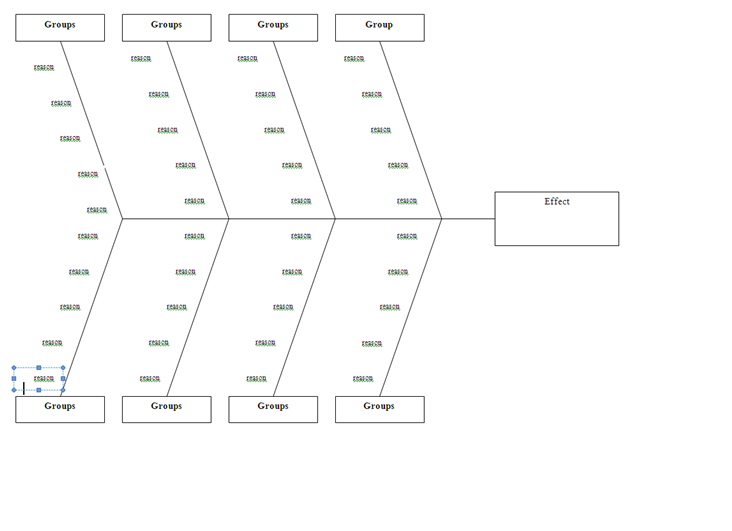
How to use a fishbone diagram for problem solving: step by step
- Agree on the problem. Describe the effect in specific, measurable terms, such as “Order dispatch takes four days instead of two”. Avoid wording that already blames a cause.
- Draw the head and spine. Put the problem statement in a box on the right and draw the spine leading to it.
- Choose the categories. Add four to six main bones. Pick a standard set or create your own.
- Brainstorm causes. For each category, ask “Why does this happen?” Write each idea as a short branch off the bone. Encourage everyone to contribute before anyone debates the ideas.
- Dig deeper with the 5 Whys. For each cause, keep asking “why” until you reach something the team can act on. Sub-causes become smaller branches.
- Select the likely root causes. Mark the causes that appear more than once or that the team rates as most likely. Then check them against data, records or observation.
- Act and review. Agree on actions for the confirmed root causes, assign owners, and check later whether the problem has improved.
Common fishbone categories
For manufacturing and operations, many teams use the “6Ms”:
- Manpower (people)
- Methods
- Machines
- Materials
- Measurement
- Mother Nature (environment)
For services and office work, these categories usually fit better: people, process, policies, place, product or service, and systems or technology. The categories only prompt thinking. If a cause does not fit neatly, place it where the team finds it most useful.
Fishbone diagram for customer service
Fishbone diagrams work well for service problems such as long call waiting times, repeat complaints or poor survey scores. Take the problem “Customers wait too long for a response to email queries”. A customer service fishbone might include:
- People: too few agents on the shift, or new agents who are unsure how to answer common queries.
- Process: no clear routing of emails, or queries passed between departments.
- Policies: approvals needed for simple refunds.
- Systems: no shared inbox or ticketing tool, or slow access to customer records.
- Customers and channels: unclear instructions on the website that lead to repeat emails.
- Measurement: response times that are not tracked, so delays go unnoticed.
Once the likely causes are confirmed, the team can fix the process rather than simply asking staff to “work faster”. BOTI’s Customer Service Excellence and Complaint Handling Course covers how service teams monitor service levels and handle complaints.
Building a fishbone problem-solving template in Excel or Visio
Excel has no built-in fishbone chart type. You can still build a reusable template quickly:
- Use Insert > Shapes to draw a box for the head, a long arrow for the spine and angled lines for the bones.
- Add text boxes for the category labels, then group the shapes so the layout stays in place.
- Alternatively, use the worksheet itself. Put one category per column, list the causes in the rows below, and add columns for “likelihood”, “evidence” and “action owner”. This version is easier to sort and filter.
- Save the file as an Excel template (.xltx) so each new problem starts from the same layout.
Microsoft Visio includes a Cause and Effect Diagram template that draws the spine and bones for you. BOTI’s Microsoft Visio Essentials to Advanced course covers working with Visio templates and diagrams. For Excel shapes and layout skills, see Microsoft Excel Beginners. If you want a fishbone template set up for your team’s own problems, ask BOTI to help you as part of a workshop.
Common mistakes to avoid
- Writing a vague problem statement, so the team cannot agree on what it is solving.
- Listing symptoms instead of causes. Keep asking “why”.
- Letting one senior voice dominate the brainstorm.
- Treating every branch as proven. The diagram shows possible causes, and these still need checking against facts.
- Stopping at the diagram without agreeing on actions and owners.
For how the fishbone fits into a wider improvement method, read the guide to business optimisation through lean six sigma. Teams that want a structured approach to analysing problems and choosing solutions can also attend Problem Solving and Decision Making Training. For a deeper grounding in improvement projects, see Lean Six Sigma Yellow Belt Training.
Frequently asked questions
What is a fishbone diagram used for in problem solving?
A fishbone diagram is used to list and organise all the possible causes of a problem under categories, so a team can identify and then test the most likely root cause before choosing a solution.
Is there a fishbone problem solving template I can use?
You can build your own template in Excel with shapes or a simple table of categories and causes, or use the Cause and Effect Diagram template in Microsoft Visio. Save it as a template file so every new problem starts from the same layout.
How do you use a fishbone diagram for customer service?
Write the service problem as the head of the fish, for example long response times. Then brainstorm causes under categories such as people, process, policies, systems, customers and measurement, and confirm the likely causes with data before fixing them.
How many categories should a fishbone diagram have?
Most fishbone diagrams use four to six categories. The 6Ms suit manufacturing and operations, while people, process, policies, place, product and systems suit service and office problems.
To learn the fishbone diagram alongside other root cause and process improvement tools, book the Lean Process and Six Sigma Training course. Call BOTI on 011 882 8853 or email [email protected]. Training runs in-house at your premises, at BOTI’s venue in Sunningdale, Johannesburg, or live online. This course is not accredited. It is delivered as a professional skills programme, and delegates receive a BOTI certificate of attendance.
Book or Request a Quote
We run this course for teams in-house, online or at our Sunningdale venue. Click the button to book or request a quote:
Or browse all our courses, run at your offices, online or at a BOTI venue:
Please Phone Us Now To Speak to One of Our Friendly Consultants
Tel:011-882-8853
OR
FOR CELL PHONES CLICK TO CALL
Please Fill in the Form
Please Email Us
[email protected]

5S and Lean Six Sigma Training
5S workplace organisation is a five-step lean method (Sort, Set in order, Shine, Standardise and Sustain) that clears clutter, gives every tool and file a marked home and turns tidy, safe work areas into a daily habit. BOTI runs 5S training for teams across South Africa: in-house at your premises, at our venue in Sunningdale, Johannesburg, or live online. It sits alongside our other process improvement, Lean and project management courses.
Introduction: what is 5S?
5S is a practical, programme-based method for improving how a workplace runs. Organisations use it to improve:
- production and productivity,
- quality, and
- safety, by reducing injuries and incidents.
It can be applied in almost any business or industry, including factories, warehouses, workshops, laboratories, clinics, retail stockrooms and offices.
5S is built on continuous improvement and the idea of a “visual workplace”, where anyone can see at a glance what belongs where and what is missing. It is linked to Kaizen and is a core part of lean manufacturing. Its aims include better financial results, higher productivity and better customer service. The process cleans up and arranges the working environment, and it is normally the first lean method an organisation puts into practice. Done well, 5S improves working conditions and reduces waste, unnecessary downtime and excess stock.
5S was developed in Japan. The name comes from five Japanese words: seiri (tidiness), seiton (orderliness), seiso (cleanliness), seiketsu (standardisation) and shitsuke (discipline). English versions were chosen that also start with S, so the name “5S” stays the same in both languages.
The five pillars of 5S
Seiri (Sort): remove everything that is not needed in the work area. “Red tagging” is a common technique. Teams attach a red tag to items whose use is unclear, then move the tagged items to a central holding area, where they are discarded, recycled or transferred. The main benefits are freed-up floor and storage space and less time spent searching.
Seiton (Set in order): arrange what remains so that each item is easy to find, use and put back. This usually means marking floors, labelling shelves and drawers, putting up signs that show the correct storage place for each item, and outlining work areas and walkways. Storage shelves and tool boards are often installed at this stage.
Seiso (Shine): clean the area thoroughly, then keep it clean with short daily cleaning routines. Cleaning is also an inspection: leaks, damage and wear show up quickly on clean equipment.
Seiketsu (Standardise): agree on one consistent way of doing the first three steps. Teams write down the standard, use photos of what a correct area looks like, and set simple checklists and schedules so that everyone works to the same rules.
Shitsuke (Sustain): make 5S part of normal work rather than a once-off clean-up. Sustaining is the hardest pillar, because it depends on discipline, management attention and regular audits. Without it, the gains from the first four steps fade quickly.
How to introduce 5S in your workplace
A 5S rollout is most effective when it starts small and is led by the people who do the work. A practical sequence looks like this:
- Choose a pilot area. Pick one workshop, stores area, production line or office section where improvement will be visible.
- Take “before” photos. Record the current state so the team can see the change.
- Train the team. Make sure supervisors and staff understand the five steps and why they matter for safety, quality and time.
- Run a sort and red-tag session. Set a clear rule for what stays, what goes to the holding area and who decides.
- Set in order and shine. Label, mark and clean, using the team’s ideas on where items should live.
- Write the standard. Capture the agreed layout, labels and cleaning routine in a one-page standard with photos.
- Audit regularly. Use a short 5S audit checklist at agreed intervals, display the scores and act on the gaps.
- Extend to other areas. Once the pilot is stable, roll 5S out to the next area and share what worked.
5S is not only for factories. In an office, the same steps apply to desks, stationery cupboards, filing systems and shared network drives: delete or archive what is not needed, give files a clear folder structure, keep shared spaces tidy, agree naming standards and check them regularly. If you would like help planning a 5S audit checklist or rollout plan for your site, ask BOTI to help you design one as part of in-house training.
5S, Kaizen and Lean Six Sigma
5S creates the stable, visible workplace that other improvement methods depend on. The principles of Kaizen are linked into Lean Six Sigma training, and BOTI’s process improvement training discusses related topics including:
- Kaizen,
- the fishbone diagram,
- lean manufacturing,
- Total Quality Management (TQM),
- 5S,
- continuous improvement, and
- overall equipment effectiveness (OEE).
In simple terms, 5S organises the workplace, Kaizen builds a habit of small, ongoing improvements, and Lean Six Sigma uses data to reduce waste and variation in processes. Many organisations start with 5S because the results are quick and visible, then move on to Kaizen events and Lean Six Sigma projects.
Which BOTI course fits your team?
- 5S Training Course – Workplace Organisation (2 days): for supervisors, team leaders and staff who will set up and sustain 5S in their own areas.
- Kaizen Training Course – Continuous Improvement (2 days): for teams that want to build a routine of small, ongoing improvements after 5S is in place.
- Lean Process and Six Sigma Training (2 days): an introduction to Lean and Six Sigma thinking for people who want the wider picture.
- Lean Six Sigma Yellow Belt Training (4 days): for staff who will take part in structured, data-based improvement projects.
Not sure which option suits your site? Tell us about your team and goals and we will recommend a course, or request a quote.
Frequently asked questions
What is 5S workplace organisation?
5S is a lean method for organising a workplace in five steps: Sort, Set in order, Shine, Standardise and Sustain. It removes clutter, gives every item a marked place, keeps areas clean and turns these habits into a routine, which reduces waste, searching time and safety risks.
Where can I do 5S training in Johannesburg or elsewhere in South Africa?
BOTI runs its 5S Training Course – Workplace Organisation in-house at your premises in South Africa, at BOTI’s venue in Sunningdale, Johannesburg, or live online. Call 011 882 8853 or email [email protected] to arrange dates for your team.
How long is BOTI’s 5S training course?
The 5S Training Course – Workplace Organisation runs over 2 days. Delegates receive a BOTI certificate of attendance.
What is the difference between 5S and Lean Six Sigma?
5S organises the workplace and is often the first lean method a company introduces. Lean Six Sigma is a wider improvement approach that uses data to reduce waste and variation in processes. Many organisations start with 5S because it creates the stable, visible workplace that later improvement projects depend on.
Can 5S be used in offices and not only in factories?
Yes. The same five steps apply to offices, warehouses, workshops, clinics and shared network drives: remove what is not needed, give files and supplies a clear home, keep the space tidy, agree a standard and check it regularly.
To put these steps into practice with your team, book the 5S Training Course – Workplace Organisation. Training runs in-house at your premises, at BOTI’s venue in Sunningdale, Johannesburg, or live online. Call BOTI on 011 882 8853 or email [email protected]. This course is not accredited. It is delivered as a professional skills programme, and delegates receive a BOTI certificate of attendance.
Book or request a quote
As well as our public courses, we run this course in-house for teams across South Africa. Use the button below to book or request a proposal:
Or browse all our courses, run at your offices, online or at a BOTI venue:
Phone Us to Speak to One of Our Consultants
Tel: 011 882 8853
OR
FOR CELL PHONES CLICK TO CALL
Fill in the Form
Or Email Us
[email protected]
Kaizen & Kaizen Course
BOTI runs kaizen training in South Africa for teams that want to improve processes step by step, cut waste and involve every employee in finding better ways to work. Our Kaizen Training Course is a two-day continuous improvement programme, and it sits within our project management, agile and process improvement courses. The guide below explains what kaizen is, how it works in practice and how it links to lean and Six Sigma.
Kaizen
Kaizen is a Japanese word that means “change for the better”. In business it refers to improvement activities at every level, from staff on the shop floor or at the front desk up to the chief executive. It is applied across the value chain, including purchasing and logistics. It has also been used in healthcare, government, financial services and many other sectors.
Kaizen aims to remove waste by improving processes continually. It was developed in Japan after the Second World War, influenced by American business and quality management experts. Today it is used around the world, including in South Africa, and well beyond manufacturing.
Kaizen has the following characteristics:
- It is practised daily, not saved for an annual review.
- It makes work more humane by reducing overburden and unnecessarily hard work (“muri”), while raising productivity. Recognising and encouraging people who take part in kaizen activities is essential.
- Small work experiments are a key tool for finding and reducing waste.
- Everyone is involved, at every level of the organisation.
- Projects can be big or small. In many manufacturing plants, a typical kaizen project is small and local, and a line supervisor guides it.
Key components of kaizen include:
- Top management involvement and visible support
- A team or structure dedicated to kaizen
- A clear, step-by-step process for running kaizen initiatives
- Capable people appointed to lead improvement initiatives
- Training and education for everyone who takes part
The literal translation of “kaizen” is simply “change for the better”. In everyday Japanese the word does not imply “continuous” improvement or a particular philosophy. In management practice, however, it has come to stand for the principles of continuous improvement, and it is now widely treated as a philosophy of work.
The three wastes kaizen targets
Kaizen practitioners often describe waste in three forms. Naming them helps teams see problems they have learnt to live with.
- Muda (waste): any activity that uses time, effort or material without adding value for the customer. Examples include waiting, rework, unnecessary movement, excess stock and duplicated approvals.
- Mura (unevenness): uneven workloads and flow. A team that is idle in the morning and overloaded in the afternoon has a mura problem.
- Muri (overburden): asking people or equipment to do more than they reasonably can, which leads to errors, breakdowns and fatigue.
Most kaizen improvements tackle one of these three. Removing them usually improves quality, speed and morale at the same time.
How a kaizen improvement cycle works
Many organisations run kaizen using the Plan-Do-Check-Act (PDCA) cycle. It keeps improvements small, testable and based on evidence rather than opinion.
- Plan: choose one problem, observe the process where the work happens, and agree on a measure that shows whether things get better.
- Do: try a small change on a limited scale, such as one shift, one line or one team.
- Check: compare the results with the measure. Ask what worked, what did not and why.
- Act: if the change worked, make it the new standard and share it. If not, learn from it and plan the next experiment.
Some organisations also run focused kaizen events, where a cross-functional team spends a few days on one process. The day-to-day habit of small improvements is what keeps the gains in place.
Kaizen beyond the factory: offices, service teams and call centres
Kaizen started in manufacturing, but the same thinking works wherever work follows a process. In an office, teams use it to shorten approval chains, remove duplicate data capture and standardise templates. In a call centre, agents and team leaders can map a common call type, find the steps that cause repeat calls or long hold times, and test simple fixes. Examples include clearer scripts, better knowledge articles or a change to how calls are routed. The principle stays the same: the people who do the work are often best placed to see how to improve it.
Kaizen, lean and Six Sigma
The principles of kaizen are built into lean six sigma training. Kaizen provides the culture of small, continual improvement. Lean focuses on flow and removing waste. Six Sigma adds data and statistical tools to reduce variation and defects. Related topics include:
- the fishbone diagram for finding root causes,
- lean manufacturing,
- Total Quality Management (TQM),
- 5S workplace organisation,
- continuous improvement, and
- overall equipment effectiveness (OEE).
If your team needs the wider statistical toolkit, read our overview of business optimisation through lean six sigma.
Frequently asked questions
What is kaizen training?
Kaizen training teaches teams the principles and habits of continuous improvement. Delegates learn how to spot waste, test small changes and turn successful changes into new standards, so that improvement becomes part of everyday work.
What is the difference between kaizen and lean six sigma?
Kaizen is the culture of small, continual improvement involving everyone. Lean focuses on flow and removing waste, and Six Sigma uses data to reduce variation and defects. Many organisations use kaizen as the foundation and add lean and Six Sigma tools as their improvement work matures.
Can kaizen be used in a call centre or office?
Yes. Any work that follows a process can be improved with kaizen. Call centre and office teams use it to reduce repeat calls, shorten turnaround times, remove duplicate steps and standardise how common tasks are done.
Is BOTI’s Kaizen Training Course accredited?
No. The Kaizen Training Course is not accredited. It is delivered as a professional skills programme, and delegates receive a BOTI certificate of attendance.
Where does BOTI run kaizen training?
BOTI runs kaizen training in-house at your premises, at BOTI’s venue in Sunningdale, Johannesburg, or live online.
To build a continuous improvement habit in your team, book the Kaizen Training Course – Continuous Improvement. The course runs over two days, and you can ask BOTI for the outline or for help matching it to your processes. Training runs in-house at your premises, at BOTI’s venue in Sunningdale, Johannesburg, or live online. Call BOTI on 011 882 8853 or email [email protected], or request a quote. This course is not accredited. It is delivered as a professional skills programme, and delegates receive a BOTI certificate of attendance.
Book or Obtain Instant Quote
We also run related process improvement courses for teams. Click the button below to request a proposal or book a course:
Or browse all our courses, run at your offices, online or at a BOTI venue:
Please Phone Us Now To Speak to One of Our Friendly Consultants
Tel: 011 882 8853
OR
FOR CELL PHONES CLICK TO CALL
Please Fill in the Form
Please Email Us
[email protected]
About Us
- We are a diverse and dynamic team of passionate training specialists who believe that self-betterment and ongoing education are transformative elements that can help people realise their full potential. We are in the constant pursuit of excellence and proud of our authentic B-BBEE roots. We want to work with companies who share our vision. Learn More


Contact us now – we reply within 15 minutes during office hours
Monday to Friday, 08:00–17:00. After hours, we reply on the next working day – or call 011 882 8853.